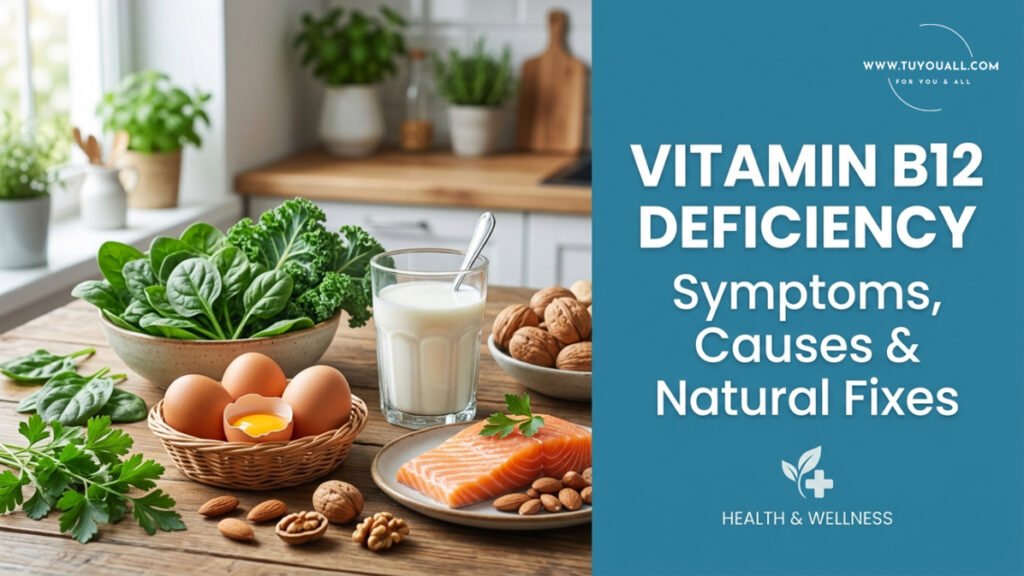
Vitamin B12 Deficiency: Discover Why 70% Of Vegetarians And 60% Of Meat-Eaters Lack It. Learn Hidden Symptoms, Absorption Hacks, And The Best Supplements For Energy.
Introduction: Do These “Normal” Problems Actually Signal a B12 Crisis?
Look at your fingernails right now. Are they turning brown or yellow? Does your face look pale even after a full night’s sleep? Do your hands and feet sometimes tingle or go numb for no reason?
If you nodded yes, this guide is for you.
These aren’t just “signs of aging” or “stress.” They often point to one single, overlooked culprit: Vitamin B12 deficiency.
Here’s the shocking part: about 70% of vegetarians are deficient. But before meat-eaters relax—60% of non-vegetarians are deficient too. Yes, even people eating eggs, chicken, and dairy daily aren’t getting enough B12.
Why? Because the problem usually isn’t what you eat. It’s how your body absorbs it.
In this guide, we’ll break down:
- The everyday symptoms doctors often miss
- Why B12 is non-negotiable for your brain, nerves, and DNA
- The real reasons your levels are low (hint: it’s probably your gut)
- The best natural food sources and supplements
- Simple Ayurvedic habits to fix absorption for good
What Is Vitamin B12 and Why Does Your Body Desperately Need It?
Vitamin B12 (also called cobalamin) isn’t just another vitamin on the list. It’s a water-soluble powerhouse that your body cannot make on its own. You must get it from food or supplements.
Without enough B12, your body starts breaking down from the inside. Here’s what B12 actually does:
- Builds Your Blood
B12 is essential for making red blood cells (RBCs). No B12 = no healthy RBCs. No RBCs = no oxygen reaching your muscles and brain. This leads to anemia—and that explains the crushing fatigue.
- Protects Your DNA
B12 drives DNA synthesis. Every new cell your body creates—from hair follicles to gut lining—needs B12. Think of it as the construction manager for cell repair and growth.
- Shields Your Nerves
B12 builds a protective coating around your nerves called the myelin sheath. When this coating wears thin, you get tingling, numbness, balance problems, and even memory loss.
- Converts Food to Energy
You can eat the healthiest diet in the world, but without B12, your body can’t convert that food into usable energy. That’s why you feel exhausted despite eating well.
- Supports Mental Health
Research links chronic low B12 to depression, anxiety, and cognitive decline. Your brain literally needs B12 to produce mood-regulating chemicals.
“Without B12, red blood cells do not form properly… It is essential for DNA synthesis… It is very important for nerve function.”
The Warning Signs: 15+ Symptoms Doctors Often Misdiagnose
B12 deficiency symptoms are so common that most people ignore them—or doctors diagnose them as stress, aging, or something else entirely.
| Symptom | What It Feels Like | Why It Happens |
| Chronic Fatigue | Tired even after 8+ hours of sleep | Low RBCs = low oxygen delivery |
| Brain Fog | Can’t focus, slow thinking, forgetful | Nerve damage + low oxygen to brain |
| Tingling/Numbness | Pins-and-needles in hands/feet | Myelin sheath breaking down |
| Pale/Yellow Skin | Face looks washed out or jaundiced | Unhealthy red blood cell breakdown |
| Mood Swings | Irritable, sad, or anxious without reason | Disrupted neurotransmitter production |
| Hair Loss | More hair fall than usual | Poor cell regeneration in follicles |
| Mouth Ulcers | Frequent sores in mouth or tongue | B12 deficiency directly affects oral tissues |
| Balance Problems | Unsteady while walking | Nerve signals to muscles are weak |
| Shortness of Breath | Breathless after mild activity | Anemia reduces oxygen capacity |
| Brown/Yellow Nails | Discolored, brittle nails | Poor cell health and circulation |
| Bone/Joint Pain | Back pain, aching bones | Inflammation + poor tissue repair |
| Memory Loss | Forgetting names, tasks, recent events | Brain nerve cells under stress |
The Scariest Part: Silent Deficiency
Sometimes, B12 drops dangerously low without showing a single symptom. Your body weakens internally, and by the time you notice, the damage is already advanced.
That’s why knowing your numbers matters.
Know Your Numbers: B12 Levels and Daily Needs
| Level (pg/mL) | Status | Action Needed |
| Below 150 | Deficient | Immediate supplementation + doctor consult |
| 150–200 | Borderline / Danger Zone | Start supplements + dietary changes |
| 200–950 | Normal / Healthy Range | Maintain with balanced diet |
Your daily requirement is just 2.4 micrograms—a tiny amount. Yet millions fall short. Why?
Because eating B12-rich food isn’t enough if your body can’t absorb it.
Why You’re Deficient: The Two Root Causes
Cause #1: You’re Not Eating Enough B12
This mainly affects vegetarians and vegans. Natural B12 is found almost exclusively in animal products and certain fermented foods.
Cause #2: Your Gut Is Broken (The Real Culprit)
This is the #1 reason even meat-eaters are deficient. Here’s how absorption actually works:
- Stomach acid (HCl) separates B12 from food proteins.
- Intrinsic factor (a special protein) binds to B12.
- This combo travels to the intestines where B12 gets absorbed into your blood.
If stomach acid is low, this entire process stops. You can eat steak and eggs all day—your body won’t extract the B12.
What Destroys Your Stomach Acid and Gut Health?
| Factor | How It Hurts B12 Absorption |
| Antacids / PPIs | Neutralize stomach acid directly |
| Alcohol | Damages liver (B12 storage site) + irritates stomach lining |
| Metformin | Diabetes drug that significantly reduces B12 absorption |
| Gastric Bypass Surgery | Removes part of the stomach/intestine where absorption happens |
| RO Water | Demineralized water weakens stomach lining over time |
| Processed Foods | Kill good gut bacteria needed for B12 processing |
| Stress + Poor Eating Habits | Eating fast, at wrong times, while stressed harms digestion |
“First, we eat food that causes gas, acidity, and constipation… then we take antacids to cure that same acidity. These antacids neutralize the stomach acid.”
The irony: You take medicine for acidity, but that medicine steals your B12. Then you feel more tired and foggy. It’s a vicious cycle.
Best Natural Food Sources of Vitamin B12
If your gut is healthy, these foods can help restore your levels:
| Food Source | B12 Content | Notes |
| Eggs | Moderate | Easy to digest for most people |
| Milk & Yogurt | Moderate | Choose fresh, full-fat options |
| Buttermilk (Chaas) | Moderate | Great for gut health too |
| Chicken & Meat | High | Best bioavailable source |
| Cheese | Moderate | Fermented varieties are better |
| Fermented Foods | Variable | Idli, Dhokla, Kanji, homemade pickles |
| Pakhala Bhata | Moderate | Traditional Odisha fermented rice dish |
But remember: These foods only work if your stomach acid and gut bacteria are functional. Otherwise, you’re just eating nutrients that pass right through.
How to Fix Your Gut for Better B12 Absorption
Before popping supplements, heal your gut. Otherwise, you’re throwing money away.
Ayurvedic Gut-Healing Routine
| Practice | How to Do It | Benefit |
| Triphala at Night | 1 tsp in warm water before bed | Detoxes gut, reduces inflammation |
| Moringa in Morning | 1 tsp powder in water OR moringa roti | Reduces inflammation, boosts liver function |
| Amla (Winter) | 2 fresh amla daily | Immunity + gut health powerhouse |
| Warm Water on Waking | 1–2 glasses warm water | Activates stomach acid production |
| Lemon Water (if suited) | Add lemon to warm water | Supports HCl production |
Lifestyle Rules for Gut Health
- Chew properly. Don’t rush meals.
- Eat at regular times. Your gut loves routine.
- Avoid ultra-processed foods. They’re the #1 enemy of good gut bacteria.
- Manage stress. Stress hormones shut down digestion.
B12 Supplements: Which One Should You Choose?
Confused by the supplement aisle? Here’s the breakdown:
Type 1: Plant-Based B12 Supplements
- Source: Extracted from specific plants and algae containing B12-producing bacteria
- Form: Converted to cobalamin, then made into capsules/tablets/powder
- Best for: Vegans who want a natural-derived option
- Tip: Check purity and brand credibility
Type 2: Synthetic B12 Supplements
Made in labs. Two forms exist:
| Form | How It Works | Best For |
| Methylcobalamin | Active form—body uses it directly. More stable. Better for nerve health. | Everyone, especially those with weak digestion or liver issues |
| Cyanocobalamin | Cheaper, common. Body must convert it to methylcobalamin first. | People with healthy gut and liver function |
Recommendation: Choose methylcobalamin. If your gut is already compromised, your body may struggle to convert cyanocobalamin. Methylcobalamin skips that step and gets to work immediately.
How to Take B12 for Maximum Absorption
| Tip | Why It Matters |
| Take on an empty stomach | B12 is water-soluble; heavy meals slow absorption |
| Avoid heavy meals around dose time | Food competes for absorption |
| Consider B12 injections | Fast-acting, bypasses gut issues entirely |
| Get a blood test first | Know your baseline before supplementing |
Frequently Asked Questions (FAQ)
Q.1. What is a dangerously low B12 level?
A level below 150 pg/mL is considered deficient and requires immediate attention. The borderline zone (150–200) also needs intervention before symptoms worsen.
Q.2. Can I get enough B12 from food alone?
Only if your gut is healthy. Many people eat B12-rich foods but remain deficient due to poor absorption. That’s why testing and gut health matter more than just diet.
Q.3. Why do meat-eaters have B12 deficiency?
Because the issue is rarely lack of intake—it’s lack of absorption. Low stomach acid, antacids, alcohol, and gut damage prevent extraction of B12 from food.
Q.4. Is methylcobalamin better than cyanocobalamin?
Yes, for most people. Methylcobalamin is the active form your body uses directly. It’s especially better if you have digestive issues, liver problems, or genetic variations that slow conversion.
Q.5. Can RO water cause B12 deficiency?
Research suggests yes. RO purification strips essential minerals from water. Over time, this demineralized water can weaken your stomach lining and reduce B12 absorption capacity.
Conclusion: Your Energy, Brain, and Nerves Depend on This One Vitamin
Vitamin B12 isn’t optional—it’s foundational. From building your blood to shielding your nerves to keeping your mind sharp, B12 touches every system in your body.
Yet millions walk around deficient, blaming their fatigue on “getting older” or “working too hard.” The truth? Their bodies are starving for a nutrient they can’t absorb.
Here’s what to remember:
- Symptoms are sneaky. Fatigue, brain fog, tingling, and pale skin aren’t “normal.”
- Your gut is the gatekeeper. Fix digestion first, or supplements won’t work.
- Choose methylcobalamin. It’s the active, effective form.
- Test, don’t guess. A simple blood test reveals where you stand.
- Ayurveda helps. Triphala, moringa, and amla restore the gut environment B12 needs.
You don’t need to accept exhaustion as your default state. With the right knowledge, testing, and habits, you can rebuild your B12 levels—and your energy—from the ground up.