This blog post is based on insights from Sagar Sinha‘s YouTube video: “SIP for Beginners: How to Become a Crorepati with ₹500 Monthly”
From ₹500 to Crorepati: A Complete Beginner’s Guide to Systematic Investment Plans
Have you ever wondered if your small monthly savings could actually make you rich? Not “get-rich-quick” rich, but genuinely, systematically wealthy over time?
A few days ago, I visited my village in Bihar. While getting a haircut at a local salon, the young barber recognized me. “Bhaiya,” he said, “I watch your videos, but I don’t understand this SIP mutual fund thing. How do we actually do it? I earn ₹8,000 a month—how can someone like me invest?”
That conversation changed everything. It made me realize that most financial advice assumes you already understand stock markets, inflation, and investment jargon. But what about the barbers, the domestic helpers, the delivery workers—the millions earning ₹6,000-12,000 monthly who’ve never looked beyond FDs and LIC?
Today, I’m writing this guide for them. For you. No fancy words, no assumptions—just clear answers to every question you’ve ever had about SIP.
What is SIP? (And What It Isn’t)
SIP stands for Systematic Investment Plan. Think of it like a digital piggy bank, but one that actually grows your money instead of just storing it.
Here’s the simple difference you need to understand:
| Term | What It Means | Analogy |
| SIP | The method of investing (how you put money in) | The road you take |
| Mutual Fund | The destination where money goes (what you invest in) | The city you’re traveling to |
SIP is just the vehicle. Mutual funds are where your money actually works. You can reach the same destination (wealth) by different roads (monthly, quarterly, or lump-sum investments), but SIP—putting in small amounts regularly—is the smoothest, most disciplined path for beginners.
For Example: Imagine Chintu, a village boy. His mother gives him ₹100 monthly. If he puts it in a regular piggy bank, after 12 months he has ₹1,200. But if he gives it to a local shopkeeper who invests in his business and shares profits, that same ₹100 could become much more. SIP does exactly this—but instead of trusting one shopkeeper, you’re trusting professional experts (fund managers) who invest in hundreds of companies through the stock market.
Why You NEED SIP (The Inflation Reality Check)
Before understanding SIP, you must understand inflation—the silent wealth killer that nobody talks about at the dinner table.
The Hard Truth: Every year, prices rise by 6-7%. This means your ₹100 today will only buy what ₹94 could buy next year. The year after? Worth even less. Keep your money in savings, and you’re actually getting poorer while the number stays the same.
Real-World Example: When I learned to ride a bike 20+ years ago, petrol cost ₹24 per liter. Today? Over ₹100. The petrol is the same, but your money shrunk.
Now look at your options:
| Investment Option | Average Annual Return | After Inflation (6%) | Real Growth? |
| LIC Policies | 4-6% | -2% to 0% | Wealth Erosion |
| Bank FDs | 6-7% | 0% to 1% | Barely Breaking Even |
| Post Office | 6-7% | 0% to 1% | Barely Breaking Even |
| Government Schemes | 7-8% | 1-2% | Minimal Growth |
| SIP in Mutual Funds | 12-15% | 6-9% | Real Wealth Creation |
For Example: Meet Amit. He puts ₹1 lakh in an FD earning 6% interest. After one year, he has ₹1,06,000. He thinks he earned ₹6,000. But inflation ate 6% of his original ₹1 lakh’s purchasing power. Net result? Zero real gain. This isn’t investing—it’s just parking money.
“The purpose of SIP is wealth creation. The purpose of insurance is protection. The purpose of FDs is emergency savings. No option is ‘bad’—they just serve different goals.” — Sagar Sinha
The Magic Ingredient: Compound Interest vs. Simple Interest
Here’s where most people lose money without realizing it. There are two types of interest, and only one builds wealth.
Simple Interest: Interest calculated only on your original principal.
- You invest ₹1 lakh at 6%
- Year 1: ₹6,000 interest (Total: ₹1,06,000)
- Year 2: Another ₹6,000 on original ₹1 lakh (Total: ₹1,12,000)
- The interest never grows
Compound Interest: Interest calculated on your principal + accumulated interest.
- You invest ₹1 lakh at 6%
- Year 1: ₹6,000 interest (Total: ₹1,06,000)
- Year 2: ₹6,360 interest on ₹1,06,000 (Total: ₹1,12,360)
- Year 3: ₹6,741 interest on ₹1,12,360
- Your money starts multiplying itself
SIP gives you compound interest. Over 20-30 years, this difference isn’t just significant—it’s transformational. It’s the difference between having ₹3 lakh and having ₹3 crores.
Can SIP Really Make You a Crorepati? (The Calculator Doesn’t Lie)
Let’s stop guessing and look at actual numbers. Open any SIP calculator on Google and see the magic yourself.
Scenario 1: The Early Starter
- Monthly Investment: ₹500
- Duration: 16 years
- Expected Return: 15% annually
- Total Invested: ₹96,000 (₹500 × 12 months × 16 years)
- Wealth Created: ₹35,00,000+
- Market Gave You: ₹34,00,000+ (Your money multiplied 36x!)
Scenario 2: The Patient Long-Term Investor
- Monthly Investment: ₹500
- Duration: 40 years
- Expected Return: 15% annually
- Total Invested: ₹2,40,000
- Wealth Created: ₹1.5 Crores+
- Market Gave You: ₹1.47 Crores (Your investment becomes invisible compared to returns!)
Scenario 3: The Slightly Higher Earner
- Monthly Investment: ₹1,000
- Duration: 35 years
- Wealth Created: ₹1 Crore+
The Shocking Truth: If you extend to 50 years (for your children/grandchildren), that same ₹500 monthly becomes ₹4.5+ Crores. Your actual contribution? Just ₹3 lakhs. The market contributed ₹4.47 crores.
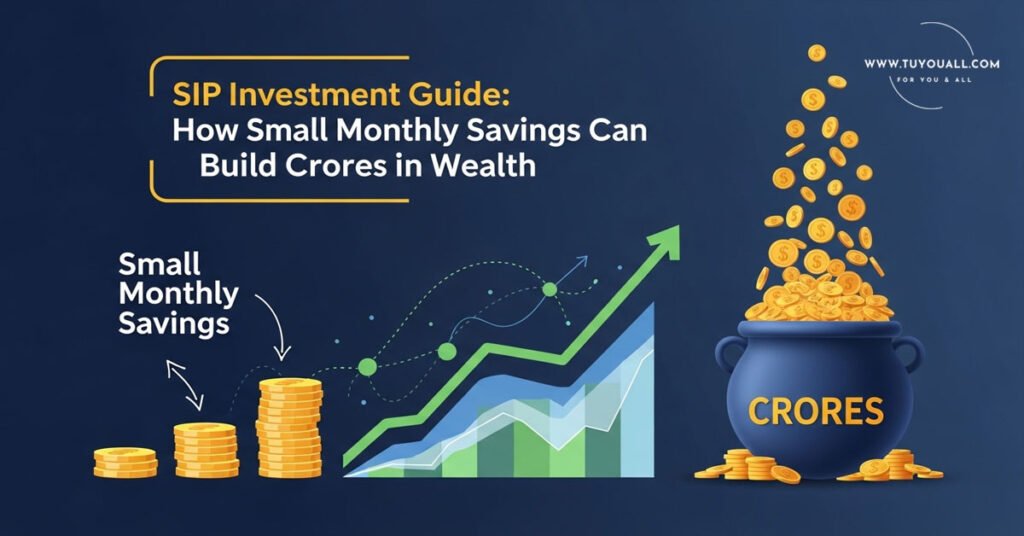
Visual Representation:
| Time Period | Your Investment (Blue) | Market Returns (Yellow) | Total Wealth |
| 5 Years | ₹30,000 | ₹13,000 | ₹43,000 |
| 16 Years | ₹96,000 | ₹34,00,000 | ₹35,00,000 |
| 25 Years | ₹1,50,000 | ₹1,12,00,000 | ₹1,13,50,000 |
| 40 Years | ₹2,40,000 | ₹1,47,60,000 | ₹1,50,00,000+ |
Notice how the blue bar (your contribution) gets smaller over time while the yellow bar (market returns) explodes? That’s compounding.
Critical Rule: Start With Wealth Protection, Not SIP
This is the most important section. Before you invest a single rupee in SIP, you need a Wealth Protection Plan. Without this, your SIP journey can end before it begins.
Why? You’re investing to build wealth for your family’s future—daughter’s wedding, children’s education, retirement. But what if something happens to you? If you die suddenly:
- Your family will need to break the SIP immediately to survive
- The ₹1 lakh you saved gets spent, ending your ₹1 crore dream
- Your family suffers financially AND your wealth plan dies with you
The Solution: Two Non-Negotiable Insurances
| Protection Type | Monthly Cost | What It Does | Why It Matters |
| Term Insurance | ₹600-700 | Gives ₹1 Crore+ to family if you die | SIP continues uninterrupted; family survives |
| Health Insurance | ₹600-700 | Pays hospital bills (₹5-20 lakhs) | You don’t break SIP for medical emergencies |
For Example: You pay ₹1,200-1,500 monthly total for both insurances. If you die, your family gets ₹1 crore. They can:
- Live comfortably
- Continue the ₹500 SIP you started
- Still reach that ₹1 crore goal you planned
Without insurance? They sell everything, break the SIP, and struggle to survive. Insurance isn’t an expense—it’s your wealth protection helmet. Just like you wear a ₹5,000 helmet for a ₹2 lakh bike, spend ₹1,500 to protect crores in future wealth.
“Term Insurance and Health Insurance are not just ‘insurance policies’—they are your Wealth Protection Plan. Your wealth-building journey should never be disturbed by emergencies.” — Sagar Sinha
Links for discounted plans (15-25% off) are usually available through financial educators’ channels. Always compare and consult experts before buying.
Understanding SIP Returns: The Truth About “Risk”
“Bhaiya, will my money sink? Is it safe?”
Let’s address the biggest fear. SIP returns are NOT fixed like FDs. Here’s the reality:
Short Term (1-5 years): Risky. Returns can be negative. Market goes up and down. You might see losses. Long Term (10+ years): Historically safe. The longer you stay, the lower the risk.
How Returns Work: Stock markets fluctuate. Look at any major company’s 20-year chart—Reliance, HDFC, Tata—they all go up and down, but trend upward over decades. Your mutual fund manager buys these stocks, so your returns follow the same pattern:
- Year 1: +20%
- Year 2: -5%
- Year 3: +15%
- Year 4: +8%
- Year 5: -2%
- Average (CAGR): ~12-15%
Key Insight: The volatility (ups and downs) is actually your friend in long-term SIPs. When markets are down, your same ₹500 buys more units (shares). When markets rise, those extra units give massive returns. This is called rupee cost averaging—and it happens automatically in SIP.
Can you lose money?
- In 1 year? Yes, possibly 10-20% loss
- In 5 years? Very unlikely to be negative
- In 10+ years? Probability of loss approaches zero based on historical data
Expected Returns by Duration:
| Investment Horizon | Expected CAGR | Risk Level |
| 1-3 years | Unpredictable (-10% to +30%) | Very High |
| 5-10 years | 10-12% | Moderate |
| 15-20 years | 12-15% | Low |
| 25+ years | 15%+ | Minimal |
Types of Mutual Funds: Which SIP Should You Choose?
Not all mutual funds are equal. They invest in different company sizes, creating different risk-return profiles.
| Fund Type | Invests In | Risk Level | Return Potential | Best For |
| Large Cap | Big stable companies (Reliance, Tata, HDFC) | Low | Moderate (12-14%) | Beginners, safety seekers |
| Mid Cap | Medium-sized companies | Medium | Higher (14-18%) | 10-15 year horizon |
| Small Cap | Small growing companies | High | Highest (18-25%+) | 20+ year horizon, risk-takers |
The Rule: Smaller companies = higher risk of failure BUT higher growth potential. Larger companies = stable but slower growth.
For Example:
- Large Cap: Like investing in a established grocery store. Won’t double overnight, won’t close overnight.
- Small Cap: Like investing in a new tech startup. Might fail, might become the next Infosys.
Recommendation for Beginners: Start with Large Cap funds. They’re safest. As you learn and your income grows, diversify into Mid and Small Cap for higher returns.
How to Start SIP: Step-by-Step Mobile Demo
Starting SIP is easier than recharging your phone. Here’s exactly how:
Step 1: Download a regulated investment app (Groww, Zerodha Coin, or your bank’s app). Avoid UPI apps offering mutual funds—they might shut down.
Step 2: Complete KYC (one-time). Link your bank account. It’s secure and free.
Step 3: Open the app → Go to “Mutual Funds” → Search “Large Cap”
Step 4: Choose any Large Cap fund. Check:
- Returns (3-year, 5-year, since inception)
- Lock-in Period: Should be “NIL” (no lock-in) for flexibility
- Exit Load: Usually 1% if withdrawn within 1 year
Step 5: Click “Invest” → Select “SIP” → Enter amount (₹500 minimum) → Choose monthly date (1st, 10th, etc.)
Step 6: Enter OTP → Done! Money auto-debits monthly.
Withdrawing Money (Redeeming):
- Open app → Select your fund → Click “Redeem”
- Money reaches your bank account in 2-3 days
- No penalties after 1 year (some funds charge 1% if withdrawn within 1 year)
Common SIP Mistakes That Destroy Wealth
- The “Get Rich Quick” Trap Seeing a fund gave 40% return last year and putting all money there. Never do this. Last year’s winner often becomes next year’s loser. SIP works through discipline, not chasing high returns.
- Stopping SIP When Market Crashes This is the biggest destroyer of wealth. When markets crash, news channels scream “Sell! Crash! Recession!” That’s exactly when you should continue—your ₹500 now buys more units at lower prices. When market recovers (it always has), you make massive gains.
- Checking Returns Daily Markets fluctuate. Your portfolio might show negative returns for months. Checking daily creates panic and bad decisions. Check once every 6 months, or better yet, once a year.
- Changing Funds Frequently Stick with one good fund for 10+ years. Constant switching kills compounding.
- Starting Without Protection Remember: No Term Insurance + No Health Insurance = Your SIP is built on sand.
SIP vs. Traditional Options: The Final Comparison
| Feature | SIP (Mutual Funds) | Fixed Deposit | LIC/Insurance | Post Office |
| Purpose | Wealth Creation | Emergency Savings | Protection | Safe Savings |
| Returns | 12-15% (market-linked) | 6-7% (fixed) | 4-6% | 6-7% |
| Inflation Protection | Yes (beats inflation) | No | No | No |
| Liquidity | High (redeem anytime) | Medium (break with penalty) | Very Low | Low |
| Tax Efficiency | Better (12.5% after 1 year, 0% up to ₹1.25L profit) | Added to income | Varies | Added to income |
| Risk | Short-term only | None | None | None |
| Minimum Amount | ₹500/month | ₹1,000+ | ₹1,000+/month | ₹100+ |
None of these are “bad.” Use FDs for emergencies (6-month expenses). Use insurance for protection. Use SIP for long-term wealth (10+ years).
Tax on SIP: How Much Does Government Take?
Holding Period Matters:
| Withdrawal Time | Tax Rate | Example |
| Within 1 year | 20% on profits | ₹20,000 profit → ₹4,000 tax |
| After 1 year | 12.5% on profits | ₹20,000 profit → ₹2,500 tax |
| After 1 year (up to ₹1.25L profit) | 0% tax | ₹1,25,000 profit → ₹0 tax |
Smart Strategy: Never withdraw within 1 year. You save tax AND avoid short-term volatility risk.
Frequently Asked Questions (FAQ)
Q1: Can I become a crorepati with just ₹500 monthly?
A: Yes, but it takes time. ₹500/month for 40-50 years = ₹1-4+ crores. The earlier you start, the less money you need to invest monthly to reach ₹1 crore.
Q2: What if I miss one month’s SIP payment?
A: No penalty for 1-2 missed months. If you miss 3-4 consecutive months, the SIP pauses. You can restart anytime. But don’t make it a habit—consistency builds wealth.
Q3: Is SIP safe? Can I lose all my money?
A: In 10+ year horizons, historical data shows near-zero probability of total loss. In 5+ years, very low risk. In 1 year? Yes, risk exists. Time reduces risk in SIP.
Q4: Which date is best for SIP deduction?
A: Any date works. Choose early in the month (1st-10th) so you invest before spending. Consistency matters more than the specific date.
Q5: What if the mutual fund company shuts down?
A: Zero risk. All mutual funds are regulated by SEBI (government body). Your money is held in custody by third parties, not the fund company. If HDFC Mutual Fund shuts down, SEBI transfers your investments to another company. Your money is safe.
Q6: Can I withdraw money anytime?
A: Yes, most equity funds have no lock-in. Click “Redeem” in your app, money arrives in 2-3 days. But don’t withdraw early—let compounding work.
Q7: Is there a penalty for early withdrawal?
A: Some funds charge 1% “exit load” if withdrawn within 1 year. After 1 year, usually no penalty. Tax Saver funds (ELSS) have 3-year lock-in.
Q8: Can I use SIP for daughter’s wedding, children’s education, retirement?
A: Absolutely! That’s exactly what SIP is for. Start specific SIPs for each goal with different timelines. Just ensure you have Term and Health Insurance first so emergencies don’t force you to break these SIPs.
Conclusion: Your Wealth-Building Action Plan
Building wealth through SIP isn’t magic—it’s disciplined mathematics. The formula is simple:
Small Amount + Consistency + Long Duration + Patience = Massive Wealth
Key Takeaways:
- Start immediately with ₹500 or whatever you can afford. Time is your biggest asset.
- Get Wealth Protection first—Term Insurance (₹1 Crore cover) and Health Insurance (₹10-20 Lakh cover) before investing.
- Stay invested for 15+ years. Wealth isn’t built in 1-5 years.
- Don’t fear market ups and downs. They’re normal and actually help long-term SIP investors.
- Never stop SIP during market crashes. That’s when wealth is actually created.
- Choose Large Cap funds as beginners for safety.
- Don’t check returns daily. Set it and forget it for months.
The barber earning ₹8,000 can become a crorepati. The domestic helper, the delivery boy, the small shopkeeper—anyone with discipline and patience can build generational wealth through SIP.
What’s stopping you from starting your first ₹500 SIP this month? Is it fear, confusion, or the belief that small amounts don’t matter? Let me know in the comments, and I’ll address your specific concerns in the next session.
Source & Credit
This blog post is based on insights from Sagar Sinha‘s YouTube video: “SIP for Beginners: How to Become a Crorepati with ₹500 Monthly”
‘The original content has been translated, expanded, and repurposed for educational purposes.’