
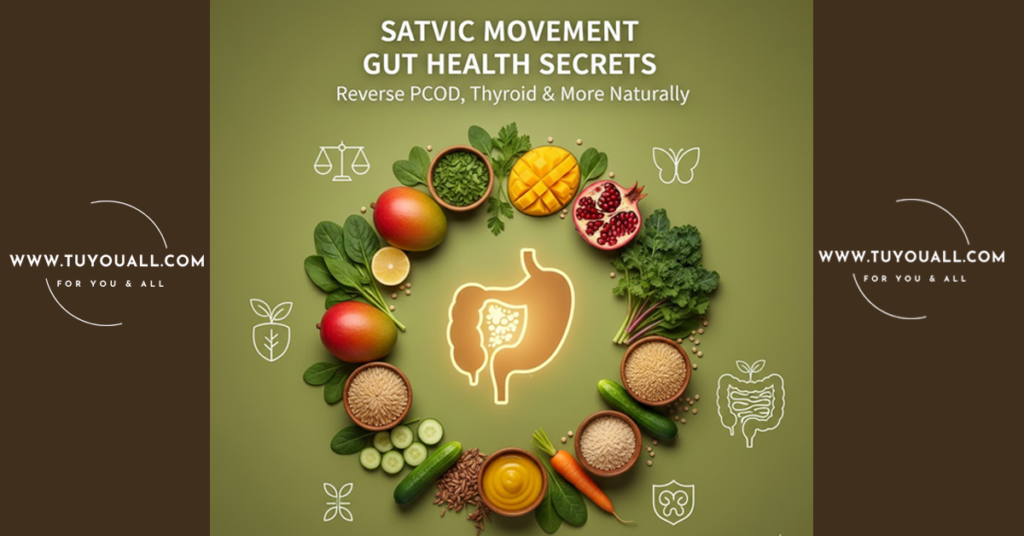
*This blog post is based on insights from Dr. Pal’s YouTube video: “Healing Chronic Diseases Through Satvic Lifestyle & Gut Health |
Can changing what’s on your plate really heal PCOD, thyroid problems, and skin diseases that doctors said you’d have for life? Two ordinary people turned this question into a life-changing movement—and their answer might surprise you.
If you’ve ever felt trapped in a cycle of doctor visits, popping pills, and hearing “you’ll have to manage this condition forever,” you’re not alone. Millions of people grow up believing their chronic health issues are permanent. But what if the real solution isn’t in your medicine cabinet, but in your kitchen? That’s exactly what the Satvic Movement founders discovered through their own remarkable healing journeys.
What Is the Satvic Movement? (And Why Millions Are Listening)
The Satvic Movement was born from two powerful personal stories that sound almost too similar to be coincidence.
Subba’s story began at age 17, when she was taking six different pills daily for PCOD, thyroid imbalance, severe hair loss, acne, and weight issues. “All my childhood I suffered with a lot of health problems,” she shares. “It completely shattered my confidence. I used to feel that out of everyone, why am I suffering with so many diseases?” After trying everything conventional medicine offered, she reluctantly tried changing her food habits. Within 3-4 months, her TSH levels normalized, her PCOD reversed, her hair grew back, and her skin cleared. “To see so much happen in such a short time was a huge revelation.”
Harsh’s journey was equally transformative. From age 7 to 18, he battled chronic sinusitis, skin conditions, and breathing problems. “I must have completed one antibiotic dosage every month,” he recalls. “The doctor would come and I would tell the doctor what you’re going to tell me because it became so normal.” When someone suggested stopping milk products, his reaction was disbelief: “I was like, how silly is this person? I have a skin problem—give me something to apply! They’re telling me to change my food habit—are they out of their mind?” But the results were immediate. His skin cleared, he could breathe without inhalers, and he finally understood food as medicine.
When these two met, they realized they were sharing the same message—just through different channels. Dr. Pal, a gastroenterologist, discovered their work when his own audience kept telling him, “Don’t talk about all this scientific stuff—just go follow Satvic Movement!”
The Gut-Health Connection: Why Your Intestines Hold the Key
Here’s where modern science and ancient wisdom collide beautifully. Dr. Pal explains the medical perspective: “Studies have shown that you are what your gut bacteria is. In animal models, if you feed a mouse broccoli for three months, its gut bacteria changes to crave broccoli. Three months later, if you give that same mouse pizza, it develops bacteria that digest pizza—and then the mouse craves pizza.”
The Satvic philosophy frames this differently but arrives at the same truth. Harsh uses a powerful analogy: “Imagine I hand you a dirty glass vase. You scrub the outside endlessly, but it never gets clean. Only when you put your hand inside and wipe the inner wall does the patch become sparkling clean. External cleanliness is completely based on internal cleanliness.”
This is why Hippocrates’ famous statement “all diseases begin in the gut” isn’t an overstatement. As Subba emphasizes, “Most diseases can be healed when they heal the gut.”
Three Critical Facts About Your Gut Bacteria
- Your gut contains 100 trillion bacteria—a unique ecosystem that responds dramatically to what you feed it
- Fiber is their food: Modern diets provide only 15g of fiber daily, while the Hadza tribe (who follow ancestral lifestyles) consume 150-200g and have 400 more bacterial species than Americans
- Cravings aren’t “you”: When you crave pizza or sugar, it’s often your gut bacteria demanding their preferred fuel
The LWP Framework: The Three Pillars of Satvic Eating
The Satvic Movement doesn’t give you a rigid diet plan. Instead, they teach principles you can apply anywhere. Enter the LWP framework—Living, Wholesome, and Plant-based.
L = Living Food (The Life Force Principle)
This principle might surprise you: food is not inert. It has life in it—what they call prana.
Living foods come directly from Earth with their life force intact:
- Fresh fruits and vegetables
- Whole grains, seeds, and nuts
- Sprouts
Dead foods have lost their vitality:
- Anything packaged, tinned, bottled, or canned
- Foods that can sit on shelves for months or years
For example, if you cut an apple and leave it out, it starts rotting within hours. Now imagine what’s inside those packets that survive for months. That life force is completely gone.
Practical tip: “When we see what is closest to Nature, that will give us the most energy,” Harsh explains. “What is furthest away from how Nature gave it to us will give us the least or no energy.”
W = Wholesome (The Complete Package)
Nature isn’t silly. Every food comes as a perfectly designed package with the right ratio of fats, proteins, and carbs. But humans think we can improve on perfection.
The fragmentation problem:
- Nature gives brown rice with its bran intact (fiber, nutrients, life)
- We strip off the bran and create white rice
- Result: We’ve “improved” it into a less nutritious food
More examples of fragmentation:
- Sesame seeds (whole) → refined sesame oil (fragmented)
- Wheat grain (whole) → refined flour (fragmented)
- Sugar cane (whole) → white sugar crystals (fragmented)
For example, when Subba talks about rice—a staple for millions of South Indians—she doesn’t demand you give it up. “I’m treating you as a regular person, not an alien,” she tells Dr. Pal. “This is not an alien thing. Everything can be managed based on what you can do within yourself.” She simply recommends unpolished rice (brown, red, or even lightly polished white rice) that retains its fiber.
P = Plant-Based (The Replace-Don’t-Remove Philosophy)
This isn’t about restriction—it’s about abundance. The Satvic principle teaches “replace, don’t remove.” When you simply remove foods, you crave them and rebound. But when you replace them with cleaner alternatives, you feel fulfilled.
The sugar spectrum perfectly demonstrates this:
| Unrefined (Green) | Minimally Refined (Yellow) | Highly Refined (Red) |
| Dates, figs, raisins, fresh fruits | Jaggery, maple syrup | White sugar, brown sugar |
| Fully intact, from Mother Nature | Some processing, still close to whole | Industrial processing, stripped of nutrients |
For example, instead of saying “no desserts,” the Satvic approach asks: “How can we make desserts that make us feel good before, during, and after eating them?” Replace industrial sugar with date paste or jaggery. Your sweet tooth gets satisfied, but your body receives actual nutrition.
The Traffic Light System: Green, Yellow, and Red Foods
To make these principles super practical, the Satvic Movement created a simple classification system.
GREEN LIST: Safe Zone
Raw ingredients, even if packaged:
- Bag of nuts or dates
- Unpolished rice
- Fresh vegetables and fruits
- Whole grains
YELLOW LIST: Proceed with Awareness
Processed but not ultra-processed—no additives:
- Clean choco bars made with only nuts and dates
- Roasted peanuts with natural spices
- Conscious packaged foods without preservatives
RED LIST: Danger Zone
Ultra-processed foods loaded with additives:
- Packaged chips and biscuits
- Frozen pizzas
- Foods with synthetic colors, refined oils, and preservatives
- Most supermarket shelf items
For example, Dr. Pal asks about frozen vegetables—a common convenience food in the US. Harsh responds with nuance: “The essence is follow Mother Nature. She gives vegetables best when fresh. For some reason, if you’re in circumstances where you must freeze them, okay—not ideal, but still better than eating a frozen pizza.”
The cooking method matters too. If you take that frozen vegetable and fry it with too much spice and salt, “we’ve destroyed the nutrition so much that it doesn’t matter whether it came fresh or frozen.” The flavor of the vegetable should be higher than the flavor of everything you add to it.
Real-Life Transformations: From Medicine to Food as Medicine
Dr. Pal shares his own wake-up call. As a gastroenterologist treating pancreatic and liver cancer, he found himself 100 kilos overweight with abnormal blood parameters. “In medical literature, for every disease, the treatment is ‘weight loss.’ But you turn the page—there’s no description about how to do the weight loss.”
He discovered what Subba and Harsh already knew: food is the medicine.
Three Powerful Examples of Food as Medicine
- The PCOD Reversal: Subba went from six daily pills to zero medications in 3-4 months by changing her plate
- The Skin Healing: Harsh eliminated lifelong sinusitis and skin problems just by stopping milk products
- The Weight Loss: Dr. Pal lost significant weight tracking calories while keeping rice in his diet—but adding more vegetables and choosing unpolished varieties
For example, Subba’s daily lunch now looks surprisingly normal: coconut curry with rice and lots of vegetables. “Rice being the same, if it’s supplemented with more vegetables, I don’t end up feeling tired. I enjoy the taste because rice is rice.” The difference isn’t eliminating rice—it’s upgrading everything around it.
Making It Work in Busy Modern Life
The biggest objection? “I don’t have time for this.”
Dr. Pal pushes on this point: “My patients complain that wholesome foods take time. Processed foods are easily available. How much damage will it do if I do it occasionally for convenience?”
The honest answer: The Satvic Movement acknowledges reality. They share the ideal scenario, but “it’s up to the patient to do as much as they can because each one’s circumstance is unique.” The key is knowing what your body is designed for, then experimenting.
Quick Wins for Busy People
- Start with breakfast: Swap packaged cereal for oatmeal made with millet
- The 50% rule: Fill half your plate with vegetables (fresh or frozen—not canned)
- Smart snacking: Keep dates, nuts, or fresh fruit at your desk instead of chips
- Gradual rice upgrade: Mix white rice with red or brown rice, slowly increasing the ratio
- Cooking method shift: Steam or lightly sauté instead of deep frying
For example, when traveling, Subba and Harsh happily eat white rice at restaurants. “We know fully well it’s an exception we’re making. But if you’re making food at home, try different varieties.” Flexibility within a strong foundation is the key to sustainability.
Frequently Asked Questions (FAQ)
Q: Is the Satvic approach safe for children and pregnant women?
Yes, the Satvic principles are based on whole, natural foods that humans have consumed for millennia. However, individual needs vary, so consult with a healthcare provider, especially for specific medical conditions or life stages.
Q: How quickly can I expect to see results?
Subba saw dramatic changes in 3-4 months. Harsh experienced immediate improvements when he stopped milk products. Results depend on your starting point and how consistently you apply the principles, but most people notice energy and digestion improvements within weeks.
Q: Do I need to give up all my favorite foods forever?
Absolutely not. The “replace, don’t remove” philosophy means you find cleaner alternatives. Love desserts? Make them with dates instead of white sugar. Crave rice? Keep it, but choose unpolished versions and add more vegetables.
Q: Is this anti-modern medicine?
No. As Dr. Pal emphasizes, “Allopathic medicine cannot work alone. It has to be integrated.” Satvic living is preventive lifestyle medicine that works alongside emergency medical care when needed.
Q: What if I live in a place where fresh food is hard to access?
The principles adapt to your reality. Frozen vegetables are better than ultra-processed foods. The goal is to get as close to nature as your circumstances allow, not perfection.
The Bottom Line: Your Gut, Your Choice
The Satvic Movement isn’t about perfection—it’s about progress toward nature. It’s understanding that you are what your gut bacteria is, and your gut bacteria is what you feed it. Whether you’re dealing with PCOD, thyroid issues, skin problems, or simply want to prevent disease, the path forward is surprisingly simple: eat food that’s living, wholesome, and close to its natural form.
As Dr. Pal discovered, even medical professionals aren’t taught preventive nutrition in their years of training. The power to heal often lies not in expensive pills, but in the daily choices we make about what goes on our plate.
What’s one food swap you could make this week to feed your gut bacteria better? Share your thoughts in the comments below—your journey might inspire someone else to take their first step.
Credit & Acknowledgments
*This blog post is based on insights from Dr. Pal’s YouTube video: “Healing Chronic Diseases Through Satvic Lifestyle & Gut Health | Dr. Pal Talks with Harsh & Subba” featuring the founders of the Satvic Movement.