
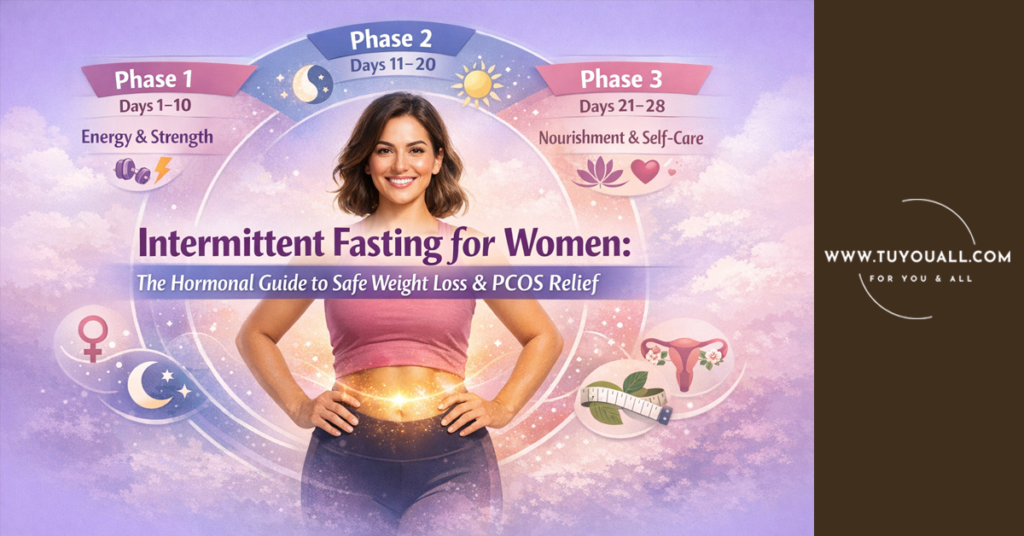
This blog post is based on insights from Dr. Pal Manik‘s YouTube video: “Why Women Should Fast Differently Than Men.”
Have you ever tried intermittent fasting, only to find yourself exhausted, cranky, and ready to eat an entire chocolate bar by day three—while your male partner or friend seems to breeze through 16-hour fasts without breaking a sweat? You’re not imagining it, and you’re definitely not failing.
Women’s bodies aren’t designed to fast the same way men’s bodies do. Why? Because your body is running a complex hormonal orchestra every single month, and if you ignore the instruments (hello, estrogen and progesterone), the whole symphony crashes. The good news? When you sync your fasting schedule with your menstrual cycle, you can unlock incredible benefits—from healing PCOS to regularizing your periods—without the fatigue and cravings.
Let me break down exactly how to do this, based on the fascinating biological rhythms that make you uniquely you.
Is Fasting Even Safe for Women?
Let’s tackle the elephant in the room first. You might have heard that fasting is bad for women, that it “messes with your hormones,” or that it’s only safe for men. Here’s the truth: fasting is absolutely safe for women, but only if you do it with your biology, not against it.
As Dr. Pal Manik explains, “Women actually start their innings with one wicket down because there are so many hormones interplaying. Their body is an actual musical orchestra which has to be synchronized properly.” —Dr. Pal Manik
Think about it this way: men’s hormonal orchestra plays the same tune every day. But your orchestra has different movements—sometimes energetic and fast, sometimes slow and nurturing. The two key “instruments” that make your symphony unique are estrogen and progesterone, and they dictate how your body responds to fasting stress.
Research backs this up. In 2021, a study took women aged 18-30 with Polycystic Ovarian Syndrome (PCOS) and had them follow an 8-hour eating window for 6-8 weeks. The results? Inflammatory markers dropped, glucose levels improved, and—here’s the kicker—several women normalized their menstrual cycles after just two months. Fasting didn’t break their hormones; it helped reset them.
Why Men and Women Need Different Fasting Rules
To understand why you can’t just copy your boyfriend’s fasting routine, you need to understand your 28-day menstrual cycle. Don’t worry—this isn’t just biology class flashbacks. This is the key to working with your body instead of fighting it.
Here’s how Dr. Pal beautifully explains the process: Your body is preparing a “bed” (the endometrium) in your uterus every month, just in case an embryo needs a cozy place to grow.
- First half (Days 1-14): Estrogen rises to build up that thick, comfy uterine lining.
- Middle (Day 14): You ovulate—an egg is released and waits for fertilization.
- Second half (Days 15-28): If the egg isn’t fertilized, progesterone rises to break down that lining, causing your period, and the cycle starts fresh.
Dr. Pal puts it perfectly: “I’m just literally amazed by the sequence of events created by God. It is absolutely magical. As long as we don’t disturb this, this is going to be a wonderful cycle.”
The problem? Estrogen loves fasting, but progesterone hates it. When you ignore these phases and fast the same way every day, you’re essentially telling your body to sprint when it needs to rest, or rest when it could be sprinting.
The 3-Phase Fasting Protocol for Women
Ready for the practical solution? Instead of forcing 16-hour fasts every single day, you cycle your fasting length to match your hormonal phases. This isn’t complicated—it’s just smart.
Phase 1: Days 1-10 (The Power Phase)
Dominant Hormone: Estrogen
Recommended Fast: 16 hours (up to 36-48 hours if experienced)
This is your superpower window. Day 1 is when your period starts, and estrogen begins its slow climb. Estrogen is incredibly resilient—it “absolutely loves fasting” and can handle stress like a champ.
Dr. Pal even jokes that this is the time to “talk to your significant other” because estrogen helps you resist stress and arguments. Your body is in building mode, but it’s not yet craving extra fuel.
What to do:
- Stick to a 16-hour fasting window with an 8-hour eating window
- If you’re experienced, you could even try 24-hour fasts or longer
- This is the best time for intense workouts while fasting
Phase 2: Days 11-20 (The Transition Phase)
Dominant Hormone: Estrogen peaks then drops; Progesterone begins rising
Recommended Fast: 14 hours
Around day 14, you ovulate. Estrogen hits its peak and then starts to decline, while progesterone begins its ascent. This is the handoff period—like a relay race where the baton is being passed.
Progesterone needs insulin and glucose to do its job properly. If you push aggressive fasting here, you’ll likely feel “off” without knowing why.
What to do:
- Shorten your fast to 14 hours (eat within a 10-hour window)
- Listen if you feel hungrier than usual—it’s not lack of willpower, it’s biology
- Keep meals nutrient-dense
Phase 3: Days 21-28 (The Nurturing Phase)
Dominant Hormone: Progesterone peaks
Recommended Fast: 12-13 hours
Welcome to pre-menstrual week. Progesterone is at its highest, and it’s demanding carbohydrates and insulin. This is why you crave chips, chocolate, and comfort food right before your period. It’s not emotional eating—it’s hormonal chemistry.
Dr. Pal shares a relatable example: “My wife says, ‘I need chocolate right now.’ I used to say, ‘This is not even a week before your menstrual period. Why are you craving for chocolate?’ She’s saying, ‘I’m craving for the next menstrual period right now.'”
What to do:
- Drop to 12-13 hour fasts (never go below 12 if you can help it)
- Eat complex carbs like sweet potatoes—they’re rich in fiber, keep you full, and satisfy those cravings without the sugar crash
- If you’re exhausted, don’t force longer fasts. As Dr. Pal emphasizes: “Please listen to your body.”
| Phase | Days | Dominant Hormone | Fasting Window | Why |
| Power Phase | 1-10 | Estrogen | 16 hours | Estrogen resists stress; body can handle longer fasts |
| Transition | 11-20 | Estrogen ↓ / Progesterone ↑ | 14 hours | Hormonal handoff requires metabolic support |
| Nurturing | 21-28 | Progesterone | 12-13 hours | Body needs glucose/insulin; cravings are biological |
PCOS and Fasting: Resetting Your Circadian Rhythm
If you have PCOS (Polycystic Ovarian Syndrome), this cyclical approach isn’t just helpful—it could be transformative. Dr. Pal explains that PCOS isn’t actually a disease; it’s a metabolic syndrome where your insulin isn’t working properly, often because your circadian rhythm (your body’s internal clock) is disrupted.
Remember that 2021 study? Women with irregular periods saw their cycles normalize after just 8 weeks of time-restricted eating. Dr. Pal has seen this firsthand: “I have personally treated three patients with polycystic ovarian syndrome with fatty liver. All of them had infertility issues… I personally have seen them improving their menstrual cycles on intermittent fasting, developing a good quality ovum, resulting in pregnancy.”
The key is not eating after sunset and maintaining that circadian rhythm—something Dr. Pal stresses is “even more important in women than in men.”
Frequently Asked Questions
Q.1. Can I do the same fasting hours every day if I feel fine? If you’re not experiencing fatigue, hair loss, or intense cravings, you can maintain 16-hour fasts. However, cycling your fasts according to the protocol often produces better hormonal balance long-term, even if you feel okay now.
Q.2. What should I eat when I have pre-menstrual cravings? Don’t fight the craving—upgrade it. Instead of processed chocolate or chips, choose complex carbohydrates like sweet potatoes, quinoa, or oats. They provide the glucose your progesterone needs while keeping you full longer due to fiber content.
Q.3. Will this work if I have irregular periods or PCOS? Yes, this method is particularly powerful for PCOS. Research shows that intermittent fasting can reduce inflammatory markers and help regularize cycles. Just start gently with 12-hour fasts and gradually adjust as your cycle becomes more predictable.
Q.4. Can men use this cycling approach? Men don’t experience the same estrogen-progesterone fluctuations, so they can typically maintain consistent fasting windows. However, men should still respect their circadian rhythms and avoid late-night eating.
Q.5. What if I break my fast early during the luteal phase? Don’t stress. As Dr. Pal says, “It is absolutely okay to give in a little bit” during days 21-28. One day of 12-hour fasting instead of 16 won’t derail your progress. Consistency over time matters more than perfection.
Conclusion
Your body isn’t broken because you can’t fast like a man. You’re beautifully complex, and intermittent fasting for women works best when it honors your natural hormonal shifts. By shortening your fasts as progesterone rises and extending them when estrogen dominates, you’re working with your biology instead of against it.
Start with the 3-phase protocol: 16 hours during days 1-10, 14 hours during days 11-20, and 12-13 hours during days 21-28. Pay attention to your energy, your cravings, and your cycle. Remember, resetting your circadian rhythm by not eating after sunset might just be the missing piece for issues like PCOS and irregular periods.
What about you? Do you notice specific cravings or energy dips at certain times of the month? Have you tried adjusting your fasting window to match your cycle? Share your experience in the comments below—I’d love to hear what’s working for you!
Credits :
This blog post is based on insights from Dr. Pal Manik‘s YouTube video: “Why Women Should Fast Differently Than Men.”
Dr. Pal Manik supports Aaram Trust (aaramtrust.com), an organization providing 24/7 free medical care, food, and shelter to hospice patients with terminal illnesses. If you found this content valuable, please consider supporting their mission through the donation link in the original video description.