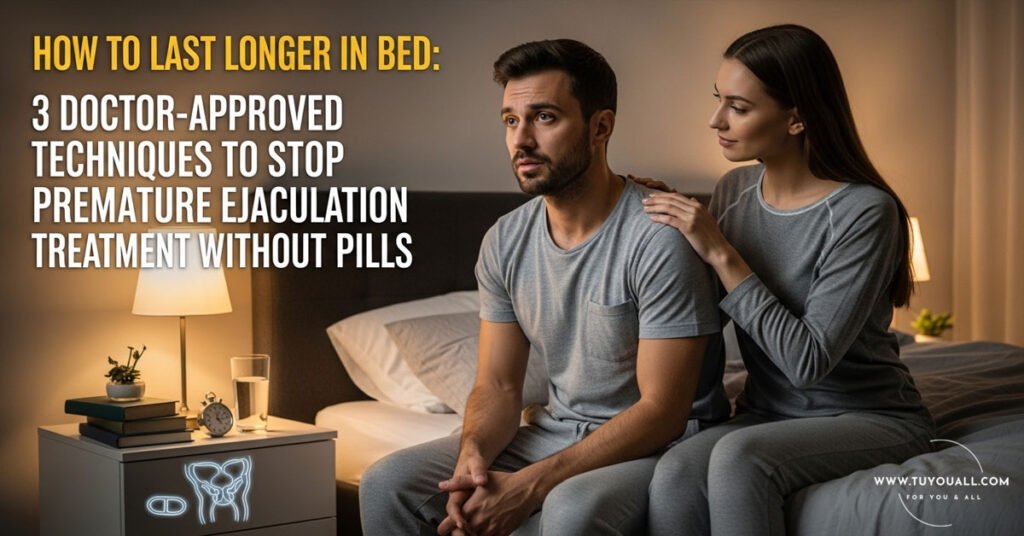
This blog post is based on insights from Dr. Praveen Tripathi‘s YouTube video: “Premature Ejaculation Treatment: 3 Techniques Without Medicines” (translated title from Hindi)
Have you ever felt frustrated because things ended way sooner than you—or your partner—hoped? You’re not alone. Millions of men experience premature ejaculation (PE), often defined as reaching climax within one minute of starting intercourse. The good news? You don’t necessarily need medication to fix this.
In this guide, we’re breaking down three practical, body-based techniques that can help you last longer in bed and regain confidence—no prescriptions required. These methods come straight from Dr. Praveen Tripathi, a specialist in sexual health, who explains them in simple terms anyone can follow.
What Is Premature Ejaculation, Really?
Before diving into solutions, let’s clarify what we’re dealing with. Premature ejaculation isn’t just about timing—it’s about control. When a man consistently reaches orgasm with minimal stimulation and feels he can’t delay it, that’s PE.
Dr. Tripathi puts it plainly: “Premature ejaculation means a man discharges or ejaculates in less than one minute. There are ways to correct this yourself without medicines.”
The techniques below work by retraining your body’s arousal patterns and strengthening the specific muscles involved in ejaculation control.
Technique 1: The Stop-Start Method (Behavioral Training)
The stop-start technique is exactly what it sounds like—a way to hit the pause button on your body’s rush toward climax.
How It Works
During intercourse, pay close attention to your arousal levels. The moment you feel that first strong sensation—the “point of no return” approaching—stop all activity completely. Wait for about 20 to 30 seconds, then resume.
Dr. Tripathi explains the science: “The ejaculation process is like a rising graph. It keeps climbing. If you pause in between, the graph almost flattens out. Then you can continue intercourse for some more time.”
Why This Helps
Think of arousal like a thermometer. When it hits the top, you climax. By stopping, you’re letting that thermometer cool down. Over multiple practice sessions, your body learns to tolerate higher levels of stimulation without tipping over the edge immediately.
Real-World Example
For example, imagine you’re driving and notice you’re speeding toward a red light. Instead of slamming the brakes at the last second (climax), you ease off the gas early (stop), coast for a bit (30-second break), then continue smoothly when the light turns green. The stop-start method trains your “sexual braking system” to respond earlier and more effectively.
Technique 2: The Squeeze Technique (Partner-Assisted Control)
The squeeze technique adds a physical intervention that literally puts the brakes on ejaculation through pressure.
How It Works
When you feel ejaculation approaching, your partner uses their thumb and two fingers to apply firm pressure to the frenulum (the sensitive underside of the penis where the head meets the shaft) or the base of the penis.
Dr. Tripathi emphasizes the pressure level: “Squeeze hard enough that there’s slight pain—but not too much, because injury can happen. And not too light, or it won’t be effective.”
The Partner’s Role
This technique requires communication and trust. Your partner isn’t just “helping”—they’re an active participant in your control training. The pressure interrupts the ejaculatory reflex, causing the arousal curve to drop, similar to the stop-start method but with a physical “reset button.”
Real-World Example
For example, think of a garden hose with water rushing through. If you pinch the hose firmly, the water stops momentarily. Release the pinch, and flow resumes—but you’ve broken the continuous pressure buildup. The squeeze technique works on the same principle, interrupting the physiological cascade toward orgasm.
Technique 3: Kegel Exercises (Pelvic Floor Strengthening)
You’ve probably heard of Kegel exercises—they’re not just for women. For men, these exercises target the pubococcygeus (PC) muscles, the same muscles you use to stop urination mid-stream. Strengthening these gives you voluntary control over ejaculation.
Finding the Right Muscles
Dr. Tripathi offers a simple identification method: “While urinating, try to stop your urine flow voluntarily without using your hands. The muscle you use to stop it—that’s the muscle we need to exercise.”
The Exercise Routine
Once you’ve identified the muscle:
- Contract the PC muscle for 3 seconds
- Relax for 3 seconds
- Repeat 10 times per set
- Complete 3-4 sets throughout the day
Why Consistency Matters
Dr. Tripathi stresses patience: “Just like you can’t become a bodybuilder in one day by going to the gym, these muscles won’t become strong in one day. You have to do these exercises repeatedly before you see significant difference.”
These muscles act as the “floor” supporting your pelvic organs. When strong, they can contract to delay ejaculation voluntarily—essentially giving you a physical “clutch” to shift gears before reaching the point of no return.
Combining Techniques for Maximum Results
These three methods aren’t mutually exclusive—in fact, they work best together:
| Technique | When to Use | Primary Benefit |
| Stop-Start | During intercourse | Breaks arousal escalation |
| Squeeze | When stop-start isn’t enough | Physical interruption of ejaculation reflex |
| Kegels | Daily training (not during sex) | Builds long-term muscle control |
Dr. Tripathi notes: “You can use these methods during sexual intercourse. If you use them along with medications, results are quite good.”
Think of Kegels as your daily gym workout building baseline strength, while stop-start and squeeze are the “game-day” techniques you deploy in the moment.
Frequently Asked Questions (FAQ)
Q1: How long does it take to see results from these techniques?
Most men notice improvement within 4-6 weeks of consistent practice. Kegel exercises particularly require 6-8 weeks of daily training before significant muscle strength develops. Behavioral techniques like stop-start may show faster initial results, but mastery comes with repeated practice.
Q2: Can I do Kegel exercises while urinating regularly?
Only use urination to initially identify the correct muscles. Regularly stopping urine flow can lead to incomplete bladder emptying and urinary issues. Once identified, practice Kegels when not urinating—while sitting, standing, or lying down.
Q3: Will these techniques cure premature ejaculation permanently?
These methods manage and significantly improve PE, but consistency matters. Like physical fitness, stopping the exercises means losing some benefits. Many men incorporate them as lifelong practices for ongoing sexual health.
Q4: Is the squeeze technique safe?
Yes, when done correctly. The pressure should be firm but not painful enough to cause injury. Communicate with your partner about intensity, and avoid squeezing the testicles or using excessive force.
Q5: Should I still see a doctor if these don’t work?
Absolutely. While these techniques help many men, persistent PE can sometimes indicate underlying medical or psychological factors. A healthcare provider can rule out hormonal issues, prostate problems, or anxiety disorders, and discuss medication options if needed.
Your Action Plan: Start Tonight
Here’s how to begin:
- Today: Identify your PC muscles using the urination test
- This week: Start 3 daily sets of 10 Kegel contractions
- Next intimate moment: Try the stop-start method at least once
- With your partner: Discuss the squeeze technique and practice communication
Remember, sexual stamina is a skill, not an innate trait. Every expert was once a beginner who practiced.
Conclusion: Take Control Naturally
Premature ejaculation can feel embarrassing and isolating, but it’s one of the most common sexual concerns men face—and one of the most treatable without medication. The stop-start technique teaches your nervous system to cool down, the squeeze technique provides an emergency brake when arousal spikes, and Kegel exercises build the physical infrastructure for long-term control.
These aren’t quick fixes or magic pills. They’re evidence-based practices that require patience, consistency, and honest communication with your partner. But for men willing to put in the work, they offer something better than a prescription: genuine, sustainable confidence in the bedroom.
Which technique will you try first—the behavioral training, the partner-assisted squeeze, or the daily muscle building? Your journey to better control starts with a single step (or squeeze).
Credit & Source
This blog post is based on insights from Dr. Praveen Tripathi‘s YouTube video: “Premature Ejaculation Treatment: 3 Techniques Without Medicines” (translated title from Hindi).
The original content has been translated, expanded, and repurposed for educational purposes.
Dr. Tripathi is a specialist in sexual medicine and related health topics, providing practical advice for