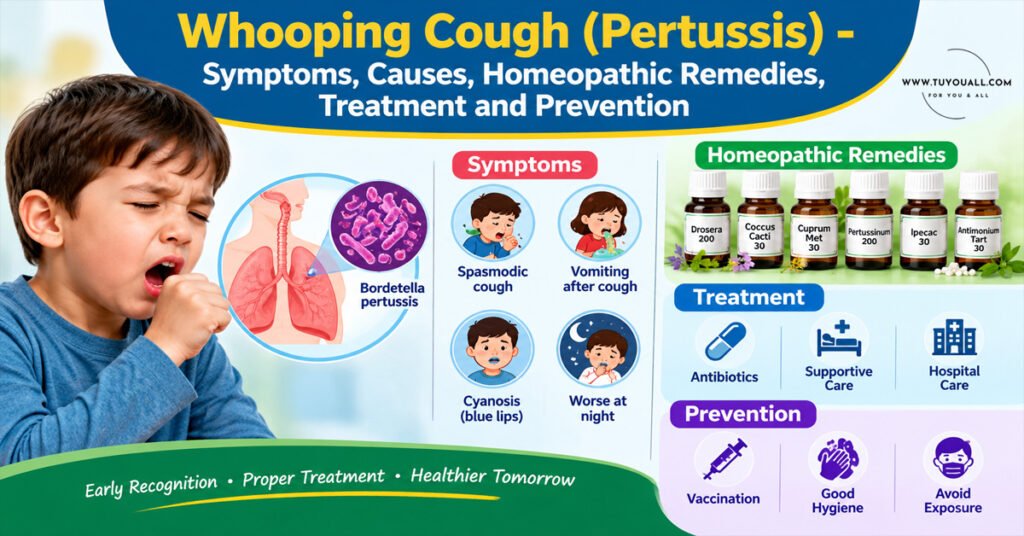
Learn About Whooping Cough (Pertussis), Its Symptoms, Causes, Diagnosis, Treatment, Homeopathic Remedies, Complications And Prevention.
Whooping cough, also known as pertussis, is a highly contagious respiratory infection that causes severe coughing attacks. It can affect people of all ages, but babies and young children face the greatest risk of serious complications.
Have you ever seen someone cough repeatedly until they struggle to breathe or vomit? This can be a warning sign of whooping cough.
Early recognition is important. With proper medical care, vaccination, and timely treatment, we can reduce the spread of infection and protect vulnerable people.
This article explains the symptoms, causes, diagnosis, treatment, complications, and prevention of whooping cough. It also discusses the homeopathic remedies listed in the supplied reference image, with an important distinction between traditional homeopathic use and scientifically proven medical treatment.
What Is Whooping Cough (Pertussis)?
Whooping cough is an infection of the respiratory system caused by a bacterium called Bordetella pertussis.
It affects the airways and causes repeated, uncontrollable coughing attacks. During an attack, a person may struggle to breathe between coughs.
The infection spreads easily from one person to another. It mainly spreads through tiny respiratory droplets released when an infected person coughs or sneezes.
Why Is It Called Whooping Cough?
The name comes from the high-pitched sound some people make when they breathe in after a severe coughing attack.
This sound is called a whoop.
However, not everyone makes this sound. Babies, vaccinated children, and adults may have pertussis without the typical whoop.
Who Is at Risk?
Anyone can develop whooping cough. However, some people face a higher risk of serious illness.
These include:
- Babies younger than six months.
- Children who have missed recommended vaccinations.
- Pregnant women and newborn babies.
- People with weakened immune systems.
- People who live with or care for an infected person.
Infants are especially vulnerable because their breathing can become dangerously affected.
Main Symptoms of Whooping Cough
The symptoms of pertussis often develop gradually. At first, the infection may look like an ordinary cold.
After one or two weeks, the cough can become much more severe.
The following symptoms are commonly associated with whooping cough.
1. Spasmodic Cough With a Whoop
A spasmodic cough occurs in repeated bursts. The person may cough many times without taking a proper breath.
At the end of an attack, the person may make a high-pitched sound while breathing in.
For Example:
A child may suddenly start coughing repeatedly while playing. After several coughs, the child struggles to breathe and makes a loud, whooping sound.
2. Coughing Followed by Vomiting
Severe coughing attacks can put considerable pressure on the stomach and abdominal muscles.
As a result, some people vomit immediately after coughing. This is known as post-tussive vomiting.
It is an important clinical clue when doctors assess possible pertussis.
3. Cyanosis During an Attack
Cyanosis refers to a bluish or greyish colour of the lips, tongue, or skin due to low oxygen levels.
It may occur during a severe coughing or breathing episode.
If someone develops blue or grey lips, tongue, or skin, seek emergency medical help immediately.
4. Coughing That Becomes Worse at Night
Many people with pertussis experience repeated coughing attacks at night.
These attacks can disturb sleep and leave the person extremely tired.
Other Possible Symptoms
Depending on the person’s age and stage of infection, symptoms may include:
- Runny or blocked nose.
- Mild fever.
- Sneezing
- Difficulty sleeping.
- Exhaustion after coughing.
- Poor feeding in babies.
- Breathing pauses (apnoea) in infants.
Remember:
A person does not need to have every symptom to develop pertussis. The absence of a whooping sound does not rule out infection.
Three Stages of Whooping Cough
Pertussis generally develops through three stages. Understanding these stages helps people recognise the infection early.
The three stages of pertussis
- Catarrhal stage (first 1–2 weeks)
Cold-like symptoms, runny nose, mild fever and occasional cough.
- Paroxysmal stage (usually several weeks)
Severe coughing fits, whooping sounds, vomiting and possible cyanosis.
- Convalescent stage (recovery)
Coughing gradually becomes less frequent. However, it may continue for weeks or months.
Typical clinical progression; the duration varies from person to person.
Stage 1: Catarrhal Stage
This is the early stage of infection.
The symptoms are similar to those of a common cold. The patient may experience:
- Runny nose.
- Sneezing
- Mild fever.
- Occasional cough.
- General discomfort.
This stage usually lasts around one to two weeks.
It is important to seek medical advice when pertussis is suspected. Early treatment offers the greatest benefit.
Stage 2: Paroxysmal Stage
This stage is known for its severe coughing attacks.
The patient may experience:
- Repeated, spasmodic coughing.
- A high-pitched whooping sound.
- Vomiting after coughing.
- Bluish skin or lips during severe attacks.
- Extreme tiredness.
- Difficulty sleeping.
Coughing attacks may become particularly troublesome at night.
Stage 3: Convalescent Stage
This is the recovery stage.
The coughing attacks gradually become less severe and less frequent. However, complete recovery may take several weeks.
Sometimes, another respiratory infection can trigger coughing episodes again during recovery.
Most Probable Diagnosis: Pertussis
The combination of spasmodic coughing, whooping, vomiting after coughing, and cyanosis strongly suggests pertussis.
However, symptoms alone cannot always confirm the diagnosis.
A doctor considers the patient’s symptoms, vaccination history, contact with infected people, physical examination, and laboratory results.
How Is Whooping Cough Diagnosed?
Doctors may recommend different tests depending on the patient’s symptoms and how long the cough has been present.
1. Clinical Examination
The doctor asks questions about:
- How long the cough has lasted.
- Whether coughing occurs in repeated attacks.
- Whether vomiting follows coughing.
- Whether the patient makes a whooping sound.
- Whether the patient has been exposed to an infected person.
- Whether vaccinations are up to date.
2. Complete Blood Count (CBC)
A CBC measures different types of blood cells.
In pertussis, doctors may find an increased number of lymphocytes. This is called lymphocytosis.
However, lymphocytosis alone cannot confirm whooping cough.
3. Pertussis PCR Test
A PCR test looks for genetic material from the Bordetella pertussis bacterium.
Doctors generally collect a sample from the back of the nose using a special swab or aspirate.
PCR is especially useful during the early weeks of coughing.
4. Bacterial Culture
A laboratory may also attempt to grow the bacteria from a respiratory sample.
Culture is most useful early in the illness. Its sensitivity decreases as time passes.
For Example:
A child develops a persistent cough with repeated attacks and vomiting. The doctor suspects pertussis and requests a nasopharyngeal swab for PCR testing.
Medical Treatment for Whooping Cough
Whooping cough requires proper medical assessment. It should not be treated as an ordinary cough.
Doctors generally use antibiotics to treat pertussis. The choice of medicine depends on age, medical history, and other clinical factors.
1. Antibiotic Treatment
Commonly recommended antibiotics include:
- Azithromycin
- Clarithromycin
- Erythromycin
- Trimethoprim-sulfamethoxazole in suitable patients.
A qualified doctor must decide which antibiotic is appropriate.
Antibiotics work best when started during the early stage of infection. They can reduce illness severity and help limit the spread of bacteria.
However, antibiotics may not stop severe coughing once the later stages have developed.
2. Supportive Care
Patients may also need supportive care to make recovery easier.
Useful measures include:
- Drinking enough fluids.
- Taking adequate rest.
- Eating small, frequent meals.
- Avoiding smoke and dust.
- Staying away from strong chemical smells.
- Using a clean, cool-mist humidifier when appropriate.
Do not give cough medicines to children without medical advice.
3. Hospital Treatment
Some patients need hospital care, especially young babies.
Hospital treatment may include:
- Monitoring breathing and oxygen levels.
- Providing oxygen when required.
- Clearing respiratory secretions when necessary.
- Giving fluids to prevent dehydration.
- Monitoring for breathing pauses and other complications.
Babies with suspected pertussis should receive prompt medical assessment.
Homeopathic Remedies for Whooping Cough: Understanding the Traditional Approach
The supplied reference image lists six homeopathic medicines traditionally associated with different whooping cough symptoms.
These remedies are included below for educational reference. However, it is important to understand the difference between traditional homeopathic practice and evidence-based medical treatment.
There is no reliable scientific evidence that homeopathic medicines cure pertussis, eliminate the bacteria, prevent complications, or stop transmission. They should not replace antibiotics, medical supervision, or vaccination.
Homeopathic Medicines Mentioned in the Reference Image
| Homeopathic medicine | Traditional symptom association in the reference |
| Drosera 200 | Paroxysmal cough, especially when lying down or after midnight. |
| Coccus Cacti 30 | Coughing followed by vomiting or thick, stringy mucus. |
| Cuprum Met 30 | Spasmodic cough and cyanosis. |
| Pertussinum 200 | Traditionally described as a nosode associated with pertussis. |
| Ipecac 30 | Whooping cough accompanied by nausea and vomiting. |
| Antimonium Tart 30 | Cough with rattling mucus and difficulty bringing it up. |
These are traditional homeopathic symptom associations, not clinically established treatment indications.
Complications of Whooping Cough
Whooping cough can cause several complications, especially when the infection affects babies and young children.
Severe coughing attacks place pressure on the chest, abdomen, and blood vessels. They can also interfere with normal breathing.
The following complications may occur.
1. Pneumonia
Pneumonia is one of the most serious complications of pertussis.
It occurs when the lungs become infected or inflamed. It may cause:
- Fever
- Fast breathing.
- Chest discomfort.
- Difficulty breathing.
- Reduced oxygen levels.
Pneumonia can be particularly dangerous in infants.
2. Hernia
Repeated and forceful coughing increases pressure inside the abdomen.
This pressure may contribute to an abdominal or groin hernia, especially in vulnerable individuals.
3. Subconjunctival Haemorrhage
Severe coughing can increase pressure in the small blood vessels around the eyes.
Sometimes, a tiny blood vessel breaks beneath the transparent covering of the eye.
This causes a bright red patch on the white part of the eye. It is called a subconjunctival haemorrhage.
4. Apnoea in Infants
Apnoea means a temporary pause in breathing.
It is a particularly dangerous complication in babies with pertussis.
Some infants may experience breathing pauses without having the typical whooping cough.
Other Possible Complications
Additional complications include:
- Dehydration
- Weight loss.
- Seizures
- Pneumothorax (air around the lung).
- Rib fractures due to severe coughing.
- Brain complications caused by low oxygen levels.
- Exhaustion and difficulty feeding.
For Example:
A two-month-old baby develops repeated breathing pauses and poor feeding. Even without a loud cough, pertussis must be considered. Immediate hospital assessment is essential.
Isolation and Infection Control
Pertussis spreads easily. Therefore, infection-control measures are important to protect family members and other vulnerable people.
A person with suspected or confirmed pertussis should follow medical and local public-health advice about isolation.
Important precautions include:
- Avoid close contact with babies and pregnant women.
- Cover the mouth and nose when coughing or sneezing.
- Wash hands regularly with soap and water.
- Avoid sharing personal items.
- Improve ventilation in indoor spaces.
- Wear a well-fitting mask when advised and around others.
- Follow the prescribed antibiotic course.
People receiving appropriate antibiotics are generally considered much less contagious after five full days of treatment. Without effective treatment, infectiousness can continue for about 21 days after cough onset.
Healthcare professionals should also assess close contacts who may need preventive antibiotics.
How to Prevent Whooping Cough
Prevention is better than treatment, particularly when babies are involved.
Vaccination is the most effective way to protect children against severe pertussis.
1. Follow the Childhood Vaccination Schedule
In India, pertussis protection is included in combination vaccines under the Universal Immunization Programme.
The routine schedule includes:
| Child’s age | Pertussis-containing vaccine |
| 6 weeks | Pentavalent vaccine – dose 1 |
| 10 weeks | Pentavalent vaccine – dose 2 |
| 14 weeks | Pentavalent vaccine – dose 3 |
| 16–24 months | DPT booster 1 |
| 5–6 years | DPT booster 2 |
Parents should confirm the schedule and any missed doses with their local healthcare provider.
Ministry of Health and Family Welfare+1
2. Protect Newborn Babies
Newborn babies are particularly vulnerable because they have not yet completed their primary vaccination series.
Parents and caregivers should:
- Keep the baby’s vaccinations up to date.
- Avoid contact with people who have persistent coughing.
- Seek medical advice after exposure to pertussis.
- Ensure household members follow recommended vaccination advice.
3. Maintain Good Hygiene
Simple hygiene habits can reduce the spread of respiratory infections.
- Wash hands frequently.
- Cover coughs and sneezes.
- Dispose of used tissues properly.
- Keep rooms well ventilated.
- Avoid close contact with infected people.
4. Consult a Doctor After Exposure
If someone in the household develops confirmed pertussis, other household members may need medical assessment.
Preventive antibiotics may be recommended for certain close contacts, particularly those at high risk of severe disease or those who have contact with vulnerable infants.
Do not wait for symptoms to develop before seeking advice.
When Should You Seek Emergency Medical Help?
Not every cough is an emergency. However, certain symptoms require immediate attention.
Warning signs that need urgent medical attention
- Blue or grey lips, tongue, or skin.
- Difficulty breathing.
- Pauses in breathing.
- Severe chest discomfort.
- Unusual sleepiness or difficulty waking.
- Signs of dehydration.
- Poor feeding in an infant.
- Repeated severe coughing attacks in a young baby.
If a baby has suspected pertussis, seek prompt medical assessment even if the symptoms appear mild.
Practical Example: Recognising Whooping Cough Early
Consider a five-year-old child who develops a mild runny nose and occasional cough.
After several days, the cough becomes more severe. The child begins coughing repeatedly, especially at night. Sometimes, the child vomits immediately after coughing.
The parents initially assume it is a common seasonal cough.
However, these symptoms may indicate pertussis.
The appropriate next steps are:
- Consult a qualified doctor promptly.
- Explain the coughing pattern and any known exposure.
- Discuss pertussis PCR testing.
- Follow prescribed treatment.
- Keep the child away from vulnerable people according to medical advice.
- Check the vaccination history.
This example shows why recognising the early warning signs matters.
Key Differences: Ordinary Cough vs Whooping Cough
| Feature | Ordinary cough | Whooping cough |
| Beginning | May start suddenly | Often begins like a cold |
| Cough pattern | Usually occasional | Repeated coughing attacks |
| Whooping sound | Usually absent | May be present |
| Vomiting after cough | Less typical | Common clinical clue |
| Night-time attacks | Variable | Often prominent |
| Duration | Depends on cause | May last weeks or months |
| Contagiousness | Depends on cause | Highly contagious |
This comparison is a general guide, not a diagnostic test. A healthcare professional must assess suspected pertussis.
Frequently Asked Questions (FAQs)
- What is the main cause of whooping cough?
Whooping cough is caused by the bacterium Bordetella pertussis. It spreads through respiratory droplets when an infected person coughs or sneezes.
- What are the most common symptoms of pertussis?
The most common symptoms include:
- Repeated spasmodic coughing.
- A high-pitched whooping sound.
- Vomiting after coughing.
- Coughing attacks that worsen at night.
- Breathing difficulties during severe attacks.
However, babies may develop breathing pauses without showing typical symptoms.
- Which test confirms whooping cough?
A nasopharyngeal swab for pertussis PCR is commonly used to detect the infection. Doctors may also recommend bacterial culture and a complete blood count.
- Can homeopathic medicines cure whooping cough?
There is no reliable scientific evidence that homeopathic medicines cure pertussis. Remedies such as Drosera, Coccus Cacti, Cuprum Met, Pertussinum, Ipecac, and Antimonium Tart are traditionally mentioned in homeopathy, but they should not replace proven medical treatment.
- How can parents protect babies from whooping cough?
Parents can protect babies by:
- Following the recommended vaccination schedule.
- Avoiding contact with infected individuals.
- Maintaining good hygiene.
- Seeking medical advice after exposure.
- Getting immediate medical attention if breathing problems develop.
References & Further Learning:
For additional clinical insights, materia medica explanations, and practical perspectives on homeopathic management, the information in this article/page has been cross-referenced with educational resources shared by qualified homeopathic practitioners and researchers in their YouTube Channel (Links given Below). Readers seeking deeper guidance on remedy selection, potencies, and holistic care may explore video lectures and case discussions by established homeopathic doctors as listed below with their YouTube Channel Link :
| SL No. | Channel / Doctor Name | Primary Focus & Clinical Background | YouTube Link |
| 1 | Dr. Kirti Vikram Singh | Covers disease-specific remedies, mother tinctures, German combinations, and daily live Q&A sessions. | https://www.youtube.com/drkirtivikramsingh |
| 2 | Dr. Pranjali Srivastava | Registered BHMS physician and certified nutritionist focusing on holistic disease management and lifestyle care. | https://www.youtube.com/@drpranjalihomeopathy
|
| 3 | Dr. Swapnil Sagar Jain | BHMS consultant at Niramay Homeopathy offering remedy guides for acute and chronic conditions. | https://www.youtube.com/@DrSwapnilSagarJain-NIRAMAY |
| 4 | Dr. Umang Khanna | Focuses on natural homeopathic treatments, chronic illness management, and educational health guides in Hindi. | https://www.youtube.com/@drumangkhanna |
| 5 | Shree Radhey Homeopathy | Hosted by Dr. Chakshu; features remedy explanations, patient case stories, and live consultation Q&As. | https://www.youtube.com/@ShreeRadhey |
| 6 | Dr. P.S. Tiwari | Senior D.M.S. homeopath with 36+ years of experience explaining classical Materia Medica and therapeutics. | https://www.youtube.com/@DrPSTiwari |
| 7 | Dr. Varun Kanwadia | BHMS, DNHE consultant sharing practical homeopathic solutions for skin, hair, respiratory, and digestive issues. | https://www.youtube.com/@varunkanwadia |
| 8 | Dr. Arpana Samanta | Gold Medalist BHMS (Delhi) & PGD (London) with 20+ years of experience covering chronic diseases like thyroid, PCOS, and skin disorders. | https://www.youtube.com/@dr.arpanasamanta |
| 9 | Dr. Rukmani Choudhary | Focuses on root-cause homeopathic treatments, comparative remedy selection, and live Q&A sessions. | https://www.youtube.com/@Dr.Rukmani-HomeopathyClinic |
| 10 | Dr. Santosh Kumar Padhy | Provides accessible homeopathic remedy suggestions and general health guidance for everyday ailments. | https://www.youtube.com/@dr.santoshkumarpadhy8888 |
Medical Disclaimer:
This article is for educational and informational purposes only. It is not a substitute for professional medical advice, diagnosis, or treatment. Always seek the guidance of a qualified healthcare provider and a licensed homeopathic practitioner before starting any treatment for pneumonia or any other medical condition.