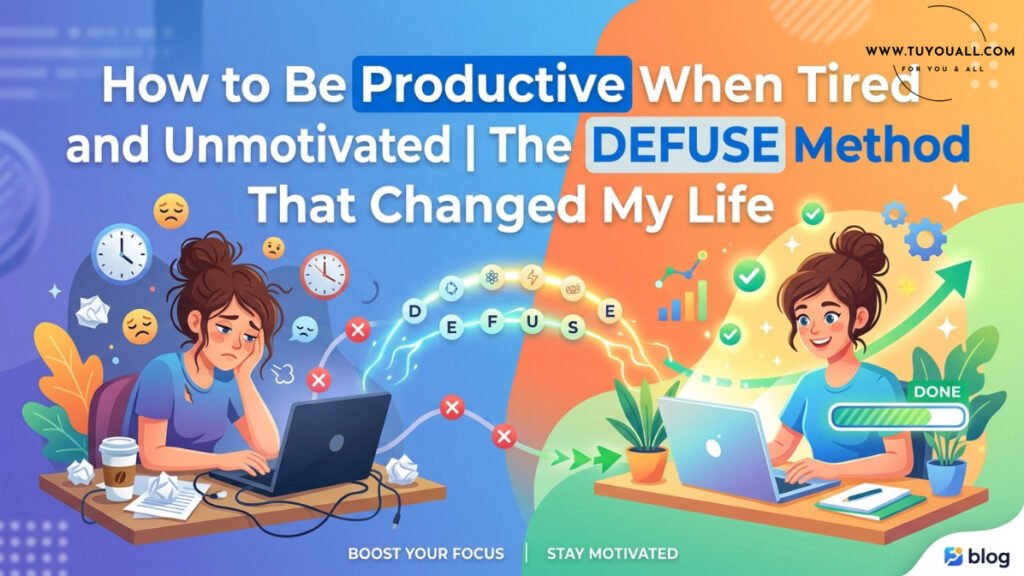
How to Be Productive When Tired and Unmotivated? Struggling To Focus When Exhausted? Learn Justin Sung’s DEFUSE Method—A 4-Step Cognitive Framework To Master Productivity Without Relying On Motivation.
Have you ever woken up feeling drained, stared at your to-do list, and thought, “I just can’t today”?
We have all been there. The interesting part? Some of the busiest people on earth feel the exact same way. Justin Sung, a medical doctor, learning coach, and entrepreneur, has worked 60 to 100 hours per week for over eleven years. He studied full-time, graduated from medicine, launched a business, and coached students—all while practicing as a doctor.
Most people assume he is highly motivated. He disagrees.
“I actually think that I’m quite lazy,” Sung admits. “I’ve been demotivated and burnt out honestly more times than I can remember.”
So how does he keep going? He uses a four-step cognitive framework called DEFUSE. It is built on a powerful psychological technique known as thought action defusion. Once you learn it, you will never need another motivational video again.
The Hidden Flaw in How We Use Motivation
Before we dive into the four steps, we need to fix a common misunderstanding. Most of us use motivation the wrong way. We rely on it to push through every task. This approach is what Sung calls motivation dependent. It sounds healthy, but it is actually a trap.
What Does It Mean to Be Motivation Dependent?
Imagine you set a goal for the day. Maybe you want to go for a run, finish a report, or study for an exam. You start with good intention. Then you sit down to work. Suddenly, your phone buzzes. You feel tired. You start overthinking. These barriers pop up between your intention and your first action.
Motivation dependent people use motivation as a battering ram. They wait for a burst of energy to destroy those barriers. When they feel lazy, they force themselves to push through. When they feel distracted, they rely on willpower to stay focused.
This works for a little while. Then it stops working.
The Burnout Cycle Explained
Motivation comes from two sources. Extrinsic motivators are external. They include money, rewards, praise, or fear of punishment. These are unstable. A smaller paycheck or a bad review can wipe them out overnight.
Intrinsic motivators come from inside. They include personal values, enjoyment, or a sense of purpose. These are more stable, but they still shift. A bad night’s sleep, a low mood, or poor health can drain them.
Because motivation always fluctuates, a motivation dependent person’s productivity also fluctuates. Researchers call this willpower depletion. If you constantly burn willpower to resist temptations and overcome barriers, you eventually run out. That empty state is what we call burnout.
The Better Path: Becoming Motivation Enhanced
The alternative is to become motivation enhanced. This means you keep motivation in reserve. You use it strategically for big challenges, not for daily chores. You do not need to feel hyped to get started. You learn to act independently of your feelings.
That is exactly what DEFUSE teaches.
| Motivation Dependent | Motivation Enhanced |
| Needs to “feel like it” before starting | Starts regardless of mood |
| Uses willpower to push through every barrier | Removes barriers ahead of time |
| Productivity rises and falls with energy levels | Maintains steady output through systems |
| Leads to willpower depletion and burnout | Preserves mental health long-term |
| Relies on external rewards or hype | Relies on cognitive frameworks and environment |
How to Be Productive When Tired and Unmotivated: The 4 Steps Explained
DEFUSE is a system designed to activate thought action defusion. In psychology, thought action fusion happens when your feelings, thoughts, and actions are glued together. You feel tired, so you think, “I must rest,” and then you stop working.
Thought action defusion separates that chain. You can feel tired and still take productive action. The four steps are:
- D – Distinguish
- F – Fake
- U – Uptime
- Z – Zone
Let us break each one down.
Step 1 – Distinguish: Separate Your Feelings from Your Actions
The first step is simple but powerful. You learn to notice a feeling without letting it control you.
Understanding Thought Action Fusion
Think about hunger. Hunger is a physical sensation. It is just a feeling in your stomach. Normally, that feeling instantly creates the thought, “I must eat,” which leads to the action of eating. The three are fused.
But they do not have to be. You can feel hunger and simply notice it. You can think, “My stomach is sending a signal. I feel the sensation. That is okay.” You do not have to act immediately.
This is a skill Sung used constantly as a doctor. He often missed lunch or dinner because of patient emergencies. He could not afford to let hunger shut down his focus. He distinguished the feeling from the action.
For Example:
Imagine you are studying and your stomach growls. Instead of stopping instantly, you tell yourself, “I feel hunger. That is a sensation, not an emergency. I will eat after this chapter.” You have just practiced thought action defusion.
The Anxiety Example
This same principle appears in anxiety therapy. Anxiety creates physical sensations: clammy hands, racing heart, tight chest. These sensations are identical to excitement. The only difference is the thought you attach to them.
Sung used this before his TEDx talk. He felt nervous. His heart raced. Instead of thinking, “I am anxious,” he reframed it. He told himself, “This is adrenaline. I am excited. I am about to crush this.” That reframed thought changed his entire experience. The talk later became one of the top 1% most viewed TEDx talks of 2022.
Key takeaway: Next time you feel tired or lazy, pause. Say, “I feel tired. That is just a feeling. It does not mean I must stop.”
Step 2 – Fake: Play the Role of a Productive Person
Once you distinguish the feeling, you need a new thought. That is where Fake comes in.
The Actor Mindset
Have you ever watched a movie and completely believed the character? You know the actor is not actually a superhero or a CEO. They are pretending. Here is the magic: even if the actor arrives on set feeling exhausted, they can still perform as a character full of energy.
You can do the same. You do not need to feel productive to act productive. You just need to pretend.
Sung explains it perfectly: “Instead of ‘I feel lazy and tired, therefore I must rest,’ we can say, ‘I feel lazy and tired. I am just going to pretend like someone who is not lazy and tired.'”
For Example:
You wake up feeling drained. You have a report due. You tell yourself, “Right now, I am playing the role of a focused professional. I do not need to feel like one. I just need to do the actions.” You open your laptop. You type one sentence. You are faking it—and that is enough.
The Reverse Feedback Loop
Here is where it gets exciting. The relationship between feelings, thoughts, and actions runs both ways. Feelings can lead to thoughts and actions. But actions can also lead to thoughts and feelings.
When you take productive actions, your brain watches. It thinks, “Wait, I am working. Maybe I am not that lazy after all.” Your energy level actually rises. You have essentially created motivation by acting first.
Sung’s old powerlifting coach summed this up in three words. When Sung asked, “How do I stop feeling tired?” the coach replied, “Just train tired.”
Step 3 – Uptime: Gradually Increase Your Focus Stamina
By now, you can distinguish feelings and fake productive behavior. The next challenge is making it last.
Leveraging Neuroplasticity
Uptime means slowly increasing how long you can maintain thought action defusion. At first, you might only manage ten minutes of focused work. That is fine. Tomorrow, aim for twelve. The next day, fourteen. Then twenty. Then thirty.
This works because of neuroplasticity. Your brain literally rewires itself based on repeated patterns. The more you practice separating feelings from actions, the easier it becomes. Over time, thought action defusion becomes your default mode.
Why This Feels Unnatural (And Why That Is Okay)
Some people worry this turns them into mindless robots. Sung has a clear response: most modern goals are already unnatural. Our ancestors did not sit exams or reply to emails. They foraged for food and built shelters. The artificial demands of modern life require artificial—but healthy—frameworks to manage them.
Using DEFUSE does not strip away your humanity. It gives you freedom. You get to spend your time on what actually matters, rather than fighting your own brain all day.
Step 4 – Zone: Build a Focus-Friendly Environment
The final step is about reducing the number of barriers you face in the first place. If your environment is full of distractions, you are forcing yourself to rely on willpower. That is motivation dependent behavior. Instead, design a zone of focus.
The Distraction Cheat Sheet Technique
Sung teaches a simple exercise called the distraction cheat sheet. Here is how it works:
- Sit down to work or study.
- Every time you get distracted, write down exactly what pulled you away.
- Be specific. Was it an app icon? A notification sound? A game controller on the desk?
After a few sessions, you will have a clear list of your personal triggers.
Common Triggers and Quick Fixes
| Distraction Trigger | Quick Fix |
| App icons on phone home screen | Remove apps from home screen or uninstall them |
| Push notifications | Turn off all non-essential notifications |
| Game controller or TV remote visible | Pack them away in a drawer |
| Cluttered desk | Create a clean, minimal workspace |
| Social media accounts logged in | Use app blockers like Focused Work or Freedom |
| No clear starting point | Lay out all materials before you sit down |
Over time, your workspace becomes a zone where distractions cannot easily reach you. You no longer need superhuman willpower because the temptations are simply gone.
A Real-World Example: DEFUSE in Action
Let us put it all together. Imagine Sarah, a college student. She has a paper due tomorrow. She slept badly and feels exhausted.
Step 1 – Distinguish: Sarah notices her heavy eyelids and low energy. She says, “I feel tired. That is a sensation, not a stop sign.”
Step 2 – Fake: She decides to play the role of a diligent student for just twenty minutes. She opens her laptop and writes a rough outline.
Step 3 – Uptime: The first ten minutes feel hard. Then she hits her stride. She extends her timer to thirty minutes. She takes a short break and repeats. Her brain adapts as she goes.
Step 4 – Zone: Last week, she used the distraction cheat sheet. She discovered Instagram was her biggest trigger. She removed the app from her home screen and logged out on her browser. Her desk now holds only her laptop, water bottle, and notes.
Sarah finishes her paper without ever “feeling like it.” She used the DEFUSE method to be productive when tired and unmotivated.
Frequently Asked Questions (FAQ)
Q1: Is the DEFUSE method the same as suppressing my emotions?
No. Suppressing means ignoring or denying how you feel. DEFUSE teaches you to notice the feeling clearly, then choose a different thought and action. You acknowledge the tiredness. You simply do not let it make every decision for you.
Q2: How long does it take to see results with thought action defusion?
You can see small results immediately. The first time you distinguish hunger from the urge to eat, you will feel the shift. However, building lasting neuroplasticity takes weeks. Most people notice significant changes after two to four weeks of daily practice.
Q3: Can I use this method if I have clinical anxiety or depression?
Thought action defusion is a technique used in clinical psychology, especially in anxiety therapy. However, mental health conditions require professional support. DEFUSE is a productivity framework, not a replacement for therapy or medical treatment.
Q4: What if I try to “fake it” but still cannot start?
Lower the bar. If ten minutes feels impossible, start with two. Write one sentence. Open one email. The goal is not to be perfect. The goal is to prove to your brain that action is possible even when motivation is absent.
Q5: Do I need special apps or tools for the Zone step?
No. The distraction cheat sheet only requires a pen and paper. App blockers are helpful but optional. The most important tool is your willingness to remove one trigger at a time.
Conclusion
You do not need to feel great to get things done. You do not need endless motivation, perfect sleep, or ideal circumstances. You need a system.
The DEFUSE method shows you how to be productive when tired and unmotivated by using four simple steps. You Distinguish feelings from thoughts. You Fake the actions of a productive person. You increase your Uptime gradually through neuroplasticity. And you build a Zone that removes distractions before they strike.
This is not a magic pill. It takes practice. But it is a proven, sustainable path away from burnout and toward consistent output.
Which step will you try first tomorrow morning?