Feeling Overwhelmed By Complex Decisions? Discover 9 Science-Backed Habits For Clearer Thinking From A Cognitive Performance Coach. Start Thinking Smarter Today!
Introduction
Have you ever stared at a tough problem and felt your brain just… freeze?
You know that feeling. There’s too much going on. Too many moving pieces. You don’t even know where to start — let alone what the right answer is.
Dr. Justin Sun, a learning and cognitive performance coach with over 14 years of experience, says that feeling isn’t a sign you’re not smart enough. It’s a sign you’re using the wrong habits.
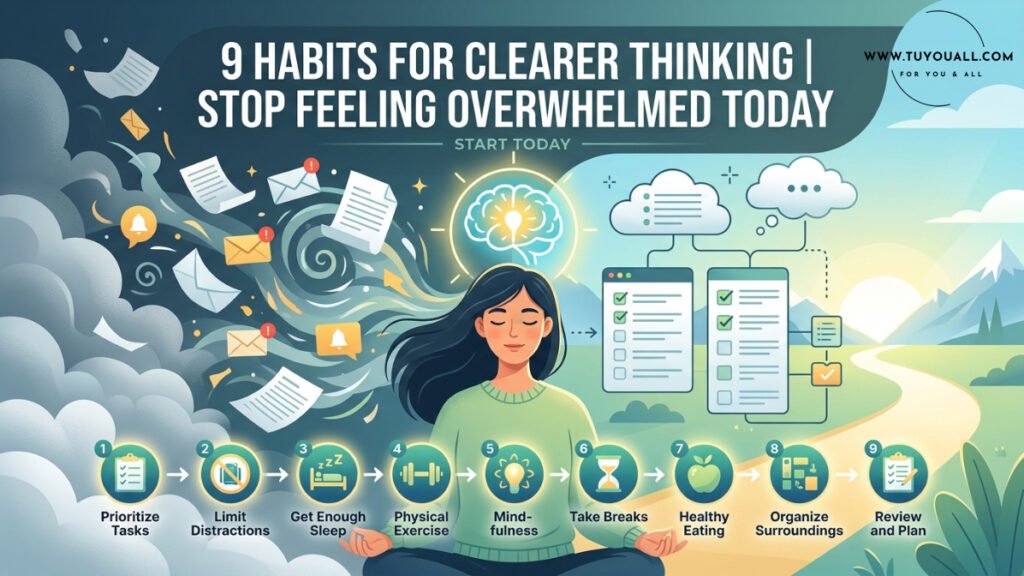
In this post, you’ll discover 9 habits for clearer thinking — five bad ones to ditch, and four powerful ones to adopt. These aren’t vague tips. They’re practical, brain-science-backed strategies that will make you a sharper decision-maker and a better problem-solver.
Let’s dive in.
Part 1: Bad Habits You Need to Stop Right Now
Bad Habit #1: Stop Cramming Your Deep Thinking
Most of us are busy. We squeeze important thinking into 5–15 minute windows between meetings, errands, or tasks.
The problem? Complex problems don’t get solved in stolen moments.
Dr. Sun noticed this in himself and in his high-performing clients. They were great at doing things — but they weren’t carving out real time to think through things deeply.
“I found that a lot of the time when there was something really complicated for me to try to think through that felt really overwhelming and really confusing it was only overwhelming and confusing because I was trying to think through it in like 5 to 15 minutes.” — Dr. Justin Sun
Practical Takeaway: Block 30–60 minutes in your evening — not every day, but whenever a pressing problem needs your attention. Sit with a pen and paper. Let your thoughts flow freely. No phone. No distractions.
This one change alone can dramatically improve how clearly you think.
Bad Habit #2: Stop Trying to Be “Right” From the Start
This one is a real game-changer.
When we face a confusing situation, our instinct is to figure out the correct answer before we say or do anything. But that pressure to be right from the start actually blocks clear thinking.
Here’s why. When there are 5 or more factors or variables to think about — and they all relate to each other in ways you don’t yet understand — your brain gets stuck. Cognitive load researchers call this multiple element interactivity. It’s not just that there’s a lot to think about. It’s that you don’t yet know how all the pieces connect.
The solution? Make a guess. Be wrong on purpose.
Clear thinkers don’t try to map everything correctly from day one. They make a rough prediction, move forward, gather feedback, and correct their thinking as they go.
For Example:
Imagine you’re trying to solve a complex business problem. Instead of waiting until you “understand everything,” sketch out your best guess of how the factors are connected. Then test that guess. You’ll quickly see where you were right — and where you need to adjust.
Each error you make narrows down your focus. Instead of juggling 5 confusing variables, you’re now fixing 1 specific mistake. That’s manageable.
Bad Habit #3: Stop Over-Consuming Information
When we feel confused, our natural reaction is: Let me learn more.
But here’s the truth — most of the time, confusion doesn’t come from lack of information. It comes from not knowing how to connect the information you already have.
If you’re already overwhelmed by 5 variables and you go read 3 more articles, you now have 10 variables to be confused about.
Practical Takeaway: The next time you feel confused and you’re tempted to Google more, stop. Instead, do Bad Habit #2’s fix — make a guess at how your current information connects. Organize what you already know before piling on more.
Bad Habit #4: Stop Keeping Everything in Your Head
Here’s a mindset shift that Dr. Sun says tripled or even quadrupled his ability to think clearly:
Stop trying to do all your thinking in your head.
Why? Because of something called working memory — the mental “workbench” where your brain processes information. Science shows you can only hold 3 to 7 things in your working memory at once.
Now think about this: if you have 5 factors to consider, and each one can connect to the others in different ways, the number of possible relationships explodes past 1,000 permutations. Your working memory maxes out instantly.
The fix is simple: Write it down. Draw it out.
“Anytime I have the thought ‘hmm, this is tricky,’ straight away I will reach for my notebook and start mapping out my thoughts.” — Dr. Justin Sun
When you put your thoughts on paper, you free up your working memory to do the real thinking — figuring out relationships and solving the problem — instead of wasting it just trying to remember your thoughts.
Here’s a simple comparison:
| Thinking In Your Head | Thinking On Paper |
| Working memory gets overloaded | Working memory stays free for analysis |
| Easy to forget key points | Nothing gets lost |
| Hard to spot patterns | Visual maps reveal connections |
| Leads to circular thinking | Enables forward progress |
Bad Habit #5: Stop Forcing Decisions
Being decisive is a great quality — but forcing a decision to avoid the discomfort of confusion is a trap.
Dr. Sun calls these ETC decisions — short for “End of Thinking Capacity.” You’ve hit the limit of what your brain wants to deal with, so you oversimplify the problem, ignore some variables, and lock in a conclusion that feels clear but is actually just… incomplete.
For Example:
You’re choosing between two job offers. One excites you more. So you focus only on salary and culture — and you conveniently ignore the commute, growth opportunities, and your gut feeling about the manager. You make a fast decision. But it’s an ETC decision.
Practical Takeaway: Whenever you arrive at a decision that feels surprisingly simple, ask yourself: “Have I genuinely thought this through — or did I just get tired of thinking?”
Part 2: Good Habits You Should Start Today
Good Habit #1: Look for “Blackbox Swans”
This is one of Dr. Sun’s most original ideas — and it’s incredibly powerful once you understand it.
A black box is any process where you know the input and the output, but you don’t really understand what happens in between.
A black swan is something unknown to you that, if you did know about it, would significantly change your decisions.
A blackbox swan is when those two overlap — a hidden factor inside an opaque process that quietly controls your outcomes.
For Example:
Dr. Sun wanted to get into ophthalmology (eye surgery). He knew he needed publications, clinical competence, and time. But the black box was the actual selection process. And the hidden black swan? The selectors heavily favored candidates they had personally met at conferences.
He would have spent all his time publishing papers — and missed the real lever entirely.
How to use this habit:
- Identify the outcome you want.
- Map the process that leads to that outcome.
- Find the parts of that process you don’t understand well.
- Dig into those specifically and ask: “What hidden factors here could change everything?”
Good Habit #2: Use a “Confusion Compass”
The next time you feel confused, don’t panic. Don’t Google. Don’t oversimplify.
Instead, ask yourself: “What am I confused about, specifically?”
Turn the emotion of confusion into a list of questions. This is what Dr. Sun calls the Confusion Compass.
Confusion isn’t your enemy. It’s a signal from your brain that says: “Hey, something needs to be figured out — and it’s in this direction.”
When you convert vague overwhelm into specific questions, two things happen:
- Your brain stops spinning in circles.
- You now have a clear research agenda — you know exactly what to go learn.
For Example:
Instead of thinking “I’m just so confused about this career change,” ask:
- “What specifically worries me about leaving my current role?”
- “What do I actually know vs. assume about the new company?”
- “What’s the worst realistic outcome, and can I survive it?”
That’s clarity. That’s actionable.
Good Habit #3: Run a Pre-Mortem
A post-mortem happens after something goes wrong — you analyze what caused the failure.
A pre-mortem flips that: before you make a decision, you assume it failed — and ask why.
This technique is powerful because it fights motivated reasoning — our tendency to focus on information that supports what we already want to do.
For Example:
You’re thinking of moving cities for a new job. You’re burned out, and this new role looks amazing. Motivated reasoning says: “The kids will adapt. The pay raise will come. The team seems great.”
Now run a pre-mortem: Assume you moved, took the job, and are miserable. Why?
Suddenly you’re thinking:
- “The kids might struggle — these are formative years.”
- “They said ‘might’ get a pay rise, not ‘will.'”
- “I only spoke with this team for 20 minutes.”
- “Am I chasing this job — or just running from burnout?”
The pre-mortem reveals options you might have missed entirely. Maybe you don’t need a new job in a new city. Maybe you just need to fix what’s burning you out right now.
Good Habit #4: Obsess Over Clarity
Before you start solving any problem, stop and ask: “Do I actually know what ‘solved’ looks like?”
Your brain is excellent at focused, coordinated thinking — but it cannot do that while also asking itself “Wait, what was the goal again?”
Clarity on your outcome is what keeps every micro-decision pointing in the right direction. Without it, you’re just busy — not effective.
This is especially important in team settings, where the goal often gets fuzzy as work gets distributed across people and meetings.
Ask these questions before you start:
- What does success look like here?
- What’s the actual outcome I’m trying to reach?
- How will I know when I’m done?
Once you have that clarity, thinking becomes much easier. Your brain stops second-guessing the destination and focuses entirely on the route.
Frequently Asked Questions (FAQ)
Q1: What is “multiple element interactivity” and why does it cause confusion?
Multiple element interactivity is a cognitive load research term. It refers to situations where you have many factors to consider — and those factors all influence each other. The more connections between variables, the harder it is for your working memory to process them, which creates the overwhelming feeling we call confusion.
Q2: How does writing things down improve thinking?
Writing externalizes your thoughts, which frees up working memory. Instead of using your mental bandwidth just to remember what you were thinking, you can now use it to analyze and connect ideas. It effectively expands your brain’s working capacity.
Q3: What is a pre-mortem and how is it different from a post-mortem?
A post-mortem analyzes a failure after it happens. A pre-mortem happens before a decision — you assume the decision will fail and ask why. It’s a proactive tool that reduces bias and helps you see potential problems before they cost you.
Q4: How do I find “blackbox swans” in my own life?
Start by identifying a goal and mapping the process that leads to it. Find the parts of that process you understand least. Then actively seek out people who’ve been through that process and ask: “What did you wish you’d known going in?” That conversation will almost always surface a blackbox swan.
Q5: Is it OK to make wrong guesses when problem-solving?
Absolutely — in fact, it’s encouraged. Making a guess gets your brain out of its loop and gives you something to test. Every wrong guess gives you focused feedback on what to correct, which is far more efficient than waiting until you’re “sure.”
9 Habits for Clearer Thinking and Improved Decision-Making
| Habit Name | Category | Description | Core Concept or Principle | Practical Takeaway | Common Mistakes to Avoid | Psychological or Cognitive Basis (Inferred) |
| Stop keeping things in your head | Bad Habits to Stop | Attempting to maintain ‘mental sharpness’ by performing all calculations and visualisations internally instead of externalising them. | Working memory is a limited ‘workbench’ with a capacity of 3-7 items. Internal connections quickly max out this capacity. | Externalise thoughts by mapping and drawing them on paper as soon as a problem feels complex or tricky. | Confusing mental sharpness with the ability to hold complex, multi-factor maps in the mind simultaneously. | Working Memory Capacity (3-7 items) |
| Stop overeating information | Bad Habits to Stop | Attempting to resolve confusion by consuming more data, books, or opinions instead of processing the information already known. | Confusion is often caused by not knowing how existing information connects, rather than a lack of information. | When confused, stop learning more; instead, digest existing variables and create a model of their connections. | Adding more variables (e.g., going from 5 to 10 things to track), which increases the ‘anatomy of confusion’. | Information Overload / Cognitive Overload |
| Stop trying to be right straight away | Bad Habits to Stop | The paralysis caused by wanting to map every variable and relationship correctly before making any conclusion or decision. | Multiple element interactivity (variables that influence each other) creates confusion; unblock the brain by making guesses. | Make predictions or guesses about how things connect and use feedback cycles to correct them later. | Focusing on being correct immediately instead of focusing on being ‘wrong quickly’ to start the feedback loop. | Multiple Element Interactivity |
| Stop cramming deep thinking | Bad Habits to Stop | Relying on short, 5-15 minute windows to solve complex problems or waiting for natural gaps in a busy schedule. | Deep thinking is a bottleneck for complex problem-solving rather than execution; it requires dedicated, predictable time. | Dedicate 30 minutes to an hour in the evening to sit with pen and paper and think through pressing problems. | Expecting clear answers to appear in tiny gaps between tasks or during high execution phases. | Cognitive Load and Attentional Shifting |
| Stop forced decisiveness | Bad Habits to Stop | Making quick decisions just to appear decisive or to escape the discomfort and mental strain of confusion. | ETC (End of Thinking Capacity) decisions occur when one arbitrarily simplifies a situation by ignoring variables due to mental exhaustion. | If a decision feels too simple for a complex problem, ask if it is an ‘ETC decision’ where you have just stopped thinking. | Valuing speed over quality in consequential decisions (e.g., career or high-value strategy). | Cognitive Closure / Heuristic Simplification |
| Start obsessing over clarity | Good Habits to Start | Ensuring the ultimate goal and win conditions are perfectly understood before beginning the thinking process. | The brain cannot coordinate complex thoughts if it is distracted by ambiguity regarding the desired outcome. | Ask: ‘Do I have clarity on what it means to solve this?’ and ‘What is the real win condition?’ before starting. | Starting a problem-solving process without knowing exactly what the ‘finish line’ looks like. | Goal-Directed Attention |
| Start using a Confusion Compass | Good Habits to Start | Treating the emotion of confusion as a signal for specific inquiry rather than an obstacle or negative state. | Confusion is intuition indicating where something needs to be figured out; turn the emotion into a cerebral focus. | Ask ‘What am I confused about specifically?’ and turn that answer into a list of targeted questions. | Treating confusion as an enemy or an emotion to be avoided by simplifying or quitting. | Metacognitive Awareness |
| Start using Pre-mortems | Good Habits to Start | Assuming a decision has already failed in the future and working backwards to find the reasons why. | Combatting bias by forcing an objective look at worst-case scenarios to de-romanticise ‘shiny’ new options. | Before a big change, ask: ‘If this goes wrong, why did it go wrong?’ to reveal hidden risks and alternative solutions. | Letting motivated reasoning ignore negative data points because you are currently unhappy with the status quo. | Motivated Reasoning / Hindsight Bias Prevention |
| Start looking for Black-Box Swans | Good Habits to Start | Identifying opaque processes (Black Boxes) that contain unknown but significant variables (Black Swans). | Understanding the hidden mechanisms through which inputs translate to outputs to find high-leverage variables. | Unpack processes you cannot explain (e.g., selection criteria) to find factors that significantly change your strategy. | Focusing only on visible inputs (like qualifications) while ignoring hidden social or systemic factors. | Mental Models and Systems Thinking |
Conclusion: Think Clearly, Decide Better
Here’s what we covered:
- Stop cramming your thinking into short windows — block real time for it.
- Stop trying to be right from the start — make guesses, get feedback, iterate.
- Stop over-consuming information — organize what you already know first.
- Stop thinking in your head — write it out, draw it out, externalize everything.
- Stop forcing decisions — an ETC decision isn’t clarity, it’s surrender.
- Start looking for blackbox swans — the hidden variables that change everything.
- Start using the confusion compass — turn emotions into specific questions.
- Start running pre-mortems — assume failure and work backwards.
- Start obsessing over clarity — know what “solved” looks like before you start.
The brain isn’t broken when it feels overwhelmed. It’s just being used in ways it wasn’t designed for. Give it the right habits — pen and paper, honest guesses, structured questions — and it will surprise you with how clearly it can think.
So here’s a question to sit with: Which of these nine habits would make the biggest difference in your life right now — and what’s the one small action you can take today to start building it?