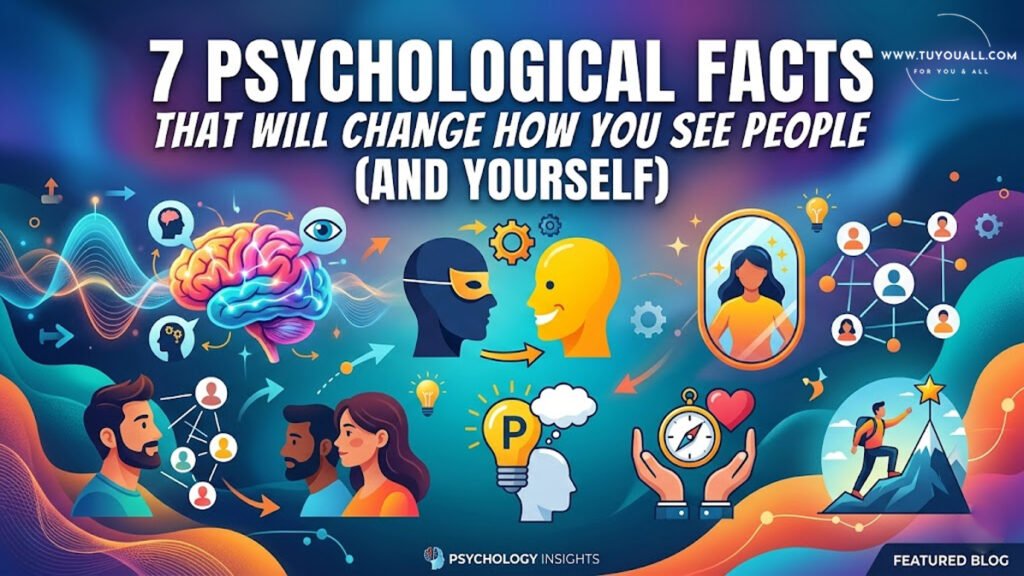
Discover Amazing Psychological Facts About Human Behavior. Learn How Music Changes Perception, Why Silence Is Powerful, And How To Build Good Habits In 66 Days.
Have you ever noticed how a sad song can instantly make you feel low, or how a fast beat pushes you to run faster at the gym?
Or maybe you’ve wondered why some people act super smart, while truly intelligent people stay quiet and humble.
The truth is, our brain plays tricks on us every single day. Scientists have done thousands of studies to understand human behavior psychology. And the best part? You don’t need a degree to use these tricks in real life.
In this article, we will explore 7 powerful psychological facts that will help you understand people better, improve your relationships, and even build healthier habits. These are simple, science-backed ideas that anyone can use.
Let’s dive in.
1. Music Changes Your Perception of Reality (More Than You Think)
We all know that music affects our mood. A happy song makes you tap your feet. A slow, sad song makes you feel emotional.
But did you know that music actually changes what you see?
The Science Behind Music and Mood
In a 2011 study, researchers gave people a simple task. They had to look at a face on a piece of paper and decide if it looked happy or sad. While doing this, the participants listened to different types of music.
The result?
- People listening to sad musicmostly saw sad faces.
- People listening to happy musicmostly saw happy faces.
This is called “expectation priming.” Your brain expects to see things that match the music you are hearing.
Real-Life Example
- At the gym:Fast, beat-heavy music pushes you to lift heavier or run faster. Your brain feels the energy.
- While studying:Soft, instrumental music (without lyrics) helps you focus because it calms your brain down.
“The type of music you listen to literally changes the lens through which you see the world.” — Psychology Study
So, next time you feel stuck in a bad mood, change the song. It’s one of the easiest psychological facts to use right now.
2. The Dunning-Kruger Effect: Why Dumb People Think They’re Smart
Have you ever met someone who acts like they know everything? They argue about topics they clearly don’t understand. They brag about their intelligence at every chance.
And have you also noticed that the truly smart people in your life are often quiet and full of doubt?
That’s not a coincidence. It has a name: the Dunning-Kruger effect.
What is the Dunning-Kruger Effect?
In 1999, two social psychologists discovered this pattern:
- Low-ability peopleoverestimate their skills. They think they are better than everyone else because they are too ignorant to know what they don’t know.
- High-ability peopleunderestimate their skills. They always feel like they could be better. They doubt themselves because they know how much there is left to learn.
How to Spot It in Daily Life
For Example: Before an exam, one friend says, “I didn’t study at all. I’m going to fail.” Then they get the highest marks. Another friend says, “That was so easy. I definitely got a perfect score.” Then they barely pass.
The first friend is likely the smarter one. They feel their own gaps in knowledge. The second friend is stuck in the Dunning-Kruger trap.
Key takeaway: If someone constantly needs to prove how smart they are, they probably aren’t that smart. True intelligence comes with humility.
3. Use Silence to Make People Talk More (The Power of Silence)
Do you struggle to keep conversations going? Do you hate awkward pauses?
Here is a counter-intuitive trick: Don’t fill the silence.
How Silence Forces Openness
Psychologists have found that when you ask someone a question and then stay quiet (while maintaining eye contact), the other person feels uncomfortable. Most people hate silence. To avoid that discomfort, they will start talking. They will share more information, reveal their feelings, or ask you questions in return.
For Example:
Imagine you ask your friend, “How was your trip?” They say, “It was fine.” Instead of jumping in with another question, you just nod and stay quiet for 5 seconds. Within those seconds, your friend will likely add, “Well… actually the flight was delayed, and then we lost our luggage…”
That extra information would have stayed hidden if you had filled the silence.
The Rule for Using Silence
- Ask one open-ended question.
- Maintain gentle eye contact.
- Count to 6 in your head if you have to.
- Watch the other person reveal more than they planned.
This is one of the most powerful psychological facts for improving your social skills.
4. How to Make Anyone Like You (Talk About Their Passion)
Want to leave a great impression on someone new?
Do not brag about yourself. Do not try to prove how smart you are.
Instead, talk about their favorite topic.
The “Learn From Them” Technique
For Example:
You meet someone who loves gardening. You might not know anything about plants. Instead of pretending you know, ask them:
- “How did you get into gardening?”
- “What is the hardest plant to grow?”
- “What is your biggest tip for a beginner?”
When you ask someone to teach you about their passion, they feel:
- Smart(because they are sharing knowledge)
- Confident(because they are the expert)
- Valued(because you care about their interests)
“When you talk, you are only repeating what you already know. But when you listen, you may learn something new.” — Dalai Lama
This trick works because everyone’s favorite sound is their own voice talking about something they love. Use this to build instant rapport.
5. The 66-Day Rule: How Long It Really Takes to Form a Habit
For years, we have been told that it takes 21 days to form a new habit. Go to the gym for 21 days, and boom — it becomes automatic.
But that is a myth.
The Real Number: 66 Days
A neuropsychological study found that on average, it takes 66 days for a new behavior to become automatic. For some people, it can take even longer — up to 254 days.
Here is how the journey usually looks:
| Phase | Days | What You Feel |
| Phase 1 | Days 1–22 | Very uncomfortable. You want to quit every day. |
| Phase 2 | Days 23–44 | Still difficult, but you are managing. |
| Phase 3 | Days 45–65 | Almost there. It feels normal now. |
| Habit Formed | Day 66+ | Automatic. Your mind and body accept the new routine. |
Why Most People Fail
People start a new habit (like waking up early or exercising) thinking they will be fine in 3 weeks. When day 22 arrives and they still struggle, they feel disappointed. They think, “Something is wrong with me.”
Nothing is wrong. They just quit too early.
Solution: Give yourself 10 weeks. If you fail on day 30, don’t restart the count. Just keep going. The path is not straight, but consistency wins.
6. Limited Choices: The Subtle Way to Influence Decisions
Do you want someone to make a decision that benefits you?
Never force them. Instead, give them limited choices that all lead to your preferred outcome.
How Restaurants Use This Trick
Have you noticed that waiters never ask, “What do you want to drink?” They ask, “Would you like Coke or Sprite?”
They don’t ask, “Do you want dessert?” They ask, “Would you like chocolate cake or ice cream?”
They are not giving you a free choice. They are giving you the illusion of choice.
For Example (Parenting): Instead of saying, “Go study now!” (which invites a “No”), say: “It’s study time. Do you want to do English first or Math first?”
The child feels in control. They pick one. But either way, they study.
For Example (Work): Instead of asking, “Can we meet on Friday?” ask, “Do you prefer a meeting at 10 AM or 3 PM on Friday?”
The other person feels respected. But the decision (a meeting on Friday) is already made by you.
Why This Works
People hate being controlled. But they love feeling like they are making their own choices. This simple trick gives them that feeling while keeping you in the driver’s seat.
7. Sunlight and Mirroring: Two Simple Body Hacks
Let’s end with two super simple but powerful hacks.
A. The Power of Sunlight on Your Mood
Have you noticed you feel better after stepping outside?
Sunlight is not just for vitamin D. Research shows that sunlight helps prevent depression and stabilizes your mood. It increases the production of feel-good hormones in your brain.
Countries with less sunlight (especially during winter) have higher rates of depression.
Your action step: Try to get just 10 minutes of direct sunlight every day. Morning sunlight is the best. It can completely change your energy levels and mental health.
B. Mirroring Body Language to Build Trust
This is a classic psychological fact used by negotiators and salespeople.
If you subtly copy someone’s body language, they will start to like you more. If they lean forward, you lean forward. If they speak slowly, you speak slowly. If they use certain words (like “awesome” or “amazing”), you use those same words.
For Example:
Your friend says, “This movie is absolutely fantastic!” You reply, “I agree, it’s absolutely fantastic.” You just mirrored their words. They will unconsciously feel a bond with you.
This is called the chameleon effect. When you act like someone, they feel safe and comfortable around you. They think, “This person is just like me.”
Psychological Facts and Life Application Tips
| Psychological Fact/Concept | Description | Practical Application | Expected Benefit |
| The Chameleon Effect | Mirroring the body language and verbal patterns of another person builds subconscious rapport and trust. | Subtly copy the expressions, gestures, and specific words frequently used by the person you are talking to. | Instant trust, increased likability, and making the other person feel more identified with you. |
| The Name Effect | Hearing one’s own name is the most pleasing sound to an individual and makes them feel important. | Use the other person’s name frequently during a conversation. | Increased likability and making the other person feel more comfortable and valued. |
| Providing a Choice (Illusion of Control) | Giving people specific options makes them feel they are in control of the decision, even if the options are curated by you. | Instead of a general command, offer two specific choices that both lead to the desired outcome (e.g., ‘English or Maths first?’). | Easier compliance and reduced resistance from others. |
| Power of Silence | People feel uncomfortable with silence in conversations and will often volunteer information to fill the gap. | Ask a question and maintain eye contact without speaking, even after the other person finishes their initial answer. | Encourages others to open up and share more detailed information or feelings. |
| Learning Term (Pratfall/Humility approach) | Acting as if you have less knowledge and asking to learn from someone makes them feel smart and valued. | Discuss a topic the other person loves and ask them to explain things to you, even if you already know about it. | Builds a positive impression and makes the other person more interested in the interaction. |
| The Snackman Effect (Eating as a Pacifier) | Eating is perceived as a non-threatening, calming activity that makes people around the eater feel more comfortable. | If a conflict or aggressive argument is brewing, sit near the person and offer them food or start eating yourself. | Defusal of aggression and reduction in the likelihood of physical or verbal conflict. |
| Singing to Reduce Anxiety | Singing releases endorphins and oxytocin, which lowers cortisol levels and heart rate. | Sing your favourite song out loud when feeling nervous or before an important presentation. | Reduced stress levels, lower heart rate, and increased confidence. |
| The Power of Sunlight | Sunlight triggers Vitamin D production which acts as a mood stabiliser and produces pleasurable hormones in the brain. | Spend at least 10 minutes in direct sunlight daily, preferably in the morning. | Prevention of mood disorders like depression and an instant improvement in mood. |
| Music Change in Perception | The brain aligns visual perception with the mood of the music being heard, known as perceptual expectation. | Listen to high-energy music during workouts and soft music when tasks require deep focus. | Improved focus and enhanced physical performance during exercise. |
| Multitasking Myth | The brain cannot focus on two tasks at once; it actually switches focus rapidly between tasks, leading to inefficiency. | Avoid trying to perform two focus-heavy tasks (like reading and watching TV) simultaneously. | Increased productivity and higher quality of work by focusing on one task at a time. |
| Habit Formation Timeline | Neuropsychological research suggests it takes approximately 66 days, not 21, to successfully form or break a habit. | Commit to a new routine for at least 66 days, pushing through the initial discomfort of the first 44 days. | Successful long-term habit integration into your mind and body. |
| Dunning-Kruger Effect | Highly intelligent people often underestimate their abilities and doubt their knowledge, while those with average intelligence tend to overestimate their superiority. | Be aware that true experts often show humility and doubt; do not be intimidated by those who over-confidently claim to be the smartest. | Better assessment of others’ actual intelligence and competence. |
Frequently Asked Questions (FAQs)
- What is the most interesting psychological fact about human behavior?
One of the most interesting facts is the Dunning-Kruger effect — the idea that less intelligent people often overestimate their abilities, while truly smart people doubt themselves.
- How can I use psychology to become more likable?
Use two simple tricks: 1) Say the other person’s name during conversation (people love hearing their own name). 2) Mirror their body language and words to build subconscious trust.
- Can silence really help in a conversation?
Yes. When you ask a question and stay silent, the other person feels uncomfortable. To fill that silence, they often reveal more honest information or keep the conversation going.
- Is multitasking real?
No. Your brain can only focus on one thing at a time. When you think you are multitasking, your brain is actually switching tasks very quickly. This reduces your efficiency and increases mistakes.
- How long does it realistically take to form a new habit?
According to research, it takes about 66 days on average. It can take longer for complex habits. Ignore the 21-day myth and give yourself at least 10 weeks.
Conclusion: Small Changes, Big Results
Psychology isn’t just for therapists or scientists. It is a tool for daily life.
Let’s quickly recap the 7 powerful psychological facts we learned:
- Music changes your perception— use happy music to boost your mood and focus.
- The Dunning-Kruger effect— humble people are often the smartest in the room.
- Silence is powerful— stay quiet after a question to get more honest answers.
- Talk about their passion— make people like you by asking them to teach you.
- 66 days to form a habit— don’t quit after 21 days; real change takes time.
- Limited choices— influence decisions by offering options that all work for you.
- Sunlight and mirroring— 10 minutes of sun and copying body language can transform your mood and relationships.
Which of these facts surprised you the most? Will you try the “power of silence” in your next conversation?
Start with just one trick today. Observe how people react. You might be shocked at how well the human mind follows these hidden rules.