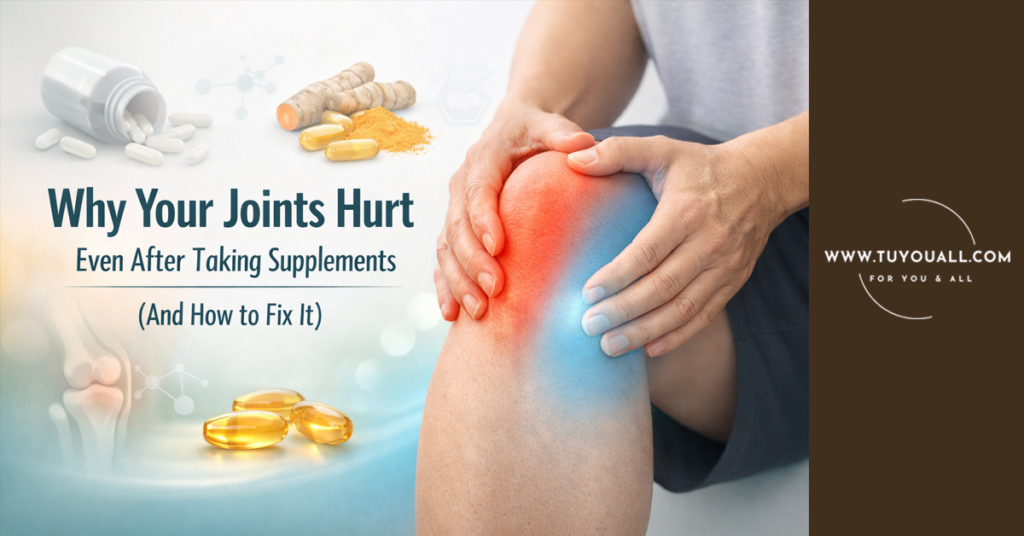
Discover why arthritis is hitting people in their 40s and how to protect your joints. A Joint Health Guide from Dr. Vijay Bose, surgeon with 6,000 knee replacements.
Have you noticed your parents or even friends in their 40s complaining about knee pain that “wasn’t supposed to happen until old age”? You’re not imagining it. Joint health is declining at alarming rates among younger Indians, and your office chair might be partly to blame.
Dr. Pal recently sat down with Dr. Vijay Bose, a renowned orthopedic surgeon at SIMS Hospital, Chennai, who has performed nearly 6,000 knee replacements over his 25-year career. What he revealed shocked Mr. Pal : “When I started practicing 25 years ago, our average patient was around 70 years old. It became 65, then 60. Now it’s 55. We’ve even done knee replacements on patients younger than 50.”
If you want to keep your joints healthy for life—or help an aging parent navigate treatment options—this guide breaks down everything you need to know, from preventing early arthritis to understanding when surgery is actually necessary.
The Shocking Truth: Why Osteoarthritis Is Hitting People Earlier Than Ever
Dr. Bose didn’t mince words: “Like diabetes or hypertension, arthritis is coming down to younger ages quite significantly.” But why?
The Genetic Factor You Can’t Ignore
Here’s something fascinating Dr. Bose noticed in his practice: Your surname might predict your joint health. “People from certain parts of India have much higher rates of osteoarthritis. Telugu people from Andhra Pradesh, Gujarati-speaking communities, and Punjabis show very high incidence rates,” he explained.
In Mumbai, most of his patients are Gujarati. In Chennai, they’re Telugu-speaking. In Delhi, they’re Punjabi. While diet and lifestyle play roles, Dr. Bose confirms there’s likely a strong genetic component at play.
The Lifestyle Epidemic: Sitting Is the New Smoking
The bigger culprit we can control? Our modern lifestyle. Dr. Bose explains that our knees naturally degenerate over time—if you lived to 120, you’d definitely have arthritis. But the problem is premature degeneration at 45 or 50.
Three major accelerators:
- Obesity: Every extra kilogram puts disproportionate pressure on knee joints
- Sedentary habits: IT professionals sitting 10-12 hours daily suffer “negative adaptation” where muscles and ligaments adapt to bad posture
- Lack of maintenance: “We have a maintenance man for our car and computer, but we think our body will just take care of itself,” Dr. Bose noted
“We were never meant to sit. Only in the last few decades have we been sitting like this. Our body is not made for that.” — Dr. Vijay Bose
When Surgery Becomes Necessary: Inside Modern Knee Replacement
If your parent is struggling with severe knee pain, you might wonder when it’s time to consider surgery. Dr. Bose clarified that knee replacement isn’t the first line of treatment, but when it’s needed, modern techniques have evolved dramatically.
What Actually Happens During Recovery?
Forget the image of months in bed. Today’s procedures are sleek and elegant:
| Recovery Milestone | Timeline | What It Means |
| Surgery Day | Morning | Procedure completed |
| First Steps | Same evening | Patient starts walking with assistance |
| Stair Climbing | Day 2 | Physiotherapy includes stairs |
| Going Home | Day 3 | Discharged with walking aid |
| Independent Walking | Week 1 | Using a stick (not walker) for short distances |
| Normal Activities | 3-4 weeks | Can go outside, light household work |
| Stick-Free | 3-4 weeks | Most patients ditch the walking aid |
Key insight: There’s no need to be bedridden. Patients can bathe themselves, watch TV, and move to the bathroom independently from day one. The body heals through movement, not immobilization.
The Supplement Trap: Are You Overdosing on Calcium and Vitamin D?
Here’s where Dr. Bose got passionate—and you might need to rethink your medicine cabinet.
The Calcium Conundrum
“During COVID, all doctors were taking vitamin C by the truckload, thinking immunity would go up,” Dr. Bose recalled. “But only take supplements when you’re deficient. Once you cross that line, serious problems occur.”
The dangers of excess calcium:
- Cardiac disease
- Intestinal problems
- Kidney stones
Dr. Bose always checks blood work before recommending calcium. “The general concept that ‘more is good’ is really surprising—even among doctors,” he warned.
Vitamin D: Vitamin or Hormone?
Vitamin D is controversial because labs often don’t print “normal” ranges on reports—it’s that debated. Here’s what you need to know:
- Below 30 ng/mL: Supplement to reach 30 (critical for bone health)
- Above 30 ng/mL: Supports metabolic health, cardiac health, and immune function
- The new understanding: Vitamin D is now classified as a hormone, not just a vitamin, because it impacts every organ system
For example, if you’re taking high-dose vitamin D “just to be safe” but already have levels of 40 or 50, you might be causing more harm than good. Always test first.
Barefoot vs. Ortho Shoes: What Your Feet Really Need
I asked Dr. Bose about ortho shoes—those expensive custom insoles and “foot-friendly” footwear. His answer was surprising.
Custom orthotics
(computer-modeled insoles made specifically for your foot) do help people with existing pain or foot problems. Generic silicone soft soles can provide temporary relief for tender spots.
But for healthy people? “I wouldn’t advise normal people to use them,” Dr. Bose said. “The best form of footwear is actually barefoot.”
Why? Because supportive shoes do the work your foot muscles should be doing. Use it or lose it—if your shoes constantly support your arches, your muscles weaken, making you dependent on external support.
“If you do more and more of what your footwear should be doing, you’ll lose the ability to do it yourself. I advise walking barefoot.” — Dr. Vijay Bose
The Best Sport for Lifelong Joint Health (According to Data)
If you’re choosing a sport for your child—or yourself—which one protects joints best long-term? I played “this or that” with Dr. Bose:
| Sport Choice | Winner | Why |
| Cricket vs. Tennis | Tennis | Better overall conditioning |
| Tennis vs. Swimming | Tennis | Swimming is “monochromatic”—only cardio, no strength training |
| Tennis vs. Basketball | Tie | Both good, but tennis edges out for sustainability |
| Tennis vs. Table Tennis | Tennis | More movement, burst energy required |
| Tennis vs. Badminton | Tie | Both excellent outdoor options |
Why tennis wins: It provides the holy grail of fitness—burst energy (anaerobic) mixed with sustained movement (aerobic), plus lateral movements that strengthen stabilizer muscles. It mimics real-world physical demands better than linear activities like running or swimming.
Pro tip: Even marathon runners now do “cross-training” (weight lifting and other sports) because doing only one activity creates imbalances. Tennis naturally incorporates this variety.
Ankle Sprains and Back Pain: When to Worry (And When to Rest)
The Ankle Sprain Reality Check
Ankle sprains are common, but Dr. Bose warned about the “missed bus” phenomenon. If you have significant swelling, you may have damaged the ATF ligament (anterior talofibular ligament).
Critical window: Ligaments have a 3-4 week healing potential. If you skip proper treatment (like a plaster cast when needed) and try to “walk it off,” after 3 months you may develop chronic ankle instability. At that point, even 6 months in a cast won’t fix it—you’ve missed the bus.
The RICE method (Rest, Ice, Compression, Elevation) works for minor sprains with minimal swelling. But if there’s significant swelling, see a doctor immediately to rule out ligament tears.
Why Your Lower Back Hurts (Hint: It’s Your Chair)
The most common problem among youngsters? Lower back pain. Dr. Bose sees endless IT professionals who sit 10-12 hours daily.
The mechanism: Your body undergoes “negative adaptation.” Muscles and ligaments permanently adjust to your slumped posture, creating chronic strain.
The fix isn’t just “sit straight.” You need:
- Core strengthening exercises
- Spine-strengthening routines
- Neck mobility work
- Regular movement breaks
“Sitting is the new smoking. Walking is a natural activity—sitting is not.” — Dr. Vijay Bose
The Dangerous Rise of Alternative “Cures”
Dr. Bose expressed grave concern about patients choosing unscientific treatments over medical care.
The Chiropractic Warning
Those dramatic “neck cracking” videos popular on YouTube? “I’ve seen patients who have become paraplegic or quadriplegic after neck manipulation,” Dr. Bose stated. “They cannot move their arms or legs because the neck houses nerves controlling everything.”
Without understanding anatomy deeply, these manipulations can cause permanent paralysis.
The Elastic Bandage Myth (Puttu)
In South India, traditional “bandage doctors” (Puttu Vaidyars) wrap sprains tightly with elastic bandages. While patients sometimes feel temporary relief, Dr. Bose sees daily complications: constricted blood supply causing nerve damage and limb dysfunction.
The real question: Why do educated people—PhDs, celebrities, industrialists—queue up for these unscientific treatments when MRI-equipped hospitals exist?
Dr. Bose believes modern medicine has failed patients in one critical way: trust. “We have to introspect as physicians. We have lost the confidence of patients. They think, ‘If I go to the hospital, they’ll extract a lot of money with unnecessary tests.'”
The solution? Ethical, patient-first care where the focus is “getting the patient all right” rather than maximizing billing.
A Surgeon’s Personal Fitness Blueprint
How does a joint specialist keep his own body maintained? Dr. Bose follows a strict four-dimensional exercise approach:
Weekly Routine:
- Tennis: 3-4 times per week (cardio + burst energy + lateral movement)
- Gym: Weight training after tennis (strength maintenance)
- Daily Mobility: 10-minute morning flexibility routine (calisthenics and yoga-inspired movements)
- Incremental Loading: Constantly increasing difficulty—”If you’ve been walking 2 km daily for five years, year one was good, year two was okay, years three through five gave you only psychological benefit. You must keep increasing load.”
His learning method: YouTube tutorials for specific moves (like crow pose or proper pull-ups), practiced daily until mastery.
Frequently Asked Questions
Q: At what age is knee replacement typically needed?
A: Traditionally 70+, but now commonly 55-60 due to lifestyle factors. Genetics and obesity can push this even earlier.
Q: Is walking barefoot actually good for knee health?
A: Yes, for healthy individuals. It strengthens foot muscles that supportive shoes weaken. However, those with existing foot pain or deformities may benefit from custom orthotics.
Q: How do I know if my ankle sprain needs a doctor?
A: Significant swelling indicates possible ligament damage. If swelling is minimal, try RICE (Rest, Ice, Compression, Elevation). If swelling is substantial, see a doctor within days—the healing window closes after 3-4 weeks.
Q: Can obesity cause knee pain without any injury?
A: Absolutely. Excess weight accelerates natural degeneration and can cause premature osteoarthritis even without traumatic injury.
Q: Are calcium and vitamin D supplements safe for everyone?
A: No. Only take these if blood tests confirm deficiency. Excess calcium can cause kidney stones and heart issues, while unnecessary vitamin D supplementation disrupts metabolic balance.
Conclusion: Your Body Needs a Maintenance Manual
Dr. Bose and his classmates from Metas Medical College literally wrote the book on this—Universal Health Code—because they realized humans get user manuals for cars and phones, but not for their own bodies.
The takeaway? Your joints aren’t wearing out; they’re crying out for maintenance. Move daily, sit less, test before supplementing, and choose sports that build full-body resilience over single-movement specialization.
If you or a parent are facing joint issues, remember: ethical medical care focused on your wellbeing (not your wallet) still exists. Don’t let fear drive you toward dangerous alternatives.