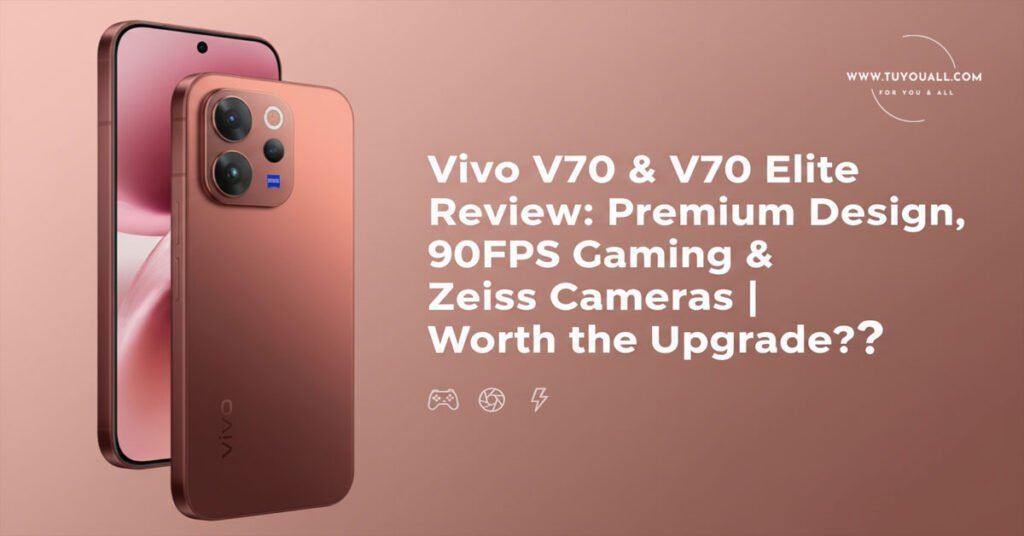
This blog post is based on insights from the YouTube video Title ” Vivo V70 & V70 Elite Unboxing and Review” by Mr. Manoj Saru .
If you’ve been holding off on upgrading your phone because nothing felt “just right,” Vivo might have finally cracked the code. The Vivo V70 series just landed in India, and after spending hands-on time with both the Vivo V70 and V70 Elite, one thing is crystal clear: Vivo actually listened to its users this time.
Remember all those complaints about curved screens, slow storage, and plastic builds? Gone. The V70 series feels like a direct response to every piece of feedback the company received. But does it live up to the hype? Let’s unbox, test, and break down everything you need to know.
What’s Inside the Box?
Before we dive into the phones, here’s what you get:
- The Vivo V70 or V70 Elite handset
- A transparent TPU case (surprisingly decent quality)
- 90W Flash Charger (yes, it’s as big as it sounds)
- USB Type-C to Type-C cable
- SIM ejector tool and quick guides
“V ka hum V kar denge, aur M ka M” — the creator jokes about the box design, which features Zeiss co-engineering branding and “Powered by OriginOS” labeling.
Design & Build: Finally, Premium Feels Premium
The Metal Frame Difference
The moment you pick up either the V70 or V70 Elite, something feels different. Really different.
Gone is the plastic frame from the V60 series. Both phones now feature a premium metal frame that instantly elevates the in-hand feel. As the creator notes: “Bhai sahab, aatma tript ho gayi yaar” (My soul feels satisfied, brother) — and honestly, we get it.
Key Design Changes:
- Flat 1.5K AMOLED display (goodbye, curved screen!)
- Square camera module (replaced the vertical layout)
- Slight camera bump (minimal but present)
- Glass back with matte finish (soft-touch, premium feel)
- IP68/IP69 certification (water and dust resistant)
Weight & Dimensions
Despite the premium materials, Vivo kept things surprisingly manageable:
| Feature | Vivo V70 | Vivo V70 Elite |
| Weight | 196g | 196g |
| Thickness | ~7.6mm | ~7.6mm |
| Screen Size | 6.59″ | 6.59″ |
| Frame Material | Metal | Metal |
| Back Material | Glass (Matte) | Glass (Matte) |
“I thought it would be heavier, but it’s under 200 grams” — the creator admits, surprised by the lightweight feel despite the metal-and-glass construction.
Available Colors: Passion Red, Beach (likely a beige/gold), and Black.
Display: Flat is the New Premium
Here’s where Vivo deserves a standing ovation. They finally ditched the curved display trend that nobody asked for.
The Big Upgrades:
- Resolution jump: Full HD to 5K (higher pixel density)
- Flat screen: No more accidental touches or distorted edges
- 120Hz refresh rate: Smooth scrolling guaranteed
- HDR certification: YouTube plays in 2160p with HDR support
- 5000 nits peak brightness: Indoor or outdoor, visibility is superb
“Vivo ko iske liye ek big thumbs up — flat screen lane ka bahut hi smart move hai” (A big thumbs up to Vivo for this smart move of bringing a flat screen).
The display features symmetrical bezels on all sides — even the chin is minimal. Colors are vibrant, blacks are deep (thanks to AMOLED), and the overall multimedia experience feels genuinely flagship-grade.
Creator’s Question to You: “Do you prefer flat screens or curved screens? Comment below!”
Performance & Gaming: Snapdragon Power Unleashed
This is where the V70 series truly distances itself from its predecessor. Vivo addressed the biggest complaint about the V60 — slow UFS 2.2 storage — by jumping straight to UFS 4.1.
Chipset Comparison:
| Model | Processor | Storage | RAM |
| Vivo V70 | Snapdragon 7s Gen 4 | UFS 4.1 | LPDDR5X |
| Vivo V70 Elite | Snapdragon 8s Gen 3 | UFS 4.1 | LPDDR5X |
Gaming Test Results (BGMI/PUBG):
Vivo V70 Elite:
- Graphics: HD, HDR, Ultra HD available
- Frame Rate: 90fps in Smooth + Extreme Plus mode
- Average FPS: 88.3fps (stable)
- Temperature: 35.9°C after extended gaming
Vivo V70:
- Graphics: Similar options
- Frame Rate: 60fps max (Smooth + Extreme Max)
Benchmark Scores:
| Test | V70 Elite Score | Stability |
| AnTuTu | 1.7+ Million | Excellent |
| CPU Throttle | 76% (Green graph) | Decent |
| Wildlife Extreme Stress | 79.2% stability | Very Good |
| Storage Speed | Significantly faster | UFS 4.1 advantage |
Key Gaming Features:
- Game Mode: Boost performance, lock touch response
- Hardware-accelerated ray tracing: More realistic reflections and shadows
- Gyroscope sensor: Responsive and accurate
“Last time, many people complained about UFS 2.2 storage type. This time, they removed it and brought UFS 4.1 directly” — addressing user feedback head-on.
Camera System: Zeiss-Tuned Excellence
The V-series has always been about photography, and while the hardware looks similar to the V60, software optimization makes the difference.
Camera Specs (Both Models):
| Lens | Specification | Sensor |
| Main Camera | 50MP Zeiss OIS | Sony LYT-700V |
| Telephoto | 50MP Zeiss Night Telephoto | Sony IMX882 |
| Ultra-wide | 8MP Zeiss Ultra Wide | – |
| Front Camera | 50MP Zeiss Selfie | – |
Photography Modes:
Portrait Mode Options:
- 23mm (standard)
- 35mm (environmental)
- 50mm (classic)
- 85mm (short telephoto)
- 100mm (compressed)
Key Improvements:
- Better low-light performance (especially telephoto)
- Refined skin tones (more natural, less processed)
- Improved HDR (better highlight/shadow balance)
- 4K 60fps video with stabilization (front and rear)
- Zoom while recording: 1x to 3x in 4K video
Special Features:
- Zeiss Mode: Signature Zeiss color science
- Micro Movie Mode: Portrait, Casual, Food, Travel Vlog presets
- AI Holi Portrait: India-exclusive feature for festive photography
- AI Reflection Remover: Clean up unwanted reflections
- Object Remover: Photoshop-like editing built-in
Real-World Example: The creator demonstrates that with slight photography skills — adjusting white balance, using proper lighting — you can capture DSLR-like photos. Sample shots show impressive dynamic range and natural bokeh.
“If you know a little bit of photography skills, you can click amazing DSLR-like photos from this” — emphasizing the camera’s potential in skilled hands.
Battery & Charging: All-Day Power
| Feature | Specification |
| Battery Capacity | 5,500 mAh (both models) |
| Charging Speed | 90W Flash Charge |
| Charger Included | Yes (in-box) |
Both phones pack the same battery as the previous generation, but more efficient chipsets should translate to better real-world endurance.
Software & Features: OriginOS 6
- Operating System: Android 16-based OriginOS 6
- Update Promise: 4 years OS updates, 6 years security updates
- Pre-installed Apps: Minimal bloat (PhonePe, Netflix — generally useful apps)
- AI Features: Google Gemini integration, Circle to Search, AI Reflection Removal, Object Remover
Connectivity:
- Bluetooth 5.4
- Wi-Fi 7 (Dual-band)
- USB 2.0
- NFC support
- 11 5G bands
Durability: Built to Last
Both phones feature:
- IP68/IP69 certification: Survive water submersion and high-pressure jets
- Schott Xensation Alpha protection: Display glass protection
- Metal frame: Better drop resistance than plastic
Drop Test: The creator performed a drop test from shoulder height — “Bhai, bach gaye!” (Brother, it survived!) — with no visible damage.
Pricing & Value
| Model | Expected Starting Price |
| Vivo V70 | ₹45,000 – ₹46,000 |
| Vivo V70 Elite | ₹50,000 – ₹55,000 |
Pricing has increased compared to previous generations, following industry trends across all smartphone brands.
FAQ: Your Questions Answered
Is the Vivo V70 series worth upgrading from V60?
Yes, if you want a flat screen, better performance, faster storage, and a more premium build. The camera improvements are incremental but noticeable in low light.
Which one should I buy — V70 or V70 Elite?
Choose V70 Elite for: 90fps gaming, Snapdragon 8s Gen 3 power, and maximum future-proofing. Choose V70 for: Better value, solid 60fps gaming, and identical camera/display experience.
Does the flat screen really make a difference?
Absolutely. No more accidental touches, easier screen protector application, and better durability against drops.
How’s the low-light camera performance?
Significantly improved, especially the telephoto lens. Night mode shots show better detail and less noise than the V60.
Is UFS 4.1 storage actually faster?
Yes — app launches are quicker, game loading times are reduced, and multitasking feels snappier compared to UFS 2.2.
Final Verdict: The Refined Flagship Experience
After extensive testing — both on-camera and off-camera — the creator’s conclusion is clear: “Vivo V70 series feels like a refined version of the V60.”
What Vivo Fixed:
✅ Curved screen → Flat 1.5K display
✅ Plastic frame → Premium metal build
✅ UFS 2.2 storage → UFS 4.1
✅ 60fps gaming limit → 90fps capability (Elite)
✅ Durability concerns → IP68/IP69 + metal frame
What Stayed Similar:
- Camera hardware (but improved via software)
- Battery capacity
- Overall design philosophy
“This time, the V-series has been very well-liked, especially the Vivo V70 Elite” — the creator’s personal favorite.
The V70 series isn’t a revolution; it’s an evolution that matters. Vivo took every legitimate complaint about the V60 and systematically eliminated it. The result? A phone that feels genuinely complete.
Would you pick the V70 or the V70 Elite? Or does another phone in this price range catch your eye? Drop your thoughts in the comments below!
Source & Credit
This blog post is based on insights from the YouTube video Title ” Vivo V70 & V70 Elite Unboxing and Review” by Mr. Manoj Saru .
The original content has been translated, expanded, and repurposed for educational purposes.