This blog post is based on insights from Harshvarrdhan Jain‘s YouTube video: “Six Well Money Management Method” .
Have you ever wondered why your bank account feels like a sieve? No matter how much you earn—₹10,000 or ₹10 lakhs—the money seems to vanish before the month ends. If making more money was the real solution, why do so many high-earners still struggle to pay their bills?
The truth is uncomfortable but simple: Wealth isn’t about how much you make; it’s about how much you keep. Financial educator Harshvarrdhan Jain argues that most people are walking around with a “leaking pipeline” in their finances, bleeding money drop by drop until they’re left with nothing but stress. But there’s a way to plug those leaks permanently—even if you’re starting with just one rupee.
Why Your Money Keeps Disappearing (The Leaking Pipeline Effect)
Imagine a city where it rains every single day, yet there’s a severe water shortage. This actually happened in England. When the government investigated, they discovered thousands of holes in the city’s pipeline. Water was flowing in constantly, but it was leaking out even faster.
“Your wealth will end if you have holes in your pipeline,” Jain explains. “You should also fix the leakages of your life.”
For most people, the biggest hole in their financial pipeline isn’t shopping or dining out—it’s the credit card.
The “Borrowed Life” Trap
Jain doesn’t mince words about plastic money: “Credit cards are used by poor people on earth.” He challenges the common defense that “if you use it right, it’s profitable.”
Listen carefully to his warning: “If a sentence has ‘if’ in its beginning, it means that work is not in your control. If we are masters in financial management, then we don’t add credit cards with the ‘if’ word.”
He calls credit card usage a “borrowed life”—a lifestyle funded by money that isn’t yours. When you live on borrowed money, you create a psychological dependency that eventually leads to default. “People all over the world who use credit cards become poor,” he states. “There is no habit of buying assets in life. We don’t understand investment… Then one day we become defaulters.”
Even if you consider yourself the exception—the disciplined person who pays off the card monthly—Jain urges you to look at the bigger picture. India’s national development has relied heavily on credit, creating a cycle where we pay over ₹83,000 crores in interest every month to institutions like the World Bank. “The day when the foundation of development of credit is removed, everything will fall,” he warns.
The Six-Well Method: Your Path to Financial Freedom
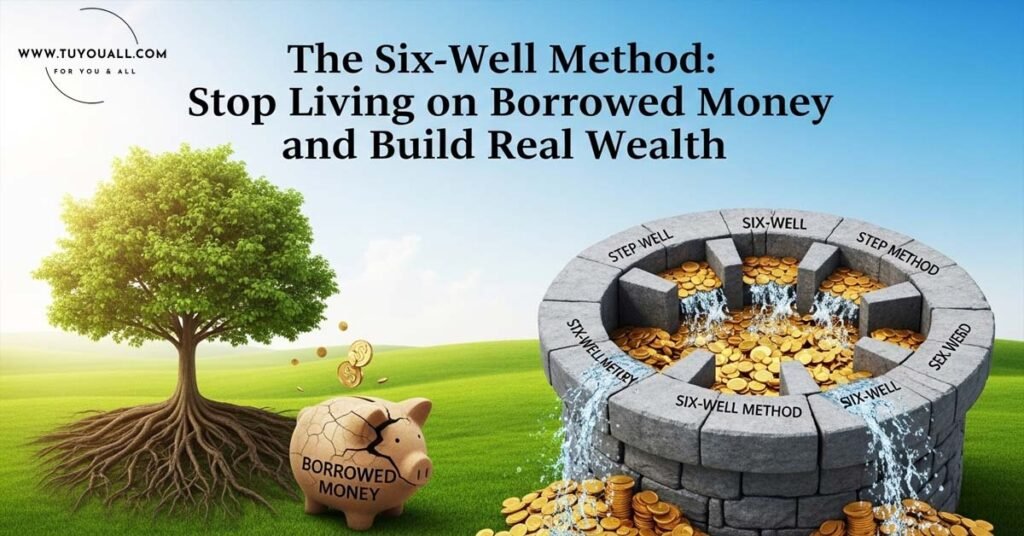
If credit cards create leakages, what creates wealth? Jain proposes a radical yet ancient solution: digging six wells instead of one.
The metaphor is powerful. If you dig one well, you might find water. But if you dig six wells, you create a “thirst” in the universe that attracts abundance from multiple sources. This isn’t mystical thinking—it’s psychological programming. By segregating your money into six distinct purposes, you train your subconscious mind to respect, attract, and retain wealth.
Here’s how the six-account system works, whether you earn ₹10,000 or ₹10 lakhs:
| Account Purpose | Percentage | Example (₹20,000 income) | Purpose |
| Needs/Expenses | 50% | ₹10,000 | Daily living, rent, food, bills |
| Investment | 10% | ₹2,000 | Future wealth building (don’t touch!) |
| Savings | 10% | ₹2,000 | Emergency cushion, liquid security |
| Education | 10% | ₹2,000 | Courses, books, skill development |
| Play/Entertainment | 10% | ₹2,000 | Sports, movies, fun—guilt-free spending |
| Charity | 10% | ₹2,000 | Giving back, sowing seeds of abundance |
Important: You don’t need six different bank accounts immediately (though that helps). You need six mental buckets. If you only have one account, use a notebook or spreadsheet to track the division. The key is the psychological separation of these funds.
The 50% Rule: Surviving on Half
The hardest pill to swallow? Living on half your income. Jain acknowledges this sounds impossible. “When this lesson was narrated in India, 100 crore people said, ‘Brother, will you make me die? Fifty percent is far away; even my earnings are not sufficient to cover my expenses.'”
But here’s the revolutionary part: Even if you’re earning ₹10,000 and spending ₹11,000, you can start this system.
How? By borrowing smartly for one month. Take a ₹100 loan (yes, just one hundred rupees). Put ₹50 in your expense account, and distribute the remaining ₹50 across your other five wells (₹10 each). Do this for 21 months. Jain promises: “After 21 months, see if your life doesn’t change, then spit on my face. Life will be changed, whole life will change.”
Why? Because you’re no longer living a “borrowed life” of consumption. You’re borrowing temporarily to build a system of wealth.
Why Charity Is Non-Negotiable
You might wonder why giving away 10% is essential when you’re trying to save. Jain explains: “Charity means sowing seeds in life. We get many times as much as we donate.”
If any well goes thirsty—even the charity well—it creates an imbalance that can destroy your other five wells. This isn’t just spiritual advice; it’s practical psychology. Generosity signals to your brain that you have enough, shifting you from a scarcity mindset to an abundance mindset.
Starting Small: The ₹1 Piggy Bank Secret
Before you worry about the six-well system, Jain asks you to do something that sounds almost childish: Get a piggy bank.
“Start acting like small boys, stupid,” he says with a smile. “Tomorrow morning, take a piggy bank that your kids have. Whether you put five paise or ₹1 only, but put it in.”
Why such a small step? Because habits build identity.
When you drop even one rupee into that piggy bank daily, you’re doing something profound. You’re telling your subconscious mind: “I am a saver. I am a wealth-builder.” Jain explains the neuroscience: “You are selecting the file of wealth every day. Where the attention goes, the energy will flow there.”
After a few days, you become a “magnet” for wealth opportunities. “As soon as the energy of money is created, a hundred times as much power you have will come. Seeing ₹2 lakh or ₹10 thousand, it will look like it is not a big deal. We will do it, man. No tensions.”
For example, if you put just ₹10 daily into your piggy bank, within a month you’ll have ₹300. Within a year, ₹3,650. But the money isn’t the point—the habit is. That daily ritual reprograms your brain to stop leaking money and start attracting it.
From Working for Money to Money Working for You
Jain shares a painful observation about his country: “The biggest misfortune of this country is that till today, this lesson has been taught: how to work for money. America has always taught: how to make money work for you.”
The six-well system is the bridge between these two worlds. When you automatically divert 10% to investments before paying bills, you prioritize your future self. When you earmark 10% for education, you’re increasing your earning capacity. When you save 10%, you’re buying peace of mind.
“Dig these six wells, one day money will work for you,” Jain promises.
This system also creates a legacy. Jain’s father followed this method, allowing him to tell his children: “My father has donated this. My father has invested this. My father has done this for education.” You pass on the education of wealth, not just the wealth itself.
Frequently Asked Questions
Q.1. What if my expenses are higher than my income? Can I still use the six-well method?
Absolutely. Jain specifically designed this for people in debt. Start by borrowing a tiny amount (even ₹100) to fund all six wells for one month. The psychological shift of “paying yourself first” will help you reduce wasteful spending naturally. Within 21 months, you should see dramatic changes in your financial situation.
Q.2. Can I use credit cards for online purchases or emergencies?
Jain admits there are exceptions—like buying software from international vendors where debit cards don’t work. However, he hasn’t used a credit card personally in 18 years. If you must use one, treat it like a debit card: pay it off immediately from your Expense account, and never carry a balance. Remember: “Credit means borrowing. Borrowed life creates poverty.”
Q.3. Do I need to open six different bank accounts?
Not immediately, though it helps prevent “accidental spending.” You can start with one account and track the divisions in a notebook or spreadsheet. The critical part is treating each portion as “untouchable” for its designated purpose. Eventually, separate accounts make this automatic.
Q.4. How long before I see real results?
Jain promises visible changes in 21 months if you’re consistent. However, the psychological shift happens much sooner—within weeks. You’ll feel more in control, less anxious, and more attractive to opportunities.
Q.5. What happens if I miss a week of transferring money?
Don’t abandon the system. Just resume the next week. Jain notes that 90% of people who hear this advice will ignore it. “But I am with the rest of 10%,” he says. Be in that 10%. Consistency beats perfection.
Conclusion
Building wealth isn’t about landing a high-paying job or winning the lottery. It’s about stopping the leaks in your financial pipeline and digging six wells that attract abundance from the universe. Start with a single rupee in a piggy bank. Graduate to the six-account system. Kill your credit cards before they kill your financial future.
The choice is yours: Continue living a borrowed life on credit, or build a wealthy life on discipline. Which well will you dig first?
Credit Section:
This blog post is based on insights from Harshvarrdhan Jain‘s YouTube video: “Six Well Money Management Method” .
The original content has been translated, expanded, and repurposed for educational purposes.’