This blog post is based on insights from the YouTube video titled “The Power of Silence – Nietzsche’s Guide” by the original content creator.
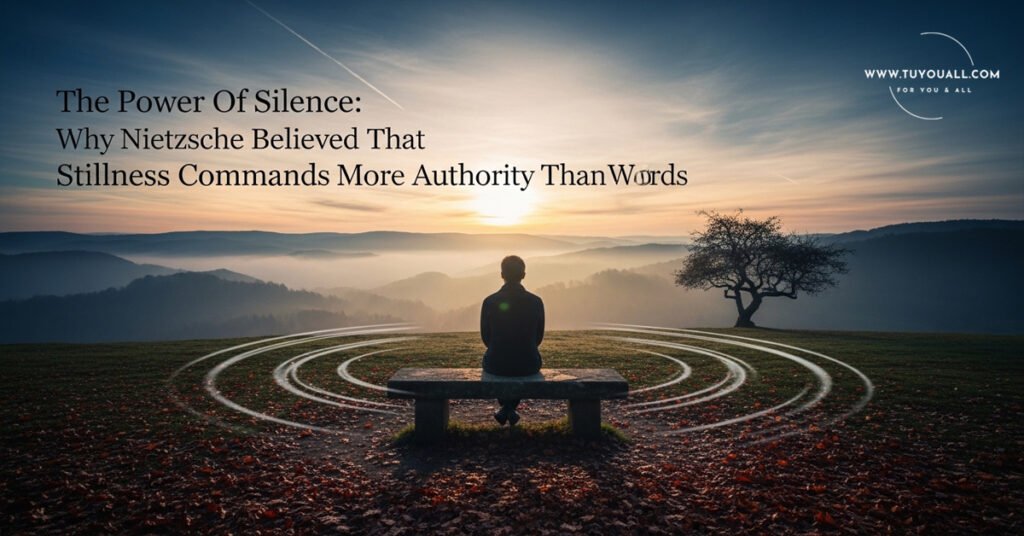
Discover Nietzsche’s Secret Weapon: The Power Of Silence. Learn how the Übermensch uses strategic stillness to dominate conversations and master self-control.
Have you ever walked away from a conversation feeling strangely defeated—even though you said everything perfectly? Maybe you explained yourself clearly, defended your point with logic, and used all the right words. Yet somehow, you still felt smaller, weaker, and strangely exposed. The power of silence lies in understanding that this feeling isn’t a failure of your argument—it’s proof that you entered the wrong battlefield entirely.
Friedrich Nietzsche, one of history’s most misunderstood philosophers, saw something most people miss: those who talk too much reveal too much. When you feel that knot in your throat after speaking, it’s not because you didn’t say enough. It’s because you believed the illusion that truth must be defended verbally, that every conversation is a war won with words. But what if the most lethal weapon in any interaction isn’t your vocabulary, but your ability to remain absolutely, intentionally still?
This isn’t about becoming passive or shrinking yourself to fit into other people’s comfort zones. This is about recognizing that true power has never been in words, but in their strategic absence. Today, we’re diving deep into Nietzsche’s radical idea that silence isn’t just the absence of noise—it’s an overwhelming presence that can destabilize opponents, expose hidden insecurities, and establish unshakeable psychological dominance.
The Herd Morality Trap: Why You Feel Compelled to Justify Everything
Let’s start with a painful truth. Why do we feel such an urgent need to respond, rebut, correct, and prove we are right?
Nietzsche identified this compulsion as a symptom of our deepest weakness: the fear of appearing weak. Behind this fear lives the ego—a fragile construct that confuses disagreement with attack and transforms every conversation into a desperate battlefield for validation.
“Most people do not seek the truth when they argue,” Nietzsche observed. “They seek power. They seek to reaffirm their beliefs not because they are solid, but because if they are shaken, everything crumbles.”
When you feel compelled to justify your position, you’ve already lost. Not because your point is wrong, but because you’ve entered their game—a rigged theater where the first person to stand up and perform has already surrendered their power. This need to explain yourself reveals that you are still trapped in what Nietzsche called herd morality: the behavior of those who live under the expectations of others, desperate to be seen as good, correct, and just.
For Example:
Imagine you’re at a family dinner, and your uncle challenges your career choice. Your immediate urge is to list all your accomplishments, your salary, your potential for promotion—anything to prove he’s wrong about you. But notice what happens in your body as you speak. Your heart races. Your voice tightens. Even if he nods politely, you walk away feeling somehow diminished. That’s because you just validated his framework—that his opinion of your worth matters enough to defend against. The power of silence emerges when you realize you owe no one an explanation for your existence.
True strength, Nietzsche argued, lies not in convincing others but in not needing to do so. It’s holding your vision even when faced with laughter, criticism, or rejection. It’s being misunderstood and remaining unshaken. The reactive mind is a subjugated mind; the observing mind—that is the dangerous one, because it is above the need to prove anything.
The Übermensch and the Architecture of Silent Authority
So if words betray us, how do we make others feel our strength without speaking? Nietzsche’s answer lies in the ideal of the Übermensch—the “Overman” or “Superman” who transcends the limitations of common morality and dominates the world through absolute self-control.
Nietzsche did not write for the weak. He wrote for “the few who have the courage to look within, confront their own misery, and transform it into strength.” For him, the common human lives trapped by conventions, moralism, and the desperate need for others’ applause. But there exists another type of being: rare, dangerous, and free.
The Übermensch does not live by reacting to the world. He shapes the world in his own image, often in complete silence.
Silence as a Language of Dominance
The Übermensch doesn’t need to win debates or engage in cheap emotional games. He observes. He understands. He carefully chooses when to speak and, more importantly, when to remain silent. Because he has understood something that others ignore: silence is a form of language.
Unlike spoken words that try to convince, silence imposes presence. The silence of the Übermensch is not empty—it is a threat, it is authority, it is the sound of absolute self-mastery.
For Example:
Consider a high-stakes business negotiation. While your competitor frantically explains why their offer is superior, filling every pause with nervous chatter, you simply sit back, maintain steady eye contact, and say nothing. The longer you remain quiet, the more they talk. The more they talk, the more they reveal their desperation, their bottom line, their hidden fears. Your silence becomes a wall they cannot climb. They start to wonder: Does he know something I don’t? Is my offer insulting? Am I talking too much? In their panic to fill the void, they often improve their own offer without you saying a word.
The Psychology of Non-Reaction
While others shout, the Übermensch commands respect with his gaze. While others explain, he observes and reveals others’ weaknesses merely with his calm. His silence is strategic economy—he knows that every spoken word is a revealed move, and every emotional reaction is an exposure of a weak point.
That is why he remains quiet. Not because he has nothing to say, but because he does not need to say anything. His presence already speaks for him, and more than that, it disturbs. His silence forces others to look within, to deal with their own noise. In a society addicted to constant chatter, those who master silence are kings.
From Passive to Active: The Two Faces of Silence
But here we must draw a crucial distinction. Not all silence is powerful. In fact, some silence is pure surrender disguised as wisdom.
There is a world of difference between the silence of the Übermensch and the silence of the oppressed. One commands; the other crumbles. One is a weapon; the other is a wound.
| Aspect | Submissive Silence (Weakness) | Active Silence (Power) |
| Origin | Fear, guilt, avoidance of conflict | Self-mastery, strategic choice |
| Internal State | Anxiety, suppressed anger, feeling trapped | Calm, centered, controlled energy |
| Effect on Others | Encourages further domination, signals you can be pushed | Creates tension, commands respect, destabilizes opponents |
| Physical Presence | Shrinking, avoiding eye contact, tense posture | Open, grounded, steady gaze, relaxed posture |
| Aftermath | Resentment, feeling victimized, loss of self-respect | Clarity, maintained boundaries, psychological advantage |
For Example:
Sarah stays silent when her coworker takes credit for her idea in a meeting. She tells herself she’s “keeping the peace” and being “mature.” But inside, she’s fuming. She avoids eye contact, stares at her notes, and feels her face burning. This is submissive silence—she has surrendered her narrative to maintain a false harmony.
Now picture Marcus in the same situation. When his colleague steals his idea, he doesn’t react immediately. He sits back, maintains a slight, knowing smile, and watches the thief squirm under the weight of his calm gaze. He doesn’t need to shout “That was my idea!” because his silence communicates: I see what you did. I know my worth. And your theft changes nothing about my capability. This is active silence—a boundary so strong it doesn’t need words to enforce it.
Why Your Silence Destabilizes Others: The Psychology Behind the Power
What makes silence so unsettling? Why do so many people feel threatened when someone simply chooses not to react?
The answer lies deep in human psychology. Silence is not just the absence of sound—it is a mirror. And what it reflects for many is unbearable.
The Mirror Effect
When you choose not to react, you aren’t just silencing yourself. You are forcing the other person to hear their own voice, to confront their own arguments without the comfort of external resistance. This destabilizes because most people do not speak to express themselves; they speak to protect themselves—to convince themselves, to hide the emptiness between what they say and who they are.
When you remain silent, their disguise falls away. Social psychology confirms that in confrontational situations, silence is perceived as judgment. Without your response, without your reaction, the speaker loses control of the narrative. The human brain goes into a state of alert—the amygdala activates, triggering fear and anxiety.
The other person starts projecting their own fears onto you: Is he judging me? Did she notice my insecurity? Does he know I’m bluffing? In this psychological battlefield, silence acts like an invisible blade. It cuts where no one sees, but everyone feels.
Breaking the Manipulation Cycle
Moreover, silence has a devastating effect on manipulators. People who thrive on emotional control depend on your reactions to stay in the game. When you do not react, you break the cycle, and the manipulator panics. They need your response to validate their position. Without it, they lose themselves. They reveal the weakness they’ve tried so hard to hide.
Silence also triggers unresolved pains—traumas of rejection, abandonment, and humiliation. Suddenly, the other person realizes they are not at the center, that their words are not enough, that their presence does not make an impact. This is intolerable for the narcissistic ego.
When you remain silent, you are not just defending yourself—you are attacking where it hurts most: at the center of the illusion.
Four Weapons of Strategic Silence: Your Practical Guide
Now comes the crucial shift. It’s time to stop merely understanding the power of silence and start using it. Knowledge without practice is dead theory. Here are four concrete weapons to transform your silence into a precision instrument:
1. The Weapon of Withholding
Be silent when your will screams for a response. This requires brutal strength because everything in you will want to react, to justify, to prove you are right. But that desire is poison.
Every time you give in, you reveal that you are still under the control of others—that you still care what they think, that you are still playing their game. True silence is born only when you kill that need. You owe nothing to anyone. The truth does not need to be spoken to exist.
2. The Weapon of Observation
While others talk, get lost in explanations, and try to fill the void with words, you listen. But don’t listen as someone waiting for their turn to speak. Listen like a hunter listens to footsteps in the forest.
Perceive the fears hidden between the lines. Catch the subtle contradictions. Notice the insecurities disguised as arrogance. Store all of this intelligence. When you do speak—if you speak—it will be surgical. It will carry the precision of someone who has mastered the emotional territory of the other.
3. The Weapon of Time
Learn to let silence last. The pause is an element of tension, and tension is power.
While the other person speaks, waiting for your reaction, and it doesn’t come, they experience an internal collapse. The discomfort grows. Their mind begins filling the void with assumptions, fears, paranoia. A simple look from you, accompanied by silence, can have more impact than ten well-formulated sentences.
4. The Weapon of Unpredictability
When you master silence, you become unpredictable. And the unpredictable is always feared because people don’t know what to expect from you.
When they don’t know what to expect, they lose the advantage. They become cautious. They start measuring every word. You invert the logic of interaction: from reactive, you become the gravitational center of the conversation.
For Example:
Your neighbor keeps making passive-aggressive comments about your lawn. Instead of defending your gardening choices or apologizing, you simply look at him for three seconds longer than comfortable, offer a slight nod, and walk away without a word. The next time you see him, he’s unusually polite. He can’t categorize you. He can’t predict your moves. You’ve seized psychological territory without raising your voice.
FAQ: Understanding the Power of Silence
Q: Isn’t staying silent just letting people walk all over me?
A: Not if it’s active silence. There’s a critical difference between silent submission (born from fear) and silent authority (born from self-mastery). Submissive silence shrinks; active silence expands. When you use silence strategically, you’re not being passive—you’re being impenetrable. You’re choosing not to engage on their terms, which is the ultimate power move.
Q: How do I know when to speak and when to stay silent?
A: Speak only when your words will topple an empire, clarify a crucial misunderstanding, or protect someone vulnerable. Otherwise, observe. Nietzsche’s Übermensch speaks rarely because he understands that every word is a revealed move. If speaking doesn’t serve your vision or establish necessary boundaries, let your presence do the talking.
Q: What if people think I’m rude or arrogant for not responding?
A: Let them. This is the test of your strength. The herd morality Nietzsche described depends on your desperate need to be seen as “nice” and “agreeable.” True authority often looks like arrogance to those who are used to manipulating others through guilt. Your silence isn’t rudeness—it’s boundary maintenance. Those who respect authentic power will recognize it; those who don’t were never going to support your growth anyway.
Q: Can silence really work in professional settings where communication is expected?
A: Absolutely. Strategic silence is most powerful in professional environments. In meetings, the person who speaks last—after observing everyone reveal their positions—often commands the most respect. In negotiations, the first person to speak usually loses. Use silence to gather intelligence, let others expose their hands, and then speak with surgical precision when the moment is right.
Q: How do I start practicing this if I’m naturally talkative or anxious?
A: Start small. Practice the “three-second pause” before responding to any question or provocation. In low-stakes conversations, count to three internally before answering. Notice how the power dynamic shifts. Gradually extend this to moments of conflict. Remember: you don’t need to fill every silence. Comfort with silence is a muscle; start lifting light weights.
Conclusion: Your Silence Is Your Kingdom
Let’s bring this home. The world doesn’t need more talkers. It doesn’t need more people frantically explaining, justifying, and defending their existence to anyone who challenges them. The world needs individuals who have mastered the power of silence—who can sit in stillness while chaos swirls around them, who can maintain their vision without the validation of the herd.
Nietzsche wrote for those willing to tear off the masks society imposed, even when it hurts. The silence of the Übermensch isn’t the silence of the coward or the oppressed. It’s the silence of the warrior who has already won before the battle begins. It’s the stillness of one who no longer needs to prove anything to anyone because he knows who he is.
Look at your life. How many times have you remained silent out of fear, out of guilt, out of not wanting to disturb? How many times have you let others decide for you, speak for you, trample over your truth? Nietzsche would say that living this way is an offense to existence itself—that accepting submissive silence is betraying yourself.
From today forward, let your silence change its tone. Let it stop being an escape and become an invisible shout of authority—a boundary, an affirmation of who you are, even if no one understands. Because who you are doesn’t need to be understood; it needs to be lived. And that requires courage.
Do you have the courage to let your silence speak louder than your words ever could?
Source/Credit Section:
This blog post is based on insights from the YouTube video titled “The Power of Silence – Nietzsche’s Guide” by the original content creator.
The original content has been translated, expanded, and repurposed for educational purposes to explore Nietzsche’s philosophy on communication, authority, and self-mastery.