This blog post is based on insights from Dr. Sweta Adatia’s YouTube interview titled “Neuroscientist Explains Morning Routine for Brain Optimization.”
Have you ever wondered why your “perfect” morning routine still leaves you anxious, scattered, or hitting snooze until the last possible second? You drink the water, you journal (sometimes), you even stretch—but by 10 AM, you’re already in survival mode, reaching for coffee like it’s oxygen.
What if the problem isn’t your discipline, but your brain waves?
According to Dr. Sweta Adatia—a leading neurologist, founder of Limitless Brain Lab, and bestselling author—most of us are crashing our brains before the day even begins. “You cannot go from zero to fifth gear immediately,” she explains. “If you jump straight from deep sleep (Delta waves) to high-alert Beta waves, your brain cranks. It won’t function properly.”
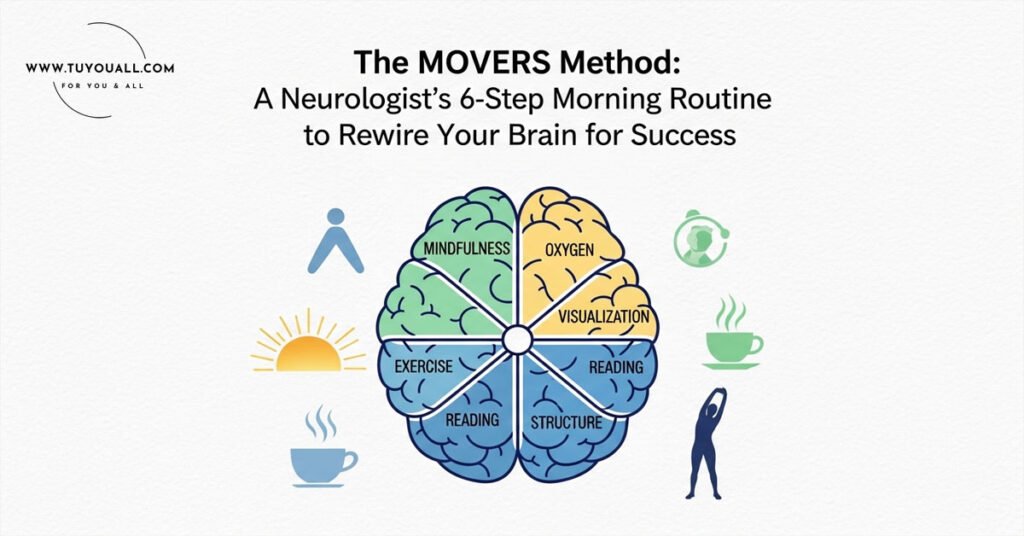
The solution isn’t another complicated checklist. It’s a neuroscience-backed protocol called MOVERS—a simple six-step sequence that hacks your Theta and Alpha states to prime your brain for what Dr. Adatia calls “ultra-success.” Whether you’re a CEO, a student, or someone just trying to stop procrastinating, this routine teaches you to reality-hack rather than just “rewire” your brain.
Let’s break down the science of why this works—and exactly how to implement it tomorrow morning.
Why Your Current Morning Routine Might Be Backfiring
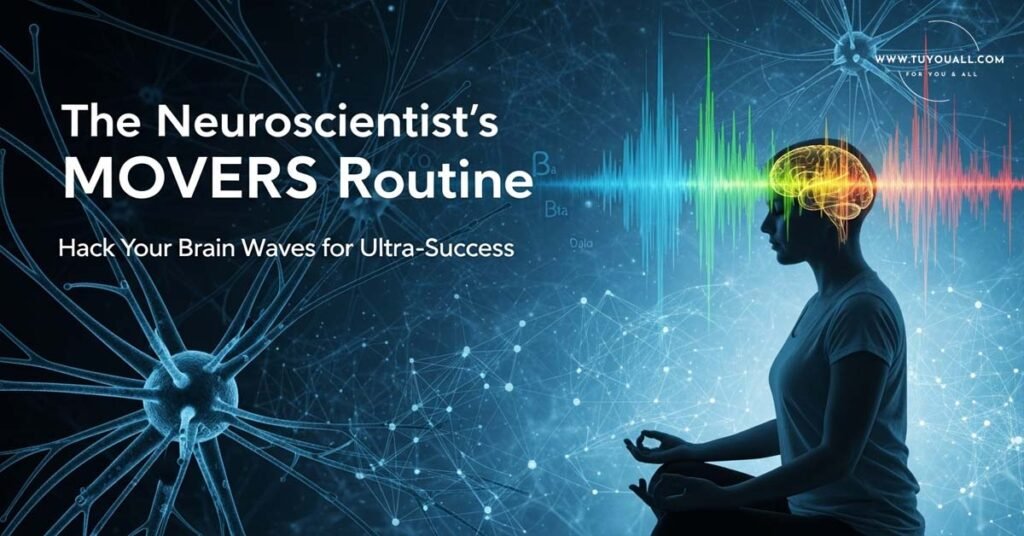
Before we dive into the solution, we need to understand the problem. Your brain operates on four primary wave patterns:
- Delta: Deep, dreamless sleep
- Theta: That groggy, creative state right before sleep or upon waking (the “suggestible” state)
- Alpha: Relaxed awareness, eyes closed, daydreaming
- Beta: Active thinking, problem-solving, conversation
When your alarm blares and you immediately check your phone, you’re forcing your brain from Delta (neutral gear) straight into high-Beta (fifth gear). “It’s jerking for the brain,” Dr. Adatia warns. “Your heart rate rises, blood pressure shoots up, and you’re already in a stress response before your feet hit the floor.”
The first hour upon waking is your “Theta-Alpha bridge”—a powerful phase where your subconscious is wide open. Mess this up, and you’re fighting your own brain chemistry all day. Master it, and you’ve hacked your internal code for focus, resilience, and creativity.
The MOVERS Protocol: Your 30-Minute Brain Optimization Blueprint
Dr. Adatia developed MOVERS after studying peak performers across industries—from athletes to billionaires. The acronym stands for Meditation, Oxygenation, Visualization, Exercise, Reading, and Scribing. Each component targets specific neural pathways to build what she calls “frontal cortex strength.”
The beauty? You don’t need hours. “Five minutes each is plenty,” she assures. “It’s not about duration; it’s about sequence.”
M is for Meditation: Capture the Theta State
The first five minutes after waking are non-negotiable. Close your eyes and simply be. Don’t check notifications. Don’t plan your day. Just sit.
“Go deeper into that Theta state,” Dr. Adatia instructs. “Include all your auto-suggestions—what you want to achieve today, this week, this month. Your subconscious door is open; put the positive programming in now.”
Why this works: In Theta, your brain is highly plastic and suggestible. This is when visualization has maximum impact.
O is for Oxygenation: Sunlight and Breath Work
Before coffee (which shoots you into Beta immediately), get natural light. “Sunlight activates your suprachiasmatic nucleus—the brain’s clock,” explains Dr. Adatia. This ancient wisdom aligns with modern neuroscience: morning light sets your circadian rhythm and triggers peak chemical reactions.
Pair this with deep breathing. “No caffeine for the first hour,” she insists. “Your body already has access to natural endorphins if you harness the Brahma Muhurta—the 90 minutes before sunrise when cortisol, adrenaline, and endorphins peak.”
Try this: Step outside for five minutes of sunlight exposure while practicing slow nasal breathing.
V is for Visualization: Mental Rehearsal Changes Your Brain
Here’s where it gets wild. Dr. Adatia cites a study where piano players were divided into two groups: one practiced physically, one only imagined practicing. After three months, both showed nearly identical brain growth in motor regions.
“Visualization is super powerful,” she emphasizes. “Before every high-stakes meeting, I walk on my treadmill and mentally rehearse every detail—where I’ll place my first step on stage, how I’ll exit, exactly what I’ll say.”
For example: If you have a difficult conversation today, close your eyes and walk through it successfully. Your brain chemicals will pre-prepare, reducing performance anxiety significantly.
E is for Exercise: Neurobics and Physical Strength
This isn’t just about biceps. “Your workout should include cross-lateral training, strength, coordination, and balance,” advises Dr. Adatia. “Try standing on one leg for 30-40 seconds while commanding your brain to maintain balance. You’re directly engaging the cerebellum and frontal cortex connection.”
Recent studies show hand grip strength directly correlates with neural strength and dementia prevention. But variety is key—monotony kills the brain. “Switch up your routes, brush your teeth with your non-dominant hand, do mirror writing,” she suggests. “These are neurobics—aerobics for your neurons.”
R is for Reading: Feed the Subconscious Positive Input
While your subconscious is still porous, consume something affirmative. “Read something positive or affirming,” says Dr. Adatia. “Your subconscious door is open—put good stuff in.” Avoid news or social media; they trigger the limbic system (your brain’s threat detector) and shut down frontal cortex function.
S is for Scribing: Write Out What’s Not Serving You
End the routine with catharsis. “Scribing means writing out what is not serving you,” Dr. Adatia explains. “We call it catharsis in psychology—release it.” This clears your working memory (RAM) of rumination, freeing up cognitive bandwidth for actual problem-solving.
Understanding Your Chronotype: Are You Fighting Your Biology?
Not everyone should wake at 5 AM—and that’s science, not excuse. Dr. Adatia references four sleep chronotypes identified by Dr. Michael Breus:
| Chronotype | Wake Time | Peak Energy | Characteristics |
| Lions | 5-6 AM | 8-12 PM | Early risers, highly disciplined |
| Bears | 7-8 AM | 10-2 PM | Steady energy, follow solar cycle |
| Wolves | 8-9 AM | 3-7 PM | Night owls, creative late |
| Dolphins | Variable | Erratic | Anxious sleepers, scattered energy |
“Can you shift your chronotype? Very much yes,” Dr. Adatia confirms. “It depends on your life phase.” If you’re building a business, you might train yourself into Lion mode. If you’re in creative recovery, honor your Bear rhythm.
Try this: Take the 5-minute chronotype quiz (link in resources below) to identify your optimal schedule.
The Frontal Cortex: Your Success Center vs. The Limbic Loop
Why do some people bounce back from failure while others spiral? It comes down to frontal cortex strength—the 40% of your brain (compared to 7% in rats) responsible for emotional control, decision-making, and resilience.
“Between 13-20 years old is a critical window for building this strength,” Dr. Adatia notes. “But because of neuroplasticity, you can start at 30, 40, or 60. The day you commit to building frontal cortex strength, your life changes.”
Most people live in the limbic loop—a cycle of Fight, Flight, Fear, and Freeze governed by the amygdala (the brain’s “watchman”). When triggered—which takes only 13 seconds to convert to rage—the amygdala hijacks your frontal cortex.
“The moment your frontal cortex starts working, your limbic system goes down,” Dr. Adatia explains. Peak performers have learned to convert reaction into response by strengthening this “command center.”
The Day Audit Exercise
Dr. Adatia recommends a simple awareness practice: “Audit your emotions, actions, responses, and relationships throughout the day. Are you living in limbic reactivity or frontal consciousness?”
Men, Women, and Breakups: The Neurochemical Reality
Ever noticed how men and women process emotional trauma differently? It’s not stereotype—it’s neurochemistry.
“When women commit, they invest oxytocin, serotonin, and some testosterone,” Dr. Adatia explains. “Men release mostly testosterone during intimacy. The bonding hormones aren’t equivalent.”
This creates divergent breakup recovery timelines:
- Women: Feel everything immediately—grief, sadness, loss. They process through the emotion in the moment. “Six to eight months later, she’s over it—’Forget it, it’s past,'” says Dr. Adatia.
- Men: Often appear fine immediately, diving into work or distraction. “But six months later, it hits them. The comparison starts—the FOMO, the ‘Did I miss out?’—and they get stuck in rumination.”
The recovery protocol: Awareness → Breathing → Commitment to daily habits. “You don’t ‘get over’ a breakup; you process the biochemistry out of your system through breath and routine.”
Emergency Brain Hacks for Daily Life
When you’re in the moment—angry, anxious, exhausted—these tools activate your parasympathetic nervous system instantly:
For Anger: The 13-Second Rule
“When anger hits, the amygdala hijacks you in 13 seconds,” Dr. Adatia warns. “Take a deep breath and count backward from 100. By the time you reach 90, the physiological response has diffused.”
For Anxiety: The Physiological Sigh (4-7-8 Breathing)
Breathe in for 4 counts, hold for 7, exhale for 8 through the nose. “This engages the vagus nerve immediately,” she says. “It’s the quickest way to shift from sympathetic (stress) to parasympathetic (calm).”
For Fatigue: The Humming Bee (Brahmari)
Close your eyes, take a deep breath, and hum like a bee for as long as possible. “This produces nitric oxide and paroxysmal gamma waves,” Dr. Adatia explains. “Three rounds reset your brain completely.”
For Migraines: Neuromodulation
For chronic sufferers, Dr. Adatia recommends safe neurostimulation devices that target the occipital nerves. “Hydration and exercise are preventive, but neuromodulation can abort an attack.”
FAQ: Your Brain Optimization Questions Answered
Q1: Can I really change my brain type or chronotype, or am I stuck with what I was born with?
Absolutely. While genetics (nature) loads the gun, epigenetics (nurture) pulls the trigger. “The day you decide to commit to frontal cortex practices—meditation, breathwork, sensory challenges—your brain begins rewiring,” Dr. Adatia confirms. Chronotypes are malleable based on life phases and intentional conditioning.
Q2: How is the MOVERS routine different from just having a “morning routine”?
Intent and neuroscience. Most routines jump straight to high-alert Beta states (checking phones, drinking coffee). MOVERS respects the Theta-Alpha bridge upon waking. “It’s not about the actions themselves, but the brain waves you create while doing them,” explains Dr. Adatia. “Five minutes of eyes-closed visualization changes your neural circuitry more than an hour of scattered activity.”
Q3: Why do I procrastinate even when I know what to do? Is my brain broken?
No, it’s defaulting to baseline. “95% of people procrastinate because the brain is lazy—it wants to conserve energy,” Dr. Adatia reveals. The hack? “Do the first five minutes. Create momentum. The brain follows action, not the other way around.” She suggests “priming” with a small caffeine dose (if needed) just to start the motion, then letting natural chemistry take over.
Q4: Can visualization really replace physical practice?
For neural pathways, yes. Research shows that mental rehearsal activates the same motor regions as physical practice. While you need physical execution for muscle memory, visualization builds the neural foundation. “The brain doesn’t always differentiate between real and vividly imagined experience,” says Dr. Adatia. “Use this to pre-wire success before high-stakes events.”
Q5: How do I know if my frontal cortex is weak or strong?
Look at your emotional regulation. “If you get triggered easily, ruminate on past conversations, or can’t detach from outcomes, your frontal cortex needs training,” Dr. Adatia advises. “Strong frontal cortex shows up as calm under pressure, the ability to ignore distractions, and quick rebound from failure.” You can also take a 5-minute Brain Fitness Assessment (see resources) to quantify your current capacity.
From Theory to Practice: Making This Work for Real Life
You might be thinking: “This sounds great, but I have kids, a job, and zero willpower at 6 AM.”
Start smaller. Dr. Adatia emphasizes that “ritual” is different from “habit.” A habit is autopilot (brushing teeth); a ritual requires full attention. Even if you only have 15 minutes, run through the MOVERS sequence in condensed form:
- 3 minutes: Eyes closed, set intentions (Theta)
- 3 minutes: Sunlight + deep breaths (Oxygenation)
- 3 minutes: Visualize your day succeeding (Visualization)
- 5 minutes: Single-leg balance or cross-crawl (Exercise)
- 1 minute: Read one affirmation (Reading)
- 1 minute: Dump worries on paper (Scribing)
“The first five minutes dictate the day’s brain chemistry,” she reminds us. “Prime it correctly, and the rest follows.”
Conclusion: Your Brain Is the Ferrari—Stop Putting Kerosene in It
Your life—your success, relationships, and health—is determined by three things: your health, your wealth (resources), and your relationships. As Dr. Adatia’s research reveals, all three depend on a single factor: frontal cortex strength.
You have 24 hours, just like every billionaire and athlete. The difference isn’t time; it’s neural efficiency. When you stop living in limbic loops of fear and reaction, and start operating from your frontal cortex of creation and response, you stop being “made by life” and start “making your life.”
Your brain isn’t hardwired. It’s not “just the way you are.” It’s the only instrument you have to play the music of your life. Tune it daily with the MOVERS routine, challenge it with neurobics, and protect it from the monotony that kills cognitive growth.
What small change will you make to tomorrow’s first hour?
Credits & Resources:
This blog post is based on insights from Dr. Sweta Adatia’s YouTube interview titled “Neuroscientist Explains Morning Routine for Brain Optimization.”
Dr. Sweta Adatia is a leading neurologist, founder of Limitless Brain Lab, and bestselling author specializing in peak performance neuroscience.
The original content has been translated, expanded, and repurposed for educational purposes.