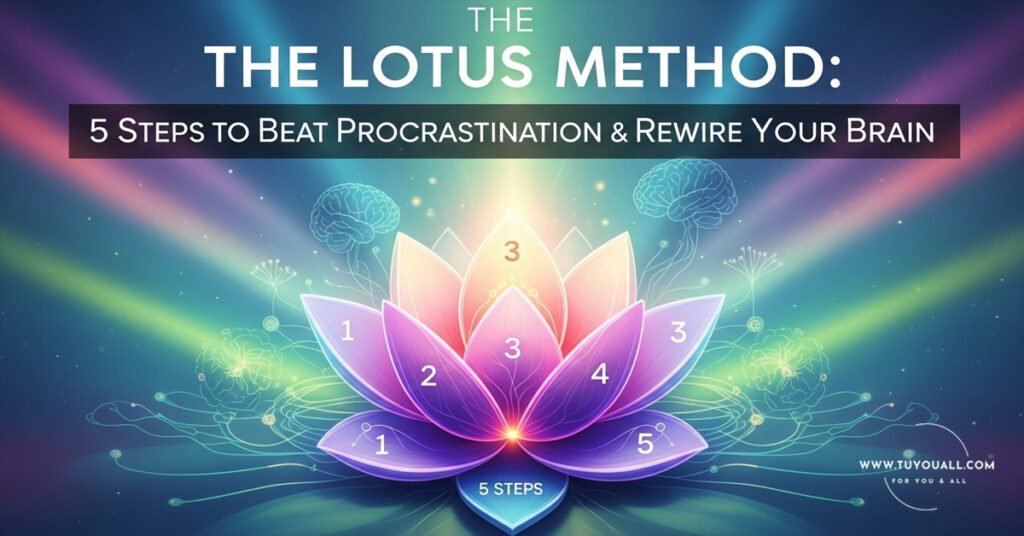
This blog post is based on insights from the YouTube video: “The Lotus Method: How to Make Your Brain Actually Want to Do Hard Things”
Discover the Lotus Method—a 5-step system to overcome procrastination by working with your brain, not against it. Start with just 10 minutes today.
Have you ever told yourself, “I’ll start in just five minutes,” only to look up at 2 a.m. eating cold pizza while deep-diving into why pigeons bob their heads when they walk? If that sounds painfully familiar, you’re not alone—and more importantly, you’re not lazy.
Here’s the uncomfortable truth most productivity gurus won’t tell you: Your brain isn’t broken. It’s doing exactly what it evolved to do. Your mind is a comfort-seeking machine designed to keep you safe from lions and starvation, not to help you write essays, build businesses, or hit the gym. In today’s world, that ancient survival mechanism has become your biggest obstacle to success.
But what if you could work with your brain instead of constantly fighting it? Enter the Lotus Method—an ancient, battle-tested approach that reprograms your brain’s natural aversion to discomfort. By the end of this guide, you’ll have a five-step blueprint to override resistance, sharpen your focus, and finally tackle the things you’ve been avoiding.
Why Your Brain Is Lying to You (And Why That’s Okay)
Before we dive into the solution, let’s understand the problem. When you need to work out, your brain suggests cleaning the kitchen first—because nothing says fitness like sparkling countertops, right? When you need to start a big project, your brain suddenly becomes fascinated by the complete history of bubble wrap. When you need to study, “just one episode on Netflix for inspiration” seems perfectly reasonable.
“You’re not procrastinating because you’re lazy—you’re procrastinating because your brain is a comfort junkie.” — Lotus Method
Here’s the neuroscience behind it: Hard things trigger the same stress response as physical danger. Your amygdala—the brain’s threat detector—can’t tell the difference between a saber-toothed tiger and a blank Word document. Both register as threats to avoid. So your brain goes, “Nope, let’s chill,” and redirects you to safer, more comfortable activities.
The result? You stay average. Comfort doesn’t keep you alive anymore—it keeps you stuck.
Step 1: Awareness—Catch Your Brain’s Scam in Real-Time
In Buddhism, there’s a powerful concept called “monkey mind”—a restless, jumpy brain that leaps from thought to thought, avoiding discomfort like it’s allergic to effort. The Lotus Method begins with a simple but transformative practice: noticing when your brain pulls this stunt.
How to Practice Awareness
When you catch yourself thinking:
- “Let’s start tomorrow”
- “Let’s just check Instagram first”
- “I need to organize my desk before I can work”
Pause and name it. Say to yourself: “Nice try, brain. I see what you’re doing. This is avoidance.”
Why This Works
Neuroscience shows that naming your mental patterns activates your prefrontal cortex—the logical, decision-making part of your brain—and simultaneously reduces activity in the emotional, reactive amygdala. It’s like turning on the lights in a dark room; the monsters disappear.
For Example:
Sarah, a freelance writer, used to spend her mornings “preparing to work”—making coffee, checking emails, reorganizing her desk. When she started practicing awareness, she noticed her brain’s pattern: “I need to check my email first” was actually “I’m avoiding the discomfort of starting.” By naming it, she reduced her “prep time” from 90 minutes to 10 minutes.
Without this awareness, you’re trying to play chess blindfolded against a grandmaster who cheats. Awareness turns the invisible into the visible.
Step 2: Flow With It, Don’t Fight It
Most people approach resistance like they’re pushing a car uphill with square wheels. They white-knuckle their way through tasks, relying on willpower and discipline. That works for about two minutes—then you burn out.
Eastern philosophy, specifically Lao Tzu’s teachings, offers a counterintuitive solution: Stop fighting the river. Learn to swim with it.
The Gateway Task Rule
Instead of declaring, “I must finish this massive project today,” try: “I’ll just start with 10 minutes.”
Make your first step ridiculously easy:
- Open the document (don’t write anything yet)
- Put on your gym shoes (don’t work out yet)
- Write just the title (don’t write the content yet)
Why This Works: Your brain’s amygdala sees big tasks as threats, but small tasks fly under its radar. Once you start, your brain releases dopamine for making progress, which builds momentum. The hardest part of any task is starting; once you’re moving, physics is on your side.
For Example:
Marcus wanted to write a novel but felt overwhelmed by the 80,000-word goal. Using the gateway task rule, he committed to writing just one sentence per day. Within a month, he was writing 500 words daily because starting was no longer scary—his brain had learned that writing wasn’t a threat.
Step 3: Stillness—Sharpen the Blade Daily
Imagine trying to cut wood with a chainsaw while it’s shaking violently. That’s your brain when it’s overloaded with notifications, noise, and a to-do list that looks like a CVS receipt.
Ancient monks practiced Zazen (sitting meditation) to let the mud in the mind settle. You can achieve the same effect with just 5–10 minutes of daily stillness.
How to Practice Stillness
This doesn’t need to be fancy:
- Sit quietly and breathe
- No phone, no music, no podcasts
- Just exist
Yes, your brain will scream at first. That’s the point. Over time, you’ll notice the chaos fades like muddy water becoming clear.
Why This Works
Research shows that meditation:
- Lowers cortisol (the stress hormone)
- Increases alpha brain waves linked to creativity and problem-solving
- Improves emotional regulation so hard tasks feel like puzzles, not threats
A calmer brain sees challenges as opportunities, not dangers.
For Example:
Jennifer, a software developer, started her workdays with 10 minutes of silent breathing. Within two weeks, she noticed she was less reactive to difficult code bugs. Instead of spiraling into frustration, she approached problems with curiosity. Her productivity increased by 40% without working longer hours.
Step 4: Intentional Action—One Slice at a Time
Shaolin monks don’t try to master every martial arts move in one day. They perfect one punch. Then another. Then another—until they can break bricks like they’re made of Lego.
Apply this same principle to your life: Pick one high-impact task per day and give it your undivided attention for 25–50 minutes.
The Rules of Deep Focus
| Don’t Do This | Do This Instead |
| Tab switching | One browser tab only |
| “Just checking” messages | Phone in another room |
| Multitasking | Single-task focus |
| Working until burnout | Time-boxed sessions |
Why This Works
Your brain has limited attentional bandwidth. Every time you switch tasks, you pay a “cognitive tax” that drains energy and focus. Research from the University of California, Irvine, found that it takes an average of 23 minutes to fully refocus after an interruption.
Deep, single-task focus can make 2 hours of work feel like 6 hours of scattered effort.
For Example:
David, a marketing manager, used to pride himself on multitasking—answering emails during meetings, Slack messaging while writing reports. When he switched to 50-minute focused blocks with no distractions, he completed his weekly workload in 3 days instead of 5. The quality of his work improved, and his stress levels dropped dramatically.
Step 5: Patience—Trust the Bloom
Here’s where the Lotus Method gets its name: The lotus flower takes time to push through the mud before it blooms. Your growth works exactly the same way.
You’ll be tempted to rush. You’ll want immediate results. But impatience is just another form of resistance. Progress works like compounding interest: nothing happens for a while, then everything happens at once.
The Compound Effect of Patience
Every hard thing you do is one petal opening. You can’t yank the flower open—it blooms when it’s ready. Trust the process.
Why This Works: Patience reduces:
- Decision fatigue (from constantly questioning your progress)
- Dopamine burnout (from chasing quick wins)
- Inconsistency (by keeping you in the game long enough for skills to click)
For Example:
Lisa started learning Spanish using the Lotus Method. For three months, she felt like she wasn’t making progress. She could barely order coffee in Spanish. But at month four, something clicked—suddenly she was having full conversations. Her brain had been building neural pathways all along; she just couldn’t see them yet.
Frequently Asked Questions (FAQ)
Q1: How long does it take to see results with the Lotus Method?
Most people notice reduced procrastination within the first week, but significant habit changes typically take 4–8 weeks of consistent practice. Remember: the lotus doesn’t bloom overnight.
Q2: Can I use the Lotus Method for multiple goals at once?
It’s best to start with one major area of focus. Once the method becomes automatic (usually after 3–4 weeks), you can apply it to other goals. Trying to overhaul everything simultaneously often triggers overwhelm.
Q3: What if I miss a day of practice?
Missing one day isn’t failure—it’s data. Notice why you missed it (awareness), then start again with a gateway task the next day. Consistency over time matters more than perfect streaks.
Q4: Is the Lotus Method backed by science?
Yes. The method combines validated techniques from cognitive behavioral therapy (awareness), neuroscience (dopamine reward systems), and mindfulness research (meditation benefits). The “gateway task” approach aligns with behavioral psychology’s “tiny habits” research.
Q5: How is this different from other productivity systems?
Unlike rigid systems that rely on willpower and discipline, the Lotus Method works with your brain’s natural tendencies. It doesn’t fight resistance—it dissolves it through awareness, small steps, and patience.
Conclusion: Your Lotus Is Waiting to Bloom
Let’s recap what you’ve learned:
- Your brain isn’t broken—it’s evolved to avoid discomfort
- Awareness turns invisible excuses into visible choices
- Small steps bypass your brain’s threat detection system
- Daily stillness sharpens your mental blade
- Single-task focus multiplies your productivity
- Patience allows compounding growth to work its magic
The Lotus Method isn’t about forcing yourself to work harder—it’s about making hard things feel less hard. When you stop fighting your brain and start working with it, productivity stops feeling like torture and starts feeling like proof you’re leveling up.
Your brain will resist at first. That’s expected. But give it time, and it will start working for you, not against you.
So here’s my question for you: What’s the one hard thing you’ll tackle today using the gateway task rule? Will you open that document? Put on those gym shoes? Write that first sentence?
The mud is thick, but your lotus is stronger. Trust the bloom.
Source & Credit
This blog post is based on insights from the YouTube video: “The Lotus Method: How to Make Your Brain Actually Want to Do Hard Things”
The original content has been translated, expanded, and repurposed for educational purposes.