This blog post is based on insights from an MIT graduate and former CEO’s YouTube video sharing his personal journey from academic struggle to accelerated learning mastery.
Discover the 3C Protocol (Compress, Compile, Consolidate) to master any skill faster. Science-backed strategies from MIT grad who went from failing grades to top 1% learner.
Introduction: The Learning Crisis Nobody Talks About
What if everything you’ve been taught about learning is actually holding you back?
Here’s a uncomfortable truth: In the age of AI, intelligence has become a commodity. Any skill advantage you have today is temporary. The only real competitive edge? How you learn and how fast you can stay ahead of the curve.
I used to be that kid—the one who failed every course in college, who couldn’t focus, who couldn’t retain anything. Growing up poor in Mumbai, I struggled through school while watching others seemingly absorb information effortlessly. Today, I’m an MIT graduate, former CEO, and board adviser to billion-dollar companies.
And no, it’s not because I’m smarter or read more books than everyone else.
It’s because I learned how to learn faster than everyone around me.
In this guide, I’m not going to give you “hacks” or quick tricks. Instead, I’ll show you exactly how your brain actually works—and introduce you to a learning system called the 3C Protocol that can put you in the top 1% of learners, even if you’ve always felt like you’re falling behind.
But first, you need to understand why 99% of people fail at learning before we fix it.
Why Your Brain Is Sabotaging Your Learning (And You Don’t Even Know It)
The “Prefrontal Cortex Bowl” Problem
Your brain weighs only three pounds, but it burns up to 20% of your body’s total fuel. One of its hungriest parts? Your prefrontal cortex—the CEO function of your brain that handles complex thinking, decision-making, and new learning.
Here’s what most people miss: Every new theory or idea you cram into that region spikes the demand for glucose and oxygen. It’s metabolically expensive. Think of your prefrontal cortex as a tiny 4-ounce cognitive bowl.
Now, if you dump a gallon of theory into a 4-ounce bowl, how much do you think it will retain?
Exactly—4 ounces.
This is the trap that has an almost 100% failure rate. Today’s AI can run millions of processes in parallel, but our human brain cannot. We’re built for serial learning—one transfer at a time. So give yourself (and your brain) a break from the information firehose.
The Lie Your Brain Tells You About “Easy” Learning
Carnegie Mellon University tested an adaptive learning system where material would get increasingly difficult based on students’ prior success. Naturally, the CMU students hated it. It felt frustrating. It created friction.
But here’s the kicker: They ended up learning twice as much as those who took the standard, “easier” tests.
We feel friction and assume failure. Neuroscience calls this the generation effect: The harder you work to generate the answer, the deeper it’s wired in your brain.
“99% of us use AI as a crutch, not as a coach. Your brain doesn’t hate struggle—it hungers for it.” —Former MIT Grad & CEO
The real question isn’t whether learning should be hard. It’s: How do you feed your brain’s hunger for productive struggle?
That’s where the 3C Protocol comes in.
The 3C Protocol: Your Accelerated Learning System
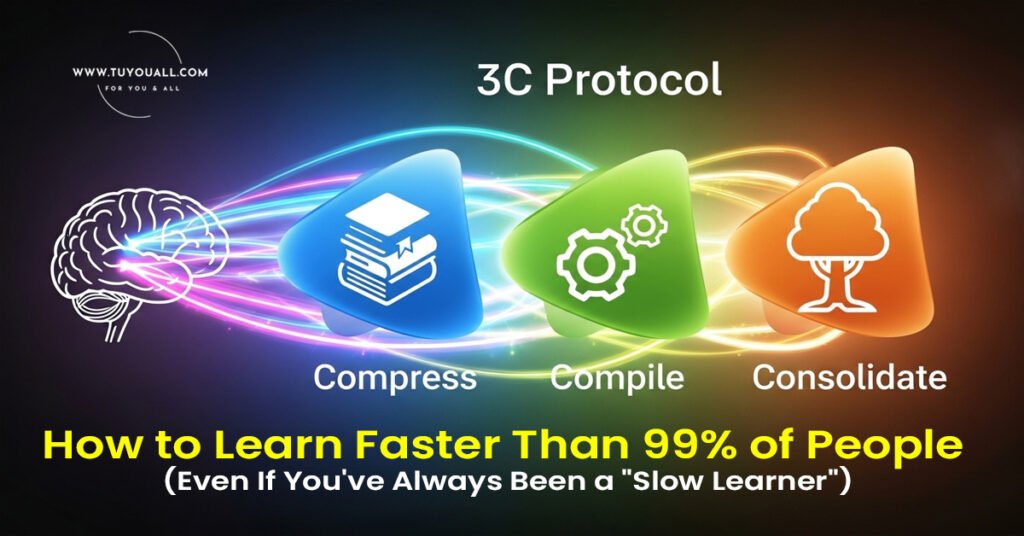
I call this system Compress, Compile, and Consolidate. Each step accelerates your learning machine. When you fire all three together, you break out of the orbit of ordinary learning and enter the top 1%.
Let’s dive into each component.
C1: COMPRESS — Turn Information Into Patterns Your Brain Can Actually Handle
What Chess Grandmasters Know That You Don’t
Watch Magnus Carlsen sit down at a chessboard. He’s not thinking about specific moves in isolation. What’s happening in his brain is fascinating: Cognitive studies estimate that chess grandmasters can internalize 50,000 to 100,000 patterns on the chessboard.
But they’re not memorizing moves. They’re compressing what they’ve learned into patterns their brain can actually handle.
Why? Because recent research shows our brain can only juggle about four independent ideas at a time. Any more than that, and it drops the ball.
Compressing isn’t about memorizing more—it’s about reducing many ideas into fewer, stronger chunks and patterns that your prefrontal cortex can carry.
How to Compress: The Three-Step Method
Step 1: Selection (The 80/20 Rule)
When I want to learn from a book, I first compress by asking: “What’s the 20% of this book that I must read to get 80% of the benefit?”
Most books are really just about one single idea. So I read only selective chapters—sometimes reading them more than once until they sink in.
Always pick the 20% that matters.
Step 2: Association (Connect to What You Know)
A paper in Science magazine showed that you can’t learn something new until you connect it to something you already know.
This is the secret behind mastering how you learn. You have to ask:
- “Where have I seen this idea before?”
- “How does this connect to something I already understand?”
This is why Magnus Carlsen wins—he connects a new move to an old pattern. He sees the harmony.
Step 3: Chunking (Create Mental Models)
Take these connected ideas and compress them into a simple model:
- A drawing or diagram
- A short summary (one sentence)
- A metaphor you can remember
- A song or rhyme
For Example:
When learning about electricity, instead of memorizing Ohm’s Law equations, compress it into the water pipe metaphor—voltage is like water pressure, current is flow rate, and resistance is pipe narrowness. Your brain retains the pattern, not the abstract formula.
99% of us get overloaded because we skip compression. The top 1%? They compress before they consume.
C2: COMPILE — Transform Consumption Into True Mastery
The Tragedy of Kim Peek: Why Memory ≠ Mastery
You might have watched the movie Rain Man. It was based on a real person named Kim Peek, a savant who grew up in the Midwest. Kim was like a walking, talking Google—he could reportedly recall every word of any of the 12,000 books he had read. He could tell you exactly what happened on any specific day in history.
Brain scans found that the bridge between his brain’s hemispheres was completely missing from birth. That uniqueness gave him incredible memory gifts.
But here’s what broke my heart: That same uniqueness made his daily life incredibly difficult to navigate. His father had to take care of his basic needs. Kim lived with his father until he passed away at 58, never married, never mastered simple chores or social cues.
Kim had the entire world stored in his memory but struggled to live in it.
This is the 99% trap: We focus on hoarding information and mistake consumption for learning. But memory alone is not mastery.
To truly compile learning into skill, you need three things: The Timer, The Test, and The Tools.
The Timer: Respect Your Brain’s Natural Rhythms
Your brain operates in ultradian cycles—approximately 90-minute periods of peak focus, followed by a need for rest. You get about 90 minutes of peak cognitive performance, then your brain must rest for at least 20 minutes.
Actionable Strategy: Look at your weekly calendar. Do you have one or two blocks of deep work? If yes, use this timer structure:
- 90 minutes of deep, focused learning
- 20 minutes of genuine rest
- Have one or two such blocks per week
- Protect them ruthlessly
This is how you learn fast without burning out.
The Test: The Agile Learning Loop
Most people learn, learn, learn for 6 weeks or 6 months, then face one big test at the end. This is a giant waste of time.
Software engineers talk about agile development—two-week sprints, constant iteration. In today’s AI companies, everything is a single-day sprint.
Apply the same concept to learning: Build a different loop.
| Traditional Learning | Agile Learning Loop |
| Learn → Learn → Learn → Big Test | Learn → Test → Learn → Test → Learn → Test |
Pick a concept, learn it, then test it immediately. Pick another concept, repeat.
The Tools: Three Methods to Test Your Learning
Tool #1: Slow Burn If you’re learning something physical (playing guitar, martial arts, sports), do it at an excruciatingly slow pace—and do it many times. Don’t turn off your brain because “slow is boring.”
Focus on every micro-move. The paradox: The slower you play, the faster you learn.
Tool #2: Immersion Every musician knows this: No matter how much you practice with the band, the moment you hit the stage, everything goes haywire.
You must test in the arena. Practicing a speech in front of a mirror is a good start. Practicing it in front of real people? That’s where true learning happens.
Tool #3: Teach to Learn ⭐ The Boss Tool Once I learn something, I teach it to someone. Sometimes I even lecture the wall as if I’m giving a TED talk. Why? Because teaching forces you to:
- Internalize the material deeply
- Connect concepts in new ways
- Reframe ideas for different audiences
I do this multiple times, trying different angles, until I feel I’ve truly learned it well.
C3: CONSOLIDATE — Lock In Learning Through Strategic Rest
If time was money and you wanted to invest it in learning, relying on sticky notes and flashcards will give you short-term gains but terrible long-term returns.
Here’s the most important insight that changes everything:
Learning is a two-stage process:
- Stage 1: Focus (you’re sending the request to your brain to rewire)
- Stage 2: Rest (this is where the actual consolidation happens)
You have to manage your rest as much as you manage your work—both at the micro and macro level.
The Learning Cycle: Work → Rest → Work → Rest
Micro-Level Rest (Inside Your 90-Minute Block)
Inside your 90-minute focus block, take frequent 10-20 second breaks. Research shows that after heavy learning, if you pause for just 10 seconds, your brain replays the information you just learned at 10-20 times the speed—and it might fire that sequence 20 times over.
You’re literally getting 20 free reps in your brain just by taking a break.
Macro-Level Rest (The Ultradian Cycle)
Again: 90 minutes of work, 20 minutes of rest. But what you do in those 20 minutes matters enormously.
I practice NSDR (Non-Sleep Deep Rest). In Sanskrit, this is called Yoga Nidra—literally “the rest that helps you connect.”
What to do during that 20-minute NSDR period: Absolutely nothing.
- Lie down or sit comfortably
- Close your eyes for 15-20 minutes
- Do nothing—don’t check your phone, don’t listen to podcasts, don’t “productive rest”
- Sometimes take a leisurely walk, but the point is not to distract yourself
The Ultimate Macro Rest: Sleep
There’s extensive research showing that when we’re sleeping, our brain replays everything we learned in reverse, consolidating it into long-term memory.
In this post-industrial technological age, we’ve forgotten what farmers have always intuitively known: You can’t keep plowing the field every day of the year. The soil must rest to regain its fertility.
Your brain is the same.
Quick Reference: The 3C Protocol at a Glance
| Component | Core Action | Key Tactics |
| COMPRESS | Reduce many ideas into fewer, stronger chunks | Selection (80/20), Association (connect to known), Chunking (mental models) |
| COMPILE | Transform consumption into mastery | Timer (90/20 ultradian cycles), Test (agile learning loops), Tools (slow burn, immersion, teach to learn) |
| CONSOLIDATE | Lock in learning through strategic rest | Micro rests (10-20 seconds), Macro rests (NSDR/Yoga Nidra), Sleep (ultimate consolidation) |
FAQ: Your Accelerated Learning Questions Answered
Q.1. How long does it take to see results with the 3C Protocol?
Most people notice improved focus and retention within 2-3 weeks of consistent application. However, the biggest gains—moving from “studying harder” to “learning smarter”—typically become obvious after 6-8 weeks of building these habits. Remember, this isn’t a quick hack; it’s a fundamental rewiring of how you approach learning.
Q.2. Can the 3C Protocol work for physical skills like sports or music?
Absolutely. The principles apply universally. For physical skills:
- Compress: Break movements into pattern chunks (the “waterfall” motion in swimming, the “box” footwork in basketball)
- Compile: Use the “Slow Burn” tool—practice movements excruciatingly slowly with full mental engagement
- Consolidate: Physical skills consolidate during sleep and NSDR just like cognitive learning
Q.3. What if I don’t have 90-minute blocks in my schedule?
Start with what you have, but protect it ruthlessly. Even 45-minute focused blocks with 10-minute rest periods will outperform 3 hours of distracted, multi-tasking “learning.” The key is the quality of focus and the genuine nature of rest—not the exact duration.
Q.4. How is this different from “speed reading” or other learning hacks?
Speed reading and similar techniques focus on input volume—how much information you can consume. The 3C Protocol focuses on processing quality—how well your brain can handle, pattern, and retain what matters. It’s the difference between drinking from a firehose (overwhelming, mostly wasted) and drinking from a filtered stream (manageable, nourishing).
Q.5. Does this work for academic learning and test preparation?
Yes, and it’s particularly powerful for academics. Instead of cramming (which floods your 4-ounce cognitive bowl), you:
- Compress course material into core concepts and patterns
- Compile by testing yourself repeatedly using the agile loop
- Consolidate with proper sleep before exams (not last-minute cramming)
Students using this approach typically report better grades with less study time—because they’re working with their brain’s biology instead of against it.
Conclusion: Your Only Competition Is You From Yesterday
I struggled with learning when I was growing up. I failed every single course in college. Couldn’t focus. Couldn’t retain anything. But these techniques—they changed my life, and they might work for you too.
As you start applying the 3C Protocol, remember three things:
First: Stop racing other people. There will always be someone who learns faster. So what? There’s someone faster than them. That loop never ends. Your only competition is you from yesterday.
Second: Get out of your own head. You cannot be the performer and the critic at the same time. While you’re learning, be the performer, not the critic. Save the evaluation for later.
Third: Give yourself time. Learning is like an ocean—it has its rhythm, its ebbs and flows. Honor that cycle. With enough time and the right system, there is nothing you can’t learn and nothing you can’t become.
What’s one skill you’ve been avoiding learning because it felt “too hard” or “too slow”? What would change if you approached it with the 3C Protocol instead?
Source & Credit
This blog post is based on insights from an MIT graduate and former CEO’s YouTube video sharing his personal journey from academic struggle to accelerated learning mastery.
The original content has been translated, expanded, and repurposed for educational purposes.