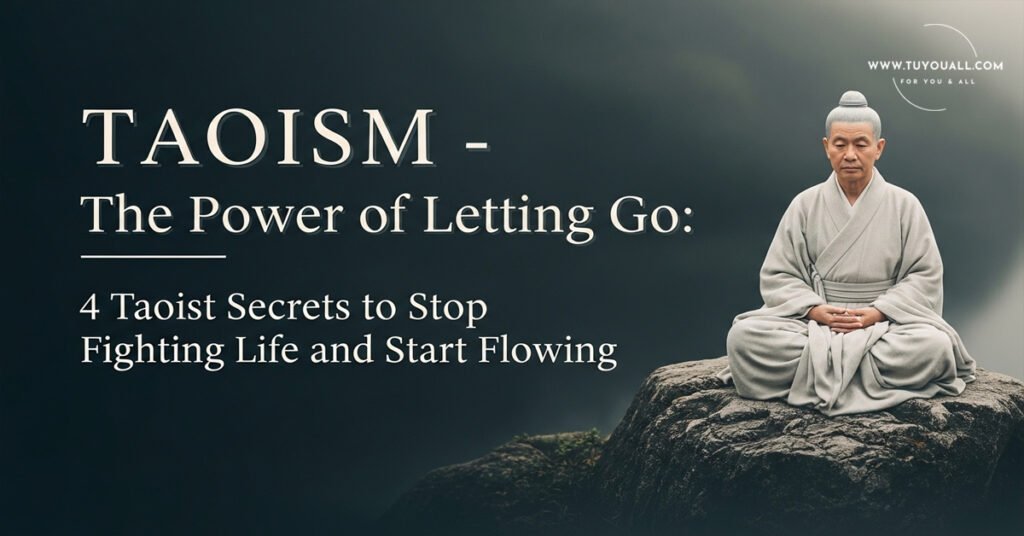
This blog post is based on insights from Einzelgänger’s YouTube video: “The Power of Letting Go | Taoism”
Introduction: Why Do We Exhaust Ourselves Trying to Control Everything?
Have you ever felt like you’re swimming upstream in life? Like no matter how hard you push, things just don’t seem to work out the way you planned?
Here’s a truth that might surprise you: the harder you try to control everything, the more miserable you become.
In our modern world, we’re obsessed with control. We track our productivity with apps, micromanage our schedules down to the minute, and try to predict every possible outcome before making a move. Companies monitor employees with increasing surveillance. Governments propose “social credit systems” to track citizens. We even try to control our partners, our children, and our futures.
But what if I told you there’s an ancient Chinese philosophy that says the exact opposite? That true mastery comes not from tightening your grip, but from opening your hand?
This philosophy is called Taoism, and it emerged from the same soil as modern China’s surveillance state—yet it offers a radically different path. As Lao Tzu wrote in the Tao Te Ching:
“Mastery of the world is achieved by letting things take their natural course. You cannot master the world by changing the natural way.” —Lao Tzu
In this article, I’ll share four powerful lessons from Taoism about the art of letting go. These aren’t just abstract spiritual concepts—they’re practical tools you can use today to reduce stress, improve your relationships, and achieve more with less effort.
1. Wu Wei: The Art of Effortless Action (Non-Doing)
What Is Wu Wei?
The Taoist concept of Wu Wei (無為) is often mistranslated as “doing nothing,” but that’s not quite right. A better translation is “effortless action” or “knowing when to act and when not to.”
Think of it like this: have you ever been so absorbed in an activity—painting, playing sports, or even having a great conversation—that time seemed to disappear? You weren’t forcing anything; you were just flowing. That’s Wu Wei.
The Problem with Over-Control
We try to control everything: our pets, our gardens, our video games, our relationships, our futures. And yes, some control is necessary for survival. But here’s what we forget: we systematically underrate the natural forces that do the heavy lifting for us.
For Example:
Imagine you’re growing a tree. You can plant it, water it, add fertilizer, and ensure it gets sunlight. But if you start poking at the roots every day, checking if it’s growing, or trying to force the branches to grow in a specific direction, you’ll kill it. As Lao Tzu compared governing to frying a small fish: “Too much poking spoils the meat.”
Wu Wei in Relationships
This applies perfectly to relationships. Attraction isn’t something you can manufacture through sheer willpower. You can’t force someone to like you.
For Example:
After a fight with your partner, anger naturally erodes over time—if you let it. But if you try to force a resolution immediately, demand apologies, or orchestrate makeup conversations, you often make things worse. Trust, when broken, cannot be enforced back into existence. It has to grow back naturally, like a healing wound.
Silence makes the heart grow fonder. By letting go, you give space for the universe’s forces to unfold.
2. Embracing Change: Stop Clinging and Start Flowing
The Rhythm of Life: Yin and Yang
Taoists understood something fundamental: life unfolds in constant movement between opposites—high and low, light and dark, success and failure, yin and yang. This isn’t a bug in the system; it’s the feature.
Yet so many of us cling to our circumstances like a drowning person grabbing a branch in a river. We want complete control over our position, terrified of where the current might take us if we let go.
The Cost of Rigidity
Lao Tzu observed:
“The living are soft and yielding; the dead are rigid and stiff. Living plants are flexible and tender; the dead are brittle and dry.” —Lao Tzu
What does this mean for you? When you refuse to accept change—when you fight against the natural flow of life—you become rigid. And rigidity leads to breakage.
For Example:
Think about someone who stays in a dead-end job for decades because they’re afraid of change. They grip that “branch” of security so tightly that they miss countless opportunities floating by. Meanwhile, the river of life keeps flowing, and they watch it pass from their fixed position, growing more brittle and bitter with each year.
Swimming Against the Stream
Then there are those who actively swim against the current. They resist “how things are” on principle, seeing virtue in constant struggle. But exercising constant resistance to how the universe unfolds isn’t heroic—it’s exhausting.
This non-acceptance also causes us to fight ourselves. Because of societal expectations, we battle against our inherent nature instead of flowing with our natural strengths.
Key Insight: Follow your strengths instead of trying to repair your weaknesses. If you’re a creative person forcing yourself into accounting, you’re swimming upstream. If you’re an introvert trying to become a celebrity politician, you’re fighting your nature.
Usefulness Is Relative
The Taoist philosopher Zhuangzi told a story about a merchant trying to sell shirts to a tribe whose members were covered in tattoos and always walked around shirtless. To them, shirts were useless. To us, they’re essential.
For Example:
Owning a car in New York City is often more trouble than it’s worth—parking is expensive, traffic is terrible, and the subway works fine. But in rural Montana, that same car is a necessity. Usefulness depends entirely on circumstances.
The lesson? Be willing to let go of what’s useless in your current situation and adopt what’s useful instead. Make change your ally, not your enemy.
3. Not Focusing on Outcomes: The Secret to Peak Performance
The Anxiety of Future-Thinking
Like the Stoics, Taoists noticed that focusing too much on future outcomes makes us anxious. When our present actions become fueled by desire for uncontrollable results, we devalue the only thing we actually possess: the present moment.
Zhuangzi illustrated this with a story about an archer:
“He who is contending for a piece of earthenware puts forth all his skill. If the prize be a buckle of brass, he shoots timorously; if it be for an article of gold, he shoots as if he were blind. The skill of the archer is the same in all the cases; but (in the two latter cases) he is under the influence of solicitude, and looks on the external prize as most important. All who attach importance to what is external show stupidity in themselves.” —Zhuangzi
Translation: When the archer stops caring about the process and starts obsessing over the prize, his performance crumbles. The higher the stakes, the worse he shoots—not because he lacks skill, but because his mind is in the future instead of the present.
Finding Your Flow State
This principle explains the psychological state of “flow” that athletes, artists, and musicians experience. When you’re in flow, you’re so immersed in the task at hand that you completely forget about the future. The dance dances itself.
For Example:
A basketball player in the zone isn’t thinking about the score, the championship, or the million-dollar contract. They’re just playing. Paradoxically, by not focusing on the outcome, they perform at their peak—and often achieve the best outcomes.
For Example:
When you’re writing, coding, or creating art, the moment you start thinking “Will people like this? Will it make money? Will it go viral?”—your creativity clogs up. The work becomes forced and mechanical.
The Taoist approach: Do the work for the work itself. Let go of the outcome. Trust that by being fully present, you’ll actually perform better—and enjoy it more.
4. Letting Go of Excess: The Middle Path to Freedom
The Trap of High Status
In our status-obsessed society, everyone wants to be at the top. But here’s what we forget: “The tallest trees catch the most wind.”
When you’re at the top, staying there requires tremendous effort. Everyone wants your position. The competition is fierce, the enemies are numerous, and the stress is constant. You’re visible, exposed, and constantly defending your territory.
Meanwhile, in the “lower regions,” people live more privately, with less competition, fewer enemies, and—crucially—less effort.
The Other Extreme: Deprivation
But the Taoists warn against the opposite extreme too. If you deliberately seek the absolute bottom—becoming an ascetic who owns nothing—you’re still attached. The attachment to deprivation is still attachment.
What Do You Actually Need?
Zhuangzi asked a simple question: What do we truly need?
He observed that “a bird that nests in the forest wants no more than one branch. A mouse that drinks from the pond drinks no more than a bellyful.”
For Example:
Look around your home. How many items do you use daily? How many sit in closets, garages, and storage units, owning you more than you own them? Each possession requires maintenance, insurance, space, and mental energy.
The Greek philosopher Epicurus (who shared many Taoist insights) noted that basic necessities are easy to come by. It’s our desires for luxury, status, and excess that make life complicated and stressful.
Traveling Light
When you let go of excess, you prevent possessions from becoming your prison cell. You can travel light—not just physically, but mentally and spiritually.
As Lao Tzu wrote: “Those who use moderation are already on the path to the Tao.”
Summary: The Power of Letting Go
| Principle | What We Usually Do | The Taoist Alternative |
| Wu Wei | Force outcomes through constant intervention | Allow natural processes to unfold with minimal interference |
| Embracing Change | Cling to circumstances and resist the flow | Move with the waves of existence, flexible and yielding |
| Non-Attachment to Outcomes | Obsess over future results, creating anxiety | Focus fully on the present moment and the task at hand |
| Moderation | Pursue excess and status, or reject everything entirely | Find the middle path—enough, but not too much |
Frequently Asked Questions (FAQ)
Q: Isn’t “letting go” just another word for being lazy or passive?
A: Not at all. Wu Wei isn’t about inaction—it’s about effortless action. A skilled dancer isn’t passive; they’re highly engaged. But they’re not fighting against the music or forcing movements that don’t fit. They’re flowing. Similarly, letting go in life means stopping the unnecessary struggle so you can engage more fully with what actually matters.
Q: How can I practice Wu Wei when I have deadlines and responsibilities?
A: Wu Wei doesn’t mean ignoring deadlines. It means approaching them without the extra layer of anxiety and forced control. Prepare, plan, and execute—but don’t obsessively check emails at 2 AM or micromanage every detail. Do what’s necessary, then step back and let things develop. Often, you’ll find solutions emerge naturally when you stop clutching at them.
Q: Does Taoism say we should never try to improve our circumstances?
A: No. Taoism isn’t about fatalism or accepting injustice. It’s about recognizing the difference between effective action and wasted effort. Plant the tree, water it, protect it from pests—but don’t stand over it 24/7 demanding it grow faster. Work toward your goals, but don’t strangle them with anxiety.
Q: How do I “let go” in relationships without becoming distant or uncaring?
A: Letting go in relationships means releasing the need to control the other person’s feelings, actions, or decisions. It means giving them space to be themselves while remaining present and supportive. Ironically, this often creates deeper intimacy than constant management does.
Conclusion: Float, Don’t Fight
Here’s the truth that runs through all four of these lessons: When we stop striving, we give nature space to unfold.
Trusting the universe doesn’t mean becoming passive. It means accepting that life is ever-changing, that control is often an illusion, and that the most sophisticated approach to existence is often the simplest one.
The power of letting go means:
- Floating along the stream instead of grasping for rocks and branches
- Cutting loose dead weight so you can navigate with minimal effort
- Becoming loose and supple instead of rigid and brittle
You don’t need to master the world by force. You just need to stop fighting it.
What in your life are you holding onto too tightly? Is it a relationship, a job, a grudge, an identity, or a vision of how things “should” be? What might happen if you opened your hand, just a little?
Source & Credit
This blog post is based on insights from Einzelgänger’s YouTube video: “The Power of Letting Go | Taoism”
The original content has been translated, expanded, and repurposed for educational purposes.