This blog post is based on insights from Harshvardhan Jain’s YouTube video discussing Richard Templar’s principles on wealth creation.
Have you ever looked at your bank account at the end of the month and thought, “I work so hard, but why isn’t my money growing?” You’re not alone. Most of us have been taught to chase one paycheck, grinding 40, 50, or even 70 hours a week, wearing exhaustion like a badge of honor. But here’s the hard truth: working harder isn’t the answer. Working smarter is.
Years ago, I stumbled upon a concept that completely rewired my brain. It came from a book by Richard Templar that I read eight times—not because I couldn’t understand it, but because I needed it to sink into my bones. The idea was simple but revolutionary: create multiple income streams. Not by working yourself to death with ten different jobs, but by turning the things you already own into passive income machines.
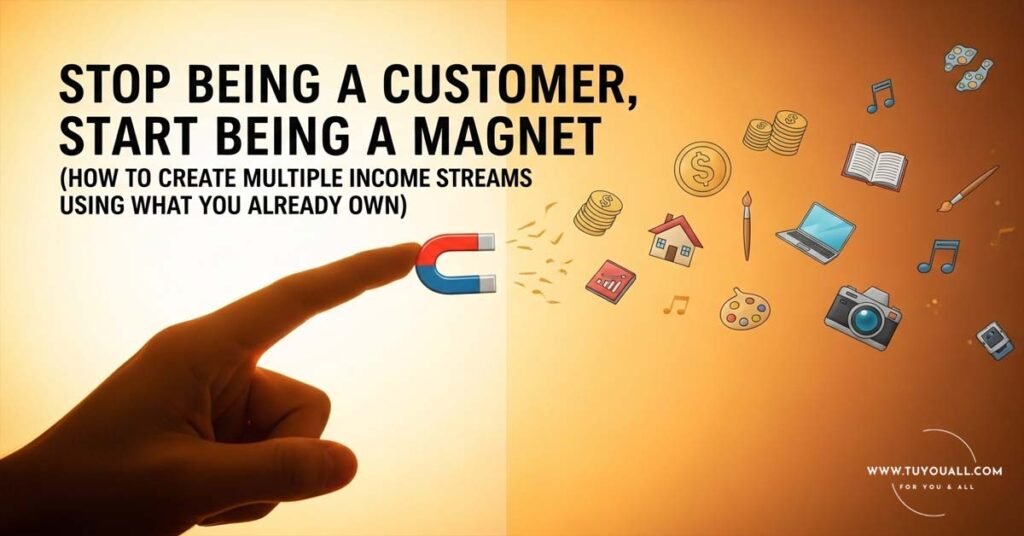
Think about it. We live in an age where money is literally falling from the sky in every direction. The only question is: are you standing there with your hands in your pockets, or are you holding a bucket?
The Parable of Focus: Why You Can’t Afford to Scatter Yourself
Before we dive into the “how,” let me tell you a story Harshvardhan Jain often shares—a story about a man who was given a strange punishment by a king. The king offered him a choice: eat 100 raw onions, or receive 100 lashes. The man thought, “Lashes hurt immediately. Let me choose the onions.”
He started eating. One onion, two onions, five onions… By the tenth onion, tears were streaming down his face. His stomach churned. He cried out, “Stop! I’ll take the lashes instead!”
So they switched. He took ten lashes, then twenty. The pain was unbearable. He screamed, “No more! Back to the onions!”
In the end, that poor man ate all 100 onions and received all 100 lashes. Why? Because he couldn’t stick to one decision.
“Focus on one thing with all your heart,” Jain explains. “But that doesn’t mean wealth comes from only one source. Wealth arrives from many directions, but your action needs focus.”
This is where most people get stuck. They try to be a taxi driver and a real estate agent and a freelance designer all at the same time, mastering none. The secret is to build one additional income stream at a time, automate it, then build the next. That’s how you achieve true financial freedom.
The Great Indian Mirror: Stop Looking at Neighbours, Start Looking at Yourself
There’s a funny thing about us Indians. We’re absolute masters at looking into other people’s houses. That’s why shows like Bigg Boss are hits—we love watching what others are doing. But when was the last time you really looked at your own assets?
Jain recalls how Templar’s advice hit him like a thunderbolt: “Write down everything you have in this world. It might take you a month just to figure out what you own, because you’ve spent your whole life looking outside.”
When Jain did this exercise, he realized he was sitting on a goldmine he had completely ignored. And chances are, so are you.
Asset Audit: What Do You Actually Own?
Take a piece of paper right now. Write down:
- Do you have a house? Even a small one?
- Do you own land? Even 100 square yards?
- Do you have a car, bike, or scooter?
- Do you have skills, knowledge, or hobbies people ask you about?
- Do you have furniture, equipment, or tools sitting idle?
If you checked even one of these, congratulations—you have the raw material to create multiple income streams. Let’s break down how real Indians are monetizing these exact assets.
Income Stream #1: Real Estate – Your Sleeping Giant
If you own property in any capital city or surrounding area in India and it’s not generating income, you’re essentially washing your feet with nectar and throwing it away. Real estate is the most obvious yet overlooked asset monetization strategy.
The Commercial Property Pivot
Jain shares his own numbers transparently: “I bought a flat for ₹56 lakhs. It now gives me ₹13,500 monthly rent. I bought an office space for ₹23 lakhs. It returns ₹19,000 monthly.”
Then came the lightbulb moment. Instead of residential properties with low rental yields, he shifted focus to commercial spaces. He’s now building “Cabin.com”—a platform where you can book a cabin for two hours to work in peace for just ₹200. Small spaces, high turnover, multiple locations (Jaipur, Sikar Road, Collectors Circle).
The math is beautiful: if a ₹3 lakh investment in three folding beds (ḍhānche) can bring ₹60 per day per bed, that’s ₹180 per day, or ₹5,400 per month. That’s more than many bank fixed deposits return, and you still own the asset.
The Message:
Stop treating your property like a dead asset. It should be working 24/7 to earn its keep.
Income Stream #2: Vehicles – From Liability to Cash Cow
Raise your hand if you think your car is an asset. Most financial books tell you cars are liabilities—and they’re right, if your car sits in the garage 25 days a month while you fly around the country for work.
Jain had this exact realization during a late-night Uber ride from Delhi to Jaipur. His driver, a Sardarji, dropped a bombshell: “Sir, for big Indian weddings, families don’t want taxis with commercial plates. They want private cars—Mercedes, BMW, Audi. They pay ₹35,000 for just two hours to make a good impression on the bride’s family.”
Jain’s Mercedes was sitting idle. Within five minutes of that conversation, his fate changed. He launched a wedding rental service offering Mercedes for ₹21,000 (below market rate to disrupt). The result? “Fifty bookings already confirmed, Rajesh ji! The money is already in my account.”
Even simpler: if you have a bike or scooter, it can earn through delivery apps. If you have a Maruti Omni or Dzire, fleet operators like Intel (for employee transport) are hungry for well-maintained vehicles.
The legendary story of Ramesh proves this path works. A 9-year-old boy whose father died, leaving only a barbershop. Ramesh worked hard for three years, bought one Omni van, and rented it to Intel. Today, Ramesh Tours and Travels owns 256 luxury cars—including BMWs, Audis, and Mercedes. And here’s the kicker: Jain notes, “Ramesh still personally cuts hair for his special customers. Because that’s his joy. The 256 cars? That’s just his passive income.”
Income Stream #3: Intellectual Capital – The Infinite Resource
Not everyone owns property or cars. But everyone has something between their ears. In the digital age, your knowledge is your most scalable wealth magnet.
The Nisha Madhulika Phenomenon
Nisha Madhulika was a regular Gujarati lady who cooked well. Her kids told her, “Mom, the neighbor auntie loves your food. Teach her!” She did. Then she thought, “Why not teach more people?” She started recording basic cooking videos from her normal, “tooti-phooti” kitchen on her mobile phone.
Today, Nisha Madhulika is a household name. Her YouTube income alone? One lakh rupees per day—from America. All because she packaged her existing skill and shared it.
From Side Hustle to Empire
Karsanbhai Patel worked a regular job but practiced making soap in the evenings. He named it after his daughter: Nirma. You know the rest of the story—he dominated the market because he activated his intellectual property outside office hours.
Or take BB Ki Vines (Bhuvan Bam). He just wanted to make people laugh. He sang, he joked, he sometimes cursed (with gusto). He built goodwill—the invisible asset that writes checks. Today, he earns lakhs daily through intellectual capital.
“But I don’t have any special talent!” you protest. Jain hears this often. His response: “You just haven’t looked hard enough. Can you tell stories? Amit Badhana did. Can you cook? Nisha did. Can you crack jokes? BB Ki Vines did. Your boudhik sampada (intellectual wealth) is waiting to pay you.”
The Wealth Magnet Mindset: Consumer vs. Creator
To truly create multiple income streams, you need to shift your identity. Here’s the difference:
| Consumer Mindset | Wealth Magnet Mindset |
| “I need to buy a bigger house to impress people” | “How can this house pay for itself?” |
| “My car is my status symbol” | “My car is my employee that generates ₹50k/month” |
| “I watch YouTube for entertainment” | “I create content that builds goodwill and pays me” |
| “I hate rich people” | “I become a magnet so money flows to me” |
| “I work for money” | “My money works for me” |
Jain is emphatic about this: “When you become a magnet for wealth, even the soil will pay you. If you’re not a magnet, even the floorboards will be taken from under you. That’s nature’s law.”
Your 5-Step Action Plan to Start Today
Enough theory. Here’s your practical roadmap to launch your first additional income stream:
- Inventory Everything – Spend this weekend listing every physical and intellectual asset you own. Be embarrassingly thorough. That scooter? Write it down. Your ability to explain math to kids? Write it down.
- Pick One Low-Hanging Fruit – Don’t try to monetize everything at once. Choose the easiest win. If you have an unused room, list it on Airbnb. If you have a car, register it on Uber (wedding segment or regular). If you can cook, teach one neighbor.
- Automate and Delegate – The Ramesh model works because he doesn’t drive all 256 cars himself. Build systems. Use technology. Create standard operating procedures so the income becomes truly passive.
- Reinvest the First Rupee – When you get your first rental income or royalty check, don’t blow it on pizza. Use it to buy the next income-producing asset. Jain bought property, then commercial space, then cabins. Compound your assets.
- Protect Your Goodwill – Jain turned down 13 advertising deals from companies selling gutka, alcohol, and other harmful products. “Money that goes against your values will eventually take away your peace,” he warns. Build goodwill that pays you for decades, not quick cash that costs your soul.
Frequently Asked Questions (FAQ)
Q1: I don’t own property or a car. Can I still create additional income streams?
Absolutely. Start with intellectual capital. BB Ki Vines started with just a phone camera. Nisha Madhulika started with her home kitchen. Your skills—teaching, writing, designing, troubleshooting phones—can be monetized immediately through YouTube, freelancing, or local teaching.
Q2: Isn’t renting out my personal car or house risky?
Every business has risks, but sitting on dead assets is the biggest risk of all. Start small: rent your car only on weekends when you’re home anyway. Rent one room, not the whole house. Use verified platforms (Uber, Airbnb, OLX) that provide insurance and verification. The “Sardarji” in Jain’s story built a fleet of cars safely by focusing on the premium wedding market where clients are verified families, not random strangers.
Q3: What’s the difference between active income and passive income?
Active income stops when you stop working—like your salary job. Passive income keeps flowing even when you sleep. However, as Jain emphasizes, passive income requires active work upfront. Ramesh drove that first Omni van himself for three years before he could buy the second. The “passive” part comes after you’ve built the system.
Q4: How long does it take to build significant additional income?
Jain’s examples show 2-5 years for substantial results. The 9-year-old Ramesh took years to build his fleet. Nisha Madhulika didn’t become a star overnight. However, you can start earning small amounts (₹5,000-₹20,000/month) within 30-90 days by renting existing assets. The key is consistency and reinvestment.
Q5: Do I need to quit my job to pursue this?
No! In fact, don’t. Karsanbhai Patel made Nirma soap in the evenings while keeping his job. Jain constantly travels for his training business while his properties and cars earn separately. Use your job to fund your first asset purchase, then let the asset income fund the next one. Only quit when your passive income exceeds your salary.
Conclusion: Will You Be the Next Ramesh?
Here’s the truth: you are already living in the era of abundance. Money is circulating everywhere—through weddings that need luxury cars, through YouTube viewers hungry for cooking tips, through businesses that need cabin spaces for remote workers. The only question is whether you’ll position yourself as a magnet to attract it, or remain a spectator who claps while others win.
You don’t need to eat 100 onions and receive 100 lashes. Pick one path. Focus. Convert that jemeb (non-working asset) into a source. Then watch as the universe conspires to fill your bucket.
What’s the first asset you’ll audit this weekend? Will it be your parked car, your empty spare room, or that hobby you’ve been hiding? Share your commitment in the comments below—accountability is the first step to activation.
Credit Section:
This blog post is based on insights from Harshvardhan Jain’s YouTube video discussing Richard Templar’s principles on wealth creation.
The original content has been translated, expanded, and repurposed for educational purposes.