This blog post is based on insights from the YouTube video exploring high-efficiency sleep methodology.
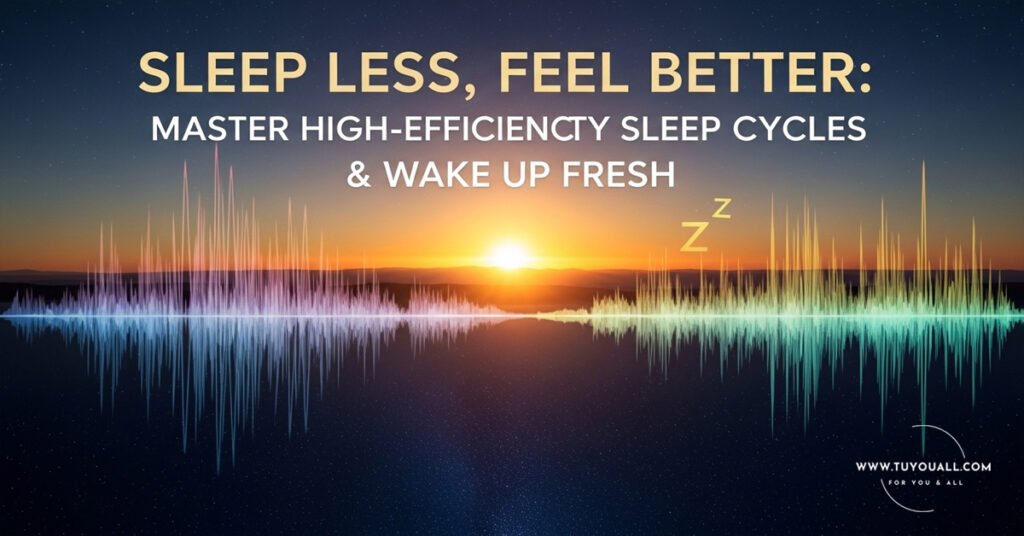
Discover High-Efficiency Sleep: how to sleep 6 hours and feel amazing using the 90-minute sleep cycle method, with science-backed strategies for deep sleep optimization and all-day energy.
Have you ever crawled into bed at a reasonable hour, determined to get eight hours of sleep, only to find yourself scrolling through “just one more video” until 3:00 AM? You finally pass out, wake up exactly six hours later with your eyes burning and brain swimming in fog, and mutter the same empty promise you made yesterday: “I’ll sleep early tomorrow.”
But tomorrow never comes.
Meanwhile, you have that one friend—that entrepreneur, that athlete, or that seemingly superhuman creator on YouTube—who casually mentions, “I only sleep five hours and I feel amazing.” And you’re left wondering, “Bro, how is that even possible?”
Today, we’re answering that exact question. We’re not talking about destroying your health through sleep deprivation. We’re talking about high-efficiency sleep—the science-backed method that allows you to sleep less while waking up sharper, calmer, and fully charged. Let’s hack your sleep cycle without destroying your body.
Why Duration Doesn’t Equal Rest: Understanding Sleep Quality vs Quantity
Here’s the first truth that changes everything: It’s not about how long you sleep; it’s about how efficiently your brain moves through sleep cycles.
Your brain doesn’t just “shut off” when you close your eyes. Instead, it travels through a sophisticated five-stage journey approximately every 90 minutes. This journey moves from light sleep down into deep restorative sleep, then up into REM (Rapid Eye Movement) sleep before starting over again.
Think of it like running laps around a track. You don’t get credit for just showing up at the stadium—you need to complete full laps to count toward your workout.
Deep sleep is where the magic happens for your body: muscle recovery activates, your immune system strengthens, and cellular energy recharges. REM sleep, on the other hand, is your brain’s recovery phase—handling focus, creativity, memory consolidation, and emotional regulation.
When your cycles are clean, aligned, and uninterrupted, your body achieves full recovery even in 5.5 to 6 hours. But when your sleep is fragmented by blue light, stress, caffeine, or environmental chaos, you can sleep nine hours and still feel like a zombie.
“Our goal isn’t more time in bed,” as the original creator explains. “It’s more deep and REM sleep per hour.”
The 90-Minute Sleep Cycle Explained
To master deep sleep optimization, you need to understand your internal architecture. Each complete sleep cycle lasts roughly 90 minutes, and waking up in the middle of one is like hitting a brick wall at full speed.
When you wake mid-cycle, you’re interrupting your brain’s delicate chemical rebalancing act. This creates sleep inertia—the groggy, disoriented feeling that makes you want to smash your alarm clock and hide under the covers.
But when you wake at the end of a complete cycle? Your brain is already in a lighter stage, making the transition to wakefulness feel natural and refreshing.
The Math of Smart Sleeping:
- 5 hours = 3 complete cycles (Minimum viable rest)
- 6 hours = 4 complete cycles (The efficiency sweet spot)
- 5 hours = 5 complete cycles (Traditional “full” rest)
For example:
If you need to wake up at 5:30 AM for morning exercise, you shouldn’t aim for 10:00 PM (7.5 hours) if you’ll just lie awake stressing about tomorrow’s meeting. Instead, aim for 11:00 PM (6.5 hours) and trust that four complete cycles will leave you more refreshed than five interrupted ones.
The 5-Step Efficient Sleep System
Ready to transform your nights? This science-backed system makes your 5 to 6 hours feel like 8+ hours of power sleep through circadian rhythm training and environmental control.
Step 1: Lock Your Sleep Schedule (Even on Weekends)
Your brain craves consistency. Every night you sleep and wake at the same time, you strengthen your circadian rhythm—your body’s internal 24-hour clock that regulates hormone release, including melatonin.
Stanford studies reveal that irregular sleep schedules confuse your brain’s timing mechanism, making your deep sleep phases shorter and lighter. It’s like constantly changing time zones without leaving your bedroom.
For Example:
Set a fixed time that respects your lifestyle. Sleep at 11:00 PM, wake at 5:30 AM. Even on weekends when friends pressure you to stay out late, maintain this rhythm. Within two weeks, you’ll find yourself waking up shockingly fresh—sometimes even before your alarm.
Step 2: Follow the 90-Minute Rule
Remember those cycles? Plan your total sleep time in multiples of 90 minutes. Set your alarm based on cycle completion, not convenient round numbers.
| Wake-Up Time | Ideal Bedtime (4 cycles/6 hrs) | Alternative (3 cycles/4.5 hrs) |
| 5:00 AM | 11:00 PM | 12:30 AM |
| 6:00 AM | 12:00 AM | 1:30 AM |
| 7:00 AM | 1:00 AM | 2:30 AM |
Pro tip: If you miss your ideal bedtime by 20 minutes, wait for the next cycle window rather than starting an incomplete one.
Step 3: The 3-2-1 Pre-Sleep Shutdown Sequence
The last hour before bed isn’t downtime—it’s preparation time for quality sleep. Use what high-performers call the 3-2-1 method:
- 3 hours before bed: No heavy meals. Digestion requires energy that should be going toward cellular repair.
- 2 hours before bed: No work or stress-inducing activities. No emails, no intense conversations, no problem-solving.
- 1 hour before bed: No screens. Blue light blocks melatonin production by up to 50%.
Replace screens with dim, warm lights (under 40 watts), gratitude journaling, meditation, or a calming playlist set to 60-80 beats per minute. Light stretching signals your nervous system that it’s time to shift from “survival mode” to “recovery mode.”
“That light exposure resets your circadian rhythm, suppresses melatonin, and boosts serotonin—your mood, motivation, and alertness hormone,” notes the creator regarding morning routines, but the inverse applies at night: eliminate light to trigger melatonin.
Step 4: Morning Sunlight Exposure
First thing after waking, resist the urge to check your phone. Instead, step outside for 10 minutes of direct sunlight (even through clouds). This light exposure immediately resets your circadian rhythm, suppressing leftover melatonin and boosting serotonin.
You’ll literally feel your brain wake up naturally rather than through the jarring shock of a caffeine hit or Instagram doom-scrolling.
For Example:
Keep your slippers by the door. The moment your alarm sounds, slide them on and step onto your balcony or porch. No coffee, no phone—just light. By day three, you’ll notice you no longer need three hits of the snooze button.
Step 5: Cold Water or Movement Protocol
Don’t hit snooze—hit action. Within 60 seconds of waking, either wash your face with cold water or perform 20 push-ups, jumping jacks, or a quick stretch routine.
This raises your heart rate and boosts dopamine and noradrenaline, clearing sleep inertia within three minutes. Your energy skyrockets naturally before you’ve even had breakfast.
Advanced Sleep Optimization Tricks
Ready for next-level sleep efficiency formula techniques used by elite performers and entrepreneurs?
Strategic Caffeine Timing
Caffeine has a half-life of 5-6 hours and a quarter-life of 12 hours. That means coffee at 2:00 PM is still 25% active in your bloodstream at 2:00 AM, even if you fall asleep easily.
“Caffeine blocks adenosine, the chemical that makes you sleepy. If you drink late, it stays in your system for 6 to 8 hours. Even if you fall asleep, your deep sleep drops by up to 30%,” explains the source material.
The Rule: No caffeine after 2:00 PM. Switch to herbal teas or decaf after lunch.
Optimize Your Sleep Environment
Your bedroom should mimic a cave: dark, cold, and quiet.
| Factor | Ideal Setting | Why It Matters |
| Temperature | 18-20°C (64-68°F) | Core body temp drops for deep sleep initiation |
| Light | Pitch black or sleep mask | Light exposure halts melatonin |
| Sound | White noise or silence | Prevents micro-arousals during cycles |
The colder and darker your room, the more deep sleep your body generates. Consider a cooling mattress pad if you sleep hot.
Magnesium and Herbal Support
Low magnesium correlates directly with poor sleep quality and frequent nighttime waking. Magnesium glycinate specifically calms the nervous system without the digestive upset of other forms.
Alternatively, ashwagandha tea or L-theanine can reduce cortisol levels before bed. Always consult your doctor first before adding supplements, especially if you’re on other medications.
Mental Declutter Protocol
When your mind races with tomorrow’s to-do list, your brain stays in beta waves—active, alert, awake mode. Five minutes of “brain dumping” onto paper shifts you into alpha and theta waves, the precursors to deep sleep.
Keep a notebook by your bed. Write down everything bothering you—emails to send, groceries to buy, that awkward conversation you keep replaying. Tell your brain, “I’ve captured this; I can forget it until morning.”
The Mindset Shift: Sleep as a Performance Tool
Here’s the paradigm shift that separates high performers from exhausted hustlers: Sleep isn’t a weakness or a waste of time—it’s a strategic performance tool.
You don’t need to brag about sleeping four hours. You don’t get a trophy for exhaustion. What you need is to master efficient recovery because, as the original creator emphasizes, “Success isn’t about who stays up late; it’s about who wakes up clear, calm, and focused.”
You cannot pour from an empty brain. You cannot generate creative solutions, lead teams effectively, or maintain emotional stability while running on fragmented, inefficient sleep.
Optimize your sleep, and you’ll get more time, energy, and life back. Sleep less, but sleep smarter. Train your body to rest deeply, dream vividly, and wake up with power.
Because one day, when you wake up five minutes before your alarm—eyes open, heart calm, mind clear—you’ll realize you never needed more time. You just needed better energy.
Frequently Asked Questions
Q.1. What is the 90-minute sleep cycle rule?
The 90-minute sleep cycle rule states that sleeping in multiples of 90 minutes (4.5, 6, 7.5, or 9 hours) allows you to wake at the end of a complete cycle, minimizing grogginess. Waking mid-cycle interrupts deep or REM sleep, causing sleep inertia and daytime fatigue.
Q.2. Can I really function well on just 6 hours of sleep?
Yes, if those 6 hours consist of high-quality, uninterrupted sleep cycles. Six hours of efficient sleep (4 complete cycles) often beats 8 hours of fragmented sleep filled with blue light exposure, late caffeine, or inconsistent timing. The key is maximizing deep and REM phases through circadian rhythm training.
Q.3. Does caffeine actually affect sleep quality if I fall asleep easily?
Absolutely. Caffeine blocks adenosine receptors, preventing deep sleep even if you lose consciousness quickly. Studies show late-day caffeine can reduce deep sleep by up to 30%, meaning you wake up physically unrested despite sleeping 8+ hours.
Q.4. How long does it take to reset my circadian rhythm?
With strict consistency (same sleep/wake times, morning sunlight, no blue light before bed), most people reset their circadian rhythm within 7-10 days. The first 3-4 days may feel difficult as your body adjusts.
Q.5. What’s the ideal room temperature for deep sleep?
Research indicates 18-20°C (64-68°F) optimizes deep sleep. Your core body temperature naturally drops during sleep initiation, and a cool room facilitates this process. Temperatures above 24°C (75°F) significantly reduce sleep efficiency.
Source & Credit:
This blog post is based on insights from the YouTube video exploring high-efficiency sleep methodology.
The original content has been translated, expanded, and repurposed for educational purposes.
“Sleep isn’t a weakness, it’s a performance tool… because one day, when you wake up before your alarm, eyes open, heart calm, mind clear, you’ll realize you don’t need more time. You just need better energy.”