This blog post is based on insights from Dr. Vandana Shiva’s keynote presentation at “A Symposium on Consciousness” (2026), titled “The Power of Quantum Thinking.”
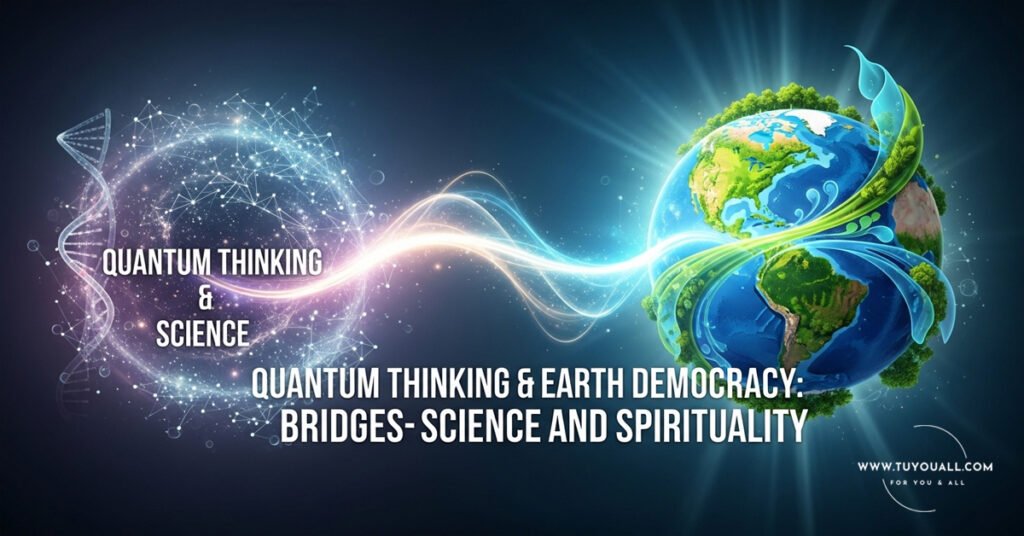
Discover how Quantum Thinking—along with quantum physics pioneer Dr. Vandana Shiva—bridges science and spirituality to transform our relationship with nature through interconnectedness, seed sovereignty, and Earth Democracy.
Have you ever felt that something is fundamentally wrong with how we treat the Earth? That despite all our technological advances, we’re somehow missing the point about our place in the universe? You’re not alone. A century ago, a radical shift began in physics—one that could transform not just science, but how we live, grow food, and relate to every living being on this planet. Yet most of us are still living according to a 300-year-old broken playbook.
Dr. Vandana Shiva—quantum physicist, activist, and author of over 20 books including Making Peace with Earth and Soil Not Oil—has dedicated her life to bridging this gap. At a recent Consciousness Symposium, she delivered a powerful keynote that connects the dots between quantum mechanics, consciousness, and ecological survival. What she shared might just change how you see everything—from the soil beneath your feet to the future of humanity itself.
The Great Betrayal: How a 300-Year-Old Experiment Still Controls Our Minds
The Architects of Separation
Here’s something they don’t teach in school: modern science wasn’t born from pure curiosity. It was engineered as a tool of domination—and its founding fathers were surprisingly explicit about their intentions.
Dr. Shiva traces our current environmental crisis back to two 17th-century figures: Francis Bacon and René Descartes. A full century before Isaac Newton’s equations, these men laid the philosophical foundations for what Dr. Shiva calls “the mechanistic paradigm”—a worldview built on separation, control, and violence against nature.
Bacon, who served as Chancellor of England and head of the Inquisition, wrote openly about his vision. In The Masculine Birth of Time, he declared that nature must be “forced out of her natural state, squeezed and molded” through violence. He literally called for “war on nature” to “storm and occupy her castles” and extend “the boundaries of human Empire.” As economic anthropologist Jason Hickel notes, Bacon actively sought to destroy the idea of a living world and transform nature “from a nurturing mother to a common harlot.”
Descartes completed the division by splitting reality into two substances: res extensa (extended matter, essentially dead stuff) and res cogitans (thinking mind). His famous “I think, therefore I am” wasn’t just philosophy—it was a declaration of independence from the body, from nature, from relationship itself.
For Example:
Imagine walking through a forest and seeing only “timber resources,” “water extraction sites,” and “developable land.” That’s the mechanistic lens in action. It renders the forest silent, dead, and waiting to be used—despite the complex, conscious ecosystem actually present.
The Violence Built Into the System
This wasn’t abstract philosophy. It justified real brutality. The same period saw the witch trials, where 9 million people—mostly women who knew herbal medicine and lived in relationship with nature—were killed for “thinking in their own way.” The mechanistic worldview and the Inquisition were two sides of the same coin: the suppression of organic, interconnected ways of knowing.
Dr. Shiva emphasizes that this paradigm isn’t just intellectually wrong—it’s structurally violent. When you view the world as inert matter waiting to be manipulated, you create the psychological and ethical conditions for extraction, exploitation, and ecological collapse.
The Quantum Revolution: Reality Isn’t What We Were Taught
From Certainty to Potential
A century ago, everything changed. Quantum theory emerged—not from one genius, but from intense debates among scientists like Einstein, Bohr, Heisenberg, and Schrödinger. What they discovered overturned the mechanistic worldview at every level.
The core revelation? The world isn’t made of static objects. It’s made of potential and transition probabilities. As Dr. Shiva explains, “There are no things in the world. There’s just potential waiting to happen.”
Think about that. The chair you’re sitting on, the screen you’re reading this on, even your own body—these aren’t solid, fixed objects. They’re patterns of potential that have crystallized into temporary form. Quantum physics shows that particles exist in superposition, simultaneously occupying multiple states until observed.
For Example:
Consider a seed. The mechanistic view sees it as a passive object containing genetic information—essentially a biological machine. The quantum view sees it as “implicate order” (to use physicist David Bohm’s term)—a compressed potential containing not just a plant, but relationships with soil, water, sunlight, pollinators, and the entire ecosystem it will help create. The seed is a process, not a thing.
The Four Pillars of Quantum Thinking
Dr. Shiva distills quantum theory into four transformative principles that apply far beyond physics:
| Principle | What It Means | Practical Impact |
| Non-duality | No separation between observer and observed; no subject-object divide | We are participants, not masters. Knowledge comes through relationship, not domination. |
| Non-locality/Entanglement | Once systems interact, they remain connected regardless of distance | Everything we do affects everything else. Local action has global consequences. |
| Uncertainty & Indeterminism | Potential and probability replace fixed certainty | We must embrace humility, adaptability, and participation rather than control. |
| Wholeness over Reductionism | Parts are determined by the whole, not the other way around | Ecosystems, communities, and relationships take precedence over isolated components |
When the Founders Turned East
What’s fascinating is how many quantum pioneers turned to ancient wisdom to make sense of their discoveries. Max Planck, who originated quantum theory, stated: “I regard consciousness as fundamental. I regard matter as derivative from consciousness.” Erwin Schrödinger, inspired by the Upanishads, wrote: “Mind is only one. There’s no separation between subject and object… individual consciousnesses are manifestations of a single mind.”
Dr. Shiva, trained in quantum physics at the University of Western Ontario (where she studied under David Bohm’s student Jeffrey Bub), recognized these connections immediately. Growing up in the Himalayan forests, she experienced the interconnected reality that quantum physics was now mathematically confirming.
From Physics to Activism: The Unbroken Thread
Why “Shifting” Wasn’t Necessary
People often ask Dr. Shiva how she “shifted” from physics to environmental activism. Her answer surprises them: she never shifted. She simply applied the same principles of indeterminism, entanglement, and non-locality to living systems.
In 1984, she founded the organic movement in India in the same region where Gandhi had built his freedom movement around spinning cloth. When GMO cotton (Bt cotton) turned that region into the “capital of farmer suicides,” she made an annual commitment to those farmers—a promise to return every year until they achieved ecological and economic sovereignty.
For Example:
The Chipko movement, where women hugged trees to prevent logging, wasn’t just protest—it was quantum thinking in action. These women understood that forests prevent landslides, maintain water cycles, and sustain life. They weren’t “resources”; they were relationships. When Dr. Shiva studied with these women—”my bigger PhD,” she calls it—she saw quantum entanglement made visible: the forest and the village were one system, separated only in the mechanistic mind.
Ecological Apartheid vs. Earth Democracy
Dr. Shiva introduces a crucial term: “ecological apartheid.” Just as apartheid in South Africa was “separateness and ruling on the basis of separateness and superiority,” ecological apartheid treats all non-human life as inferior objects for human manipulation.
The alternative? Earth Democracy—a worldview where “all life is entangled.” Drawing on the African concept of Ubuntu (“I am because you are”) and the Indian Vasudhaiva Kutumbakam (“the world is one family”), Earth Democracy recognizes that trees provide our oxygen, soil microbiomes mirror our gut biomes, and the health of the planet is inseparable from human health.
The Gut-Soil-Brain Continuum: Consciousness Everywhere
Beyond Brain-Centered Consciousness
One of Dr. Shiva’s most provocative points challenges the current obsession with locating consciousness solely in the human brain. She points to cutting-edge research showing:
- The gut is our “second brain”—containing millions of neurons and producing neurotransmitters
- Soil biodiversity directly correlates with gut microbiome health—they are “one continuum”
- Plant roots function as neurological centers—Darwin called them “the brain of the plant”
For Example:
When you add organic matter to soil, life “bursts” forth. Nutrition increases in plants. The entire system activates. This isn’t metaphor—it’s measurable quantum biological activity. The consciousness we seek isn’t locked in human skulls; it’s “pervasive everywhere,” distributed through mycelial networks, root systems, and microbial communities.
Negative Entropy: Life’s Quantum Magic
Physicist Erwin Schrödinger asked “What is life?” and identified its defining feature: negative entropy. While machines create entropy (waste heat, pollution, disorder), living systems organize themselves, store energy, and create order from chaos through photosynthesis.
Every photon that hits a leaf performs quantum magic—lifting an electron, storing energy, building life without heating up. This is why Dr. Shiva rejects Bill Gates’ recent claim that planting trees is “nonsense” for climate change. Trees aren’t just carbon storage devices; they’re quantum biological engines of negative entropy, creating the conditions for life to flourish.
Seed Sovereignty: Living Quantum Resistance
The War on Seed Freedom
In 1987, the pesticide industry held a meeting that changed Dr. Shiva’s trajectory. They declared: “Now we have to make up profits from seed.” Their strategy was threefold:
- Use genetic engineering to claim seeds as “inventions”
- Patent life itself
- Make seed-saving illegal through international trade laws
This was the mechanistic paradigm applied to biology—treating seeds as machines to be engineered, owned, and controlled. Dr. Shiva responded by founding Navdanya (“nine seeds”), a movement to save biodiversity and defend farmers’ rights to save and share seeds.
For Example:
When Monsanto claimed ownership of Bt cotton seeds, Indian farmers who had saved seeds for millennia suddenly faced lawsuits and debt. The “Gardens of Hope” Dr. Shiva established with widows of farmer suicide victims weren’t just food gardens—they were quantum resistance. By maintaining biodiversity (nine crops, twelve crops growing together instead of monocultures), these women created systems of “Health per Acre” rather than “Yield per Acre,” measuring success by ecosystem vitality rather than commodity extraction.
Gandhi’s Salt, Shiva’s Seeds
Dr. Shiva explicitly connects her work to Gandhi’s Salt Satyagraha. Just as Gandhi picked up salt from the sea and declared “nature gives it for free; we need it for survival; we will make salt,” she initiated Seed Satyagraha. “Seed is brought to us by Nature, her evolution, and our breeding over thousands of years. We will continue to save and share seeds as our moral and ecological duty of freedom.”
This is quantum thinking as civil disobedience: recognizing that life cannot be owned, that seeds are not machines, and that cooperation (symbiosis) outperforms control (domination).
The Hard Problem Isn’t Consciousness—It’s Separation
Reframing the “Hard Problem”
At a previous consciousness symposium, Dr. Shiva heard the term “hard problem” of consciousness—the mystery of how subjective experience arises from physical matter. Her response was characteristically sharp: “Typical of Cartesian thought to take a constructed divide and then keep wondering how you’ll overcome the divide, rather than realize that the divide is constructed.”
The real hard problem, she argues, is epistemic apartheid—the hierarchy of knowledge that privileges Western mechanistic science over indigenous wisdom, expert opinion over lived experience, and abstraction over relationship.
For Example:
When Chipko women stopped at the forest edge, removed their slippers, and prayed to the forest goddess before entering, they weren’t being superstitious. They were practicing quantum relationality—acknowledging their participation in a conscious system, asking permission, promising reciprocity (“I will never take more than I need”). This is sophisticated ecological science, encoded in ritual.
The Joy of Participation
Dr. Shiva distinguishes between “mastery” and “participation.” Mastery requires force, creates burnout, and generates entropy. Participation brings humility, joy, and negative entropy.
When an audience member asked if she should stop gardening because weeding feels like violence, Dr. Shiva responded: “Joy and participation isn’t mastery—it’s relationship.” The key is intention. Tending a garden with awareness of interconnection, with gratitude for the plants that feed us, with acceptance of limits (“enoughness”)—this is non-violent participation. The mechanistic alternative is “farming without farmers, food without farms”—lab-grown protein factories that actually require 5x more land for feedstock and produce 25x more emissions than organic agriculture.
FAQ: Understanding Quantum Consciousness & Earth Democracy
Q: How can quantum physics, which deals with subatomic particles, apply to large-scale ecology and agriculture?
A: Quantum principles like entanglement and non-locality operate at all scales, not just the microscopic. Dr. Shiva’s research shows that biodiversity density (more crops per acre) creates more food through cooperative relationships—quantum-style synergy rather than mechanical addition. Ecosystems function as entangled wholes where “the health of the soil and the biodiversity of the soil is totally entangled with the biodiversity and health of the gut.” The same patterns appear whether we’re talking about electron correlations or farm-to-body nutrition.
Q: Isn’t the mechanistic worldview responsible for modern medicine and technology? Why abandon it completely?
A: Dr. Shiva doesn’t reject all technology—she rejects the philosophy of domination built into mechanistic science. She notes that quantum theory actually enables more sophisticated technology while maintaining ethical relationship. The issue is whether we view nature as “dead matter to be extracted” or “living consciousness to participate with.” The latter approach, she argues, produces better long-term outcomes for health, food security, and climate stability.
Q: What does “consciousness as fundamental” actually mean in practical terms?
A: It means consciousness isn’t a byproduct of brain activity—it’s the ground of reality itself. As Max Planck stated, “Everything that we regard as existing postulates consciousness.” Practically, this shifts us from “how can we control nature?” to “how can we participate wisely?” It means recognizing that plants, forests, and ecosystems have agency and responsiveness. It means understanding that artificial intelligence, lacking embodied participation in living systems, cannot replicate the wisdom of genuine consciousness.
Q: How can individuals apply quantum thinking to daily life?
A: Start with relationship. Buy food from local farmers who maintain biodiversity. Start a garden, even a small one, and observe the entanglement between soil, plants, insects, and yourself. Practice “enoughness”—taking only what you need with gratitude. Recognize that your gut microbiome connects you to soil health across the planet. Vote and advocate for “Earth Democracy” policies that recognize rights of nature. As Dr. Shiva says, “When you do the right thing, you find joy”—negative entropy in personal action.
Q: What is the connection between seed saving and quantum theory?
A: Seeds embody “implicate order”—David Bohm’s term for the enfolded potential that unfolds into visible reality. A seed contains not just genetic information, but the potential for infinite relationships with soil, water, weather, and creatures. Patenting seeds treats them as static objects (mechanistic view), while saving seeds honors them as dynamic potential (quantum view). Seed sovereignty is therefore quantum sovereignty—the right to participate in evolution’s unfolding rather than having it controlled by corporate “master molecules.”
Conclusion: The Choice Before Us
We stand at a crossroads that Francis Bacon and René Descartes couldn’t have imagined, but that their philosophy made inevitable. The mechanistic paradigm has delivered us to climate chaos, mass extinction, farmer suicides, and epidemic chronic disease. It promised mastery and delivered entropy.
Dr. Vandana Shiva offers a different path—one that quantum physics confirmed mathematically a century ago, and that indigenous wisdom has practiced for millennia. This path recognizes that we are not separate from nature observing it; we are nature observing itself. It replaces the violence of extraction with the joy of participation. It transforms “ecological apartheid” into “Earth Democracy.”
The choice isn’t between science and spirituality, or between progress and tradition. It’s between a dead universe of objects and a living universe of relationships. Between certainty that leads to control and uncertainty that leads to creativity. Between entropy that burns out and negative entropy that sustains.
As Dr. Shiva reminds us, trees don’t burn out. They’ve been going for millions of years, maintaining the atmosphere that makes our consciousness possible. When we align with living systems—when we think quantum, act local, and participate fully—we tap into that same inexhaustible energy.
The revolution won’t be mechanistic. It will be quantum, conscious, and deeply alive.
What relationship will you choose to cultivate today?
Source & Credit
This blog post is based on insights from Dr. Vandana Shiva’s keynote presentation at “A Symposium on Consciousness” (2026), titled “The Power of Quantum Thinking.”
The original content has been translated, expanded, and repurposed for educational purposes.
Dr. Vandana Shiva is the founder of Navdanya International, recipient of the Right Livelihood Award (1993), and author of over 20 books including Making Peace with Earth, Soil Not Oil, and Stolen Harvest. She holds a Ph.D. in quantum theory from the University of Western Ontario and has been recognized as a “Gandhi of Grain” for her activism in seed sovereignty and anti-GMO movements.