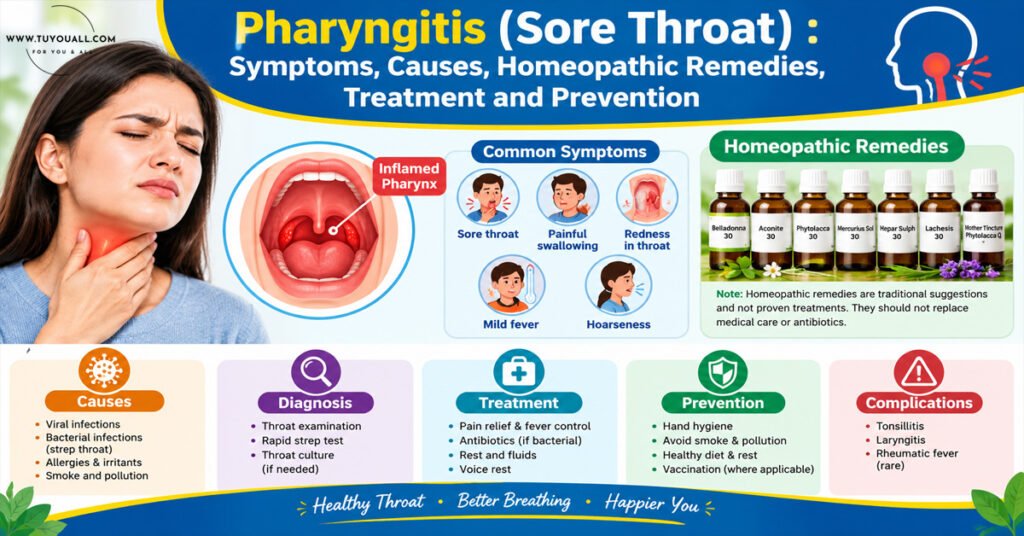
Learn About Pharyngitis Symptoms, Causes, Diagnosis, Treatment, Homeopathic Remedies, Prevention, And Warning Signs That Need Medical Attention.
A sore throat can make simple things like swallowing, speaking, and eating uncomfortable. In many cases, it improves within a few days. However, some sore throats need medical attention, especially when a bacterial infection such as strep throat is possible.
This guide explains the symptoms, causes, diagnosis, treatment, prevention, and traditional homeopathic remedies associated with pharyngitis. It also explains when to seek medical help and why antibiotics should only be used when appropriate.
Important health note: The remedies listed in the supplied image are traditional homeopathic suggestions, not proven treatments. They should not replace medical assessment or evidence-based care.
What Is Pharyngitis?
Pharyngitis means inflammation of the pharynx, the area at the back of the throat. People commonly call it a sore throat.
It may cause:
- Pain or irritation in the throat
- Pain when swallowing
- Redness at the back of the throat
- Mild fever
- Hoarseness or a rough voice
Pharyngitis can happen on its own or along with a cold, flu, or another respiratory infection. Most cases are caused by viruses. Some cases are caused by bacteria, including Group A Streptococcus, which causes strep throat.
Symptoms of Pharyngitis
The symptoms can range from mild throat irritation to severe pain. They often depend on the cause of the infection.
Common symptoms
The supplied case image lists these main complaints:
- Sore throat: A scratchy, dry, burning, or painful feeling in the throat.
- Painful swallowing: Swallowing food, water, or even saliva may hurt.
- Throat redness: The back of the throat may look red or inflamed.
- Mild fever: Some people develop a raised body temperature.
- Hoarseness: The voice may sound rough, weak, or different.
Other symptoms may include:
- Coughing and sneezing
- Runny or blocked nose
- Swollen glands in the neck
- Headache
- Tiredness
- Enlarged or swollen tonsils
- White patches or pus on the tonsils
Viral and bacterial symptoms: What is the difference?
Viral and bacterial throat infections can feel similar. However, some symptoms offer useful clues.
| Feature | Viral pharyngitis | Strep throat |
| Cough | Common | Usually absent |
| Runny nose | Common | Usually absent |
| Hoarse voice | Can occur | Less typical |
| Fever | May occur | Common |
| Painful swallowing | Possible | Common |
| Tonsil patches | Sometimes | May occur |
| Cause | Respiratory viruses | Group A Streptococcus bacteria |
These clues cannot confirm the cause by themselves. A healthcare professional may need to perform a throat test.
Causes of Pharyngitis
Pharyngitis develops when the tissues at the back of the throat become irritated or inflamed.
1. Viral infections
Viruses cause most cases of acute pharyngitis. Common examples include:
- Common cold viruses
- Influenza viruses
- Coronavirus
- Adenoviruses
- Other respiratory viruses
A viral sore throat may occur with a cough, cold, runny nose, or body aches.
2. Bacterial infections
Group A Streptococcus is an important bacterial cause. It is commonly known as strep throat.
Strep throat occurs most often in children aged 5–15 years. Adults can also develop it.
A confirmed strep infection needs appropriate antibiotic treatment. This helps reduce symptoms, spread, and the risk of complications.
CDC+1
3. Allergy and environmental irritation
Not every sore throat is caused by an infection. Other triggers include:
- Dust and air pollution
- Cigarette smoke
- Allergies
- Dry air
- Excessive shouting or speaking
- Acid reflux
For example,
a person who speaks loudly for several hours may develop throat irritation and hoarseness without having an infection.
4. Risk factors
Some situations make throat irritation or infection more likely:
- Close contact with someone who has a respiratory infection
- Crowded classrooms, offices, or public transport
- Poor hand hygiene
- Exposure to smoke or air pollution
- Seasonal respiratory infections
- Frequent contact with infected children
How Is Pharyngitis Diagnosed?
A doctor usually begins by asking about symptoms and examining the throat.
The examination may include:
- Checking throat redness and swelling
- Looking for enlarged tonsils or white patches
- Checking glands in the neck
- Measuring body temperature
- Asking about cough, cold symptoms, and recent contact with sick people
Rapid strep test
A rapid antigen detection test uses a throat swab. It checks for Group A Streptococcus and can provide a result quickly.
Throat culture
A throat culture checks whether strep bacteria grow from a throat swab. It can detect some infections missed by a rapid test.
In children aged 3 years and older, a negative rapid strep test should generally be followed by a throat culture when strep is suspected. In adults, this follow-up is not usually needed.
Important: A red throat alone does not prove that someone has a bacterial infection. A healthcare professional should decide whether testing is needed.
Treatment of Pharyngitis
Treatment depends on what causes the sore throat. Most viral cases improve with supportive care. Bacterial infections may need specific treatment.
1. Supportive care for a sore throat
These simple steps can make the throat feel more comfortable:
- Drink enough water throughout the day.
- Gargle with warm salt water if you can gargle safely.
- Choose soft foods that are easy to swallow.
- Avoid smoking and smoky environments.
- Rest your voice.
- Get enough sleep.
- Use a clean humidifier if the air is dry.
Warm salt-water gargling may soothe irritation. However, it does not cure a bacterial infection.
Avoid inhaling steam from a pot of boiling water. It can cause serious burns, especially in children. A warm shower or a properly used humidifier is a safer option.
2. Medicines for pain and fever
Paracetamol may help reduce throat pain and fever. Ibuprofen may also help when it is suitable for the person.
Always follow the product label or a healthcare professional’s advice. Age, pregnancy, allergies, kidney problems, stomach ulcers, and other conditions can affect which medicine is safe.
Medicated throat lozenges may provide some relief for adults. Their benefit is usually modest.
3. Antibiotics for bacterial pharyngitis
Antibiotics do not work against viruses. Therefore, they should not be used for an ordinary viral sore throat.
When a rapid test or throat culture confirms Group A strep, a doctor will usually prescribe an appropriate antibiotic. Penicillin or amoxicillin is commonly recommended when there is no relevant allergy.
Take the medicine exactly as prescribed. Do not stop early, share antibiotics, or use leftover tablets.
Correct treatment helps reduce the spread of strep and lowers the risk of complications, including acute rheumatic fever.
4. When should you expect improvement?
Many uncomplicated sore throats improve within about one week. Some discomfort may remain for several days.
Seek medical advice if symptoms worsen, do not begin to improve, or keep returning. Do not wait for a routine follow-up if serious warning signs appear.
Homeopathic Remedies for Pharyngitis
The supplied image lists seven homeopathic medicines traditionally associated with different sore-throat patterns.
Homeopathy uses a system of highly diluted preparations. However, reliable evidence has not established that these remedies treat pharyngitis or kill the bacteria responsible for strep throat.
The descriptions below explain the traditional associations shown in the case image. They are not proven medical indications or treatment recommendations.
1. Belladonna 30
Traditional association: Sudden throat discomfort, marked redness, heat, and a throbbing sensation.
The case image associates Belladonna with a sudden, hot, red, throbbing sore throat.
2. Aconite 30
Traditional association: Sudden symptoms after exposure to cold air, with dryness or a burning feeling.
The case image lists this remedy for a dry, burning throat after cold exposure.
3. Phytolacca 30
Traditional association: A dark-red or painful throat, sometimes with discomfort extending towards the ears.
The case image describes pain that may seem to travel from the throat towards the ears.
4. Mercurius Sol 30
Traditional association: Throat discomfort accompanied by excessive saliva, mouth ulcers, or bad breath.
These features can also occur with infections that need medical assessment.
5. Hepar Sulph 30
Traditional association: A sharp, splinter-like throat sensation and sensitivity to cold.
This is a traditional homeopathic symptom description, not a clinically proven way to identify the cause of a sore throat.
6. Lachesis 30
Traditional association: Left-sided throat discomfort and pain when swallowing liquids.
The case image also mentions symptoms that feel worse after sleep.
7. Mother Tincture Phytolacca Q
Traditional association: The supplied image lists Phytolacca mother tincture diluted in warm water for gargling.
However, this should not be treated as a recommended gargle. Mother tinctures can contain active plant substances and alcohol. Their safety depends on the preparation and concentration.
Do not gargle with or swallow a mother tincture unless a qualified healthcare professional has checked that specific product and its safety.
Homeopathic Remedy Summary
| Remedy shown in the image | Traditional symptom association |
| Belladonna 30 | Sudden, hot, red, throbbing throat |
| Aconite 30 | Dry, burning throat after cold exposure |
| Phytolacca 30 | Dark-red throat and pain towards the ears |
| Mercurius Sol 30 | Salivation, ulcers, and bad breath |
| Hepar Sulph 30 | Splinter-like pain and cold sensitivity |
| Lachesis 30 | Left-sided pain and discomfort swallowing liquids |
| Phytolacca Q | Listed in the image for gargling; safety needs assessment |
Possible Complications of Pharyngitis
Most sore throats settle without serious problems. However, certain infections can cause complications, especially when they are not recognised or treated appropriately.
1. Tonsillitis
Tonsillitis means inflammation of the tonsils. It may cause:
- Swollen tonsils
- Throat pain
- Fever
- Painful swallowing
- White patches on the tonsils
Tonsillitis can be viral or bacterial.
2. Laryngitis
Laryngitis is inflammation of the voice box. It can cause:
- Hoarseness
- Weak or lost voice
- Dry cough
- Throat irritation
Resting the voice and drinking enough fluids may help.
3. Acute rheumatic fever
Acute rheumatic fever is a serious inflammatory illness that can develop after an untreated Group A strep infection.
It can affect the heart, joints, brain, and skin. Appropriate treatment of confirmed strep throat helps reduce this risk.
4. Other possible complications
Some bacterial throat infections can lead to:
- A collection of pus near the tonsil, called a peritonsillar abscess
- Infection in deeper tissues of the neck
- Scarlet fever
- Kidney inflammation after certain strep infections
These complications are not typical of every sore throat. They need medical assessment.
When Should You See a Doctor?
Do not ignore a sore throat that is severe, persistent, or getting worse.
Seek emergency medical help if you have:
- Difficulty breathing
- Inability to swallow
- Drooling because you cannot swallow saliva
- Noisy or high-pitched breathing
- Rapidly worsening severe symptoms
These signs may indicate a serious problem affecting the airway or throat.
Arrange a medical assessment if you notice:
- High fever or shaking chills
- Dehydration or passing very little urine
- A rash with a sore throat
- Severe pain or swollen neck glands
- Symptoms that are not improving after about one week
- Repeated episodes of sore throat
- A weakened immune system
Children, older adults, and people with long-term health conditions may need earlier assessment.
Prevention of Pharyngitis
You cannot prevent every sore throat. However, good hygiene and healthy habits can lower the risk of infection.
1. Wash your hands regularly
Wash your hands with soap and water, especially:
- Before eating
- After using the toilet
- After coughing or sneezing
- After touching shared surfaces
If soap and water are unavailable, use a suitable alcohol-based hand sanitiser.
2. Avoid sharing personal items
Do not share:
- Drinking glasses
- Water bottles
- Spoons and forks
- Toothbrushes
- Towels
These habits can help reduce the spread of infections.
3. Cover coughs and sneezes
Use a tissue or your elbow when coughing or sneezing. Dispose of used tissues safely and wash your hands afterwards.
4. Avoid smoke and air pollution
Cigarette smoke and polluted air can irritate the throat. Avoid smoking and limit exposure to dusty or smoky places whenever possible.
5. Maintain healthy daily habits
A balanced diet, adequate sleep, and regular physical activity support general health. Drink enough water and avoid excessive strain on your voice.
6. Follow medical advice for confirmed strep throat
People with confirmed strep throat should take prescribed antibiotics correctly. They should also follow advice about staying away from school, work, or close contact until they are no longer likely to spread the infection.
For example, CDC guidance advises people with strep throat to stay home until they have no fever and have taken appropriate antibiotics for at least 12–24 hours.
Practical Examples: Understanding Different Types of Sore Throat
The following examples show why identifying the cause matters.
Example 1: Sore throat with a common cold
A person develops a sore throat, sneezing, a runny nose, and a mild cough.
These symptoms often suggest a viral infection. Rest, fluids, and suitable pain relief may be enough. Antibiotics are not useful for a viral infection.
Example 2: Sudden sore throat with fever
A school-aged child develops sudden throat pain, fever, and painful swallowing. The child does not have a cough or runny nose.
Strep throat may be a possibility. A doctor can examine the child and decide whether a rapid strep test or throat culture is needed.
Example 3: Hoarseness after speaking loudly
A person speaks loudly for several hours at an event. Later, the throat feels dry and the voice becomes hoarse.
Voice strain may be responsible. Resting the voice and drinking enough fluids may help. Persistent or worsening symptoms still need assessment.
Example 4: Sore throat with a rash
A child develops a sore throat, fever, and a new rash.
This combination needs prompt medical assessment. Scarlet fever is one possible cause, but a clinician must determine the diagnosis.
Frequently Asked Questions (FAQs)
- What is the main cause of pharyngitis?
Viruses are the most common cause of pharyngitis. Bacteria, especially Group A Streptococcus, can also cause it. Allergies, smoke, dry air, and acid reflux may cause similar throat symptoms.
- How long does pharyngitis usually last?
Many uncomplicated sore throats improve within about one week. The duration depends on the cause and the person’s general health. See a doctor if symptoms worsen or do not improve.
- Can pharyngitis be treated without antibiotics?
Yes. Most cases are viral and do not need antibiotics. However, confirmed Group A strep throat needs appropriate antibiotic treatment prescribed by a healthcare professional.
- Which homeopathic remedies are traditionally used for pharyngitis?
The supplied case image lists Belladonna, Aconite, Phytolacca, Mercurius Sol, Hepar Sulph, Lachesis, and Phytolacca mother tincture. These are traditional homeopathic associations, not proven treatments for pharyngitis. They should not replace medical diagnosis or appropriate treatment.
- Can untreated strep throat cause rheumatic fever?
Yes. Acute rheumatic fever can develop after an untreated Group A strep infection. Appropriate antibiotic treatment of confirmed strep throat helps reduce this risk.
References & Further Learning:
For additional clinical insights, materia medica explanations, and practical perspectives on homeopathic management, the information in this article/page has been cross-referenced with educational resources shared by qualified homeopathic practitioners and researchers in their YouTube Channel (Links given Below). Readers seeking deeper guidance on remedy selection, potencies, and holistic care may explore video lectures and case discussions by established homeopathic doctors as listed below with their YouTube Channel Link :
| SL No. | Channel / Doctor Name | Primary Focus & Clinical Background | YouTube Link |
| 1 | Dr. Kirti Vikram Singh | Covers disease-specific remedies, mother tinctures, German combinations, and daily live Q&A sessions. | https://www.youtube.com/drkirtivikramsingh |
| 2 | Dr. Pranjali Srivastava | Registered BHMS physician and certified nutritionist focusing on holistic disease management and lifestyle care. | https://www.youtube.com/@drpranjalihomeopathy
|
| 3 | Dr. Swapnil Sagar Jain | BHMS consultant at Niramay Homeopathy offering remedy guides for acute and chronic conditions. | https://www.youtube.com/@DrSwapnilSagarJain-NIRAMAY |
| 4 | Dr. Umang Khanna | Focuses on natural homeopathic treatments, chronic illness management, and educational health guides in Hindi. | https://www.youtube.com/@drumangkhanna |
| 5 | Shree Radhey Homeopathy | Hosted by Dr. Chakshu; features remedy explanations, patient case stories, and live consultation Q&As. | https://www.youtube.com/@ShreeRadhey |
| 6 | Dr. P.S. Tiwari | Senior D.M.S. homeopath with 36+ years of experience explaining classical Materia Medica and therapeutics. | https://www.youtube.com/@DrPSTiwari |
| 7 | Dr. Varun Kanwadia | BHMS, DNHE consultant sharing practical homeopathic solutions for skin, hair, respiratory, and digestive issues. | https://www.youtube.com/@varunkanwadia |
| 8 | Dr. Arpana Samanta | Gold Medalist BHMS (Delhi) & PGD (London) with 20+ years of experience covering chronic diseases like thyroid, PCOS, and skin disorders. | https://www.youtube.com/@dr.arpanasamanta |
| 9 | Dr. Rukmani Choudhary | Focuses on root-cause homeopathic treatments, comparative remedy selection, and live Q&A sessions. | https://www.youtube.com/@Dr.Rukmani-HomeopathyClinic |
| 10 | Dr. Santosh Kumar Padhy | Provides accessible homeopathic remedy suggestions and general health guidance for everyday ailments. | https://www.youtube.com/@dr.santoshkumarpadhy8888 |
Medical Disclaimer:
This article is for educational and informational purposes only. It is not a substitute for professional medical advice, diagnosis, or treatment. Always seek the guidance of a qualified healthcare provider and a licensed homeopathic practitioner before starting any treatment for pneumonia or any other medical condition.