This blog post is based on insights from Dr. Vikas Divyakirti‘s YouTube video exploring parenting challenges in the AI era.
Have you ever handed your crying toddler a smartphone just to get five minutes of peace? You’re not alone. But here’s the uncomfortable truth: that small act might be opening a door to dangers we never imagined—dangers that didn’t exist when we were kids.
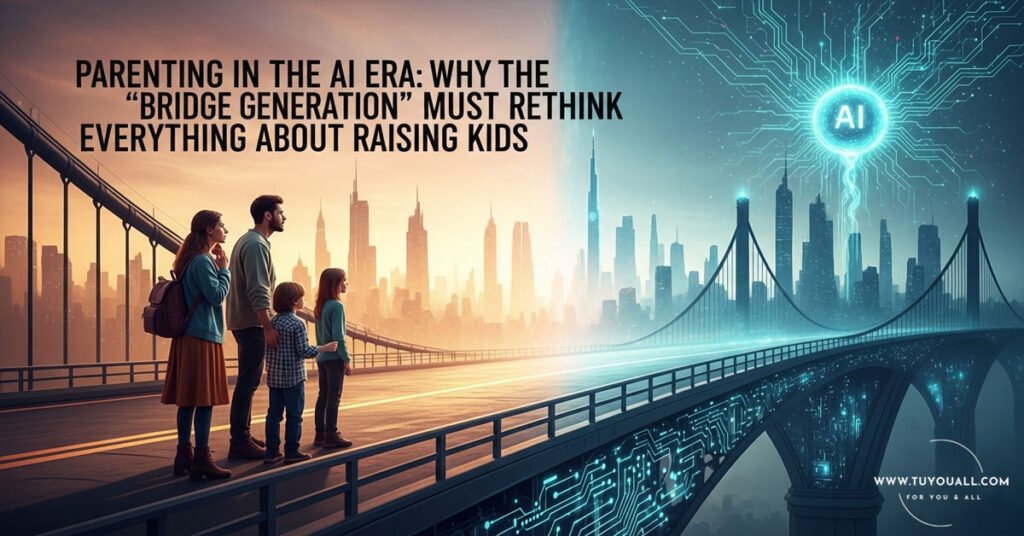
Dr. Vikas Divyakirti, educator and thought leader, recently delivered a powerful message to parents that stopped me in my tracks. He calls us the “bridge generation”—the unique group of parents (roughly ages 40-55) who have witnessed the entire digital revolution from black-and-white TVs to Artificial General Intelligence (AGI). We’ve lived through the transformation from rotary phones to smartphones that are more powerful than the computers that sent humans to the moon.
But here’s the problem: while we were adapting to these changes as adults, our children were born into them. And that difference changes everything about parenting.
The Bridge Generation: Caught Between Two Worlds
Dr. Divyakirti paints a vivid picture of our unique position: “We are the most interesting generation in human history. When we were born, television was just arriving in India (1975). We saw color TV, VCRs, landline phones where you had to rotate the dial, then wireless phones, then those brick-like mobile phones with buttons you could literally hammer nails with.”
We experienced the gradual evolution:
- Our childhood: Rotary phones → Basic mobile phones (₹16 per minute for calls!)
- Our youth: Button phones → Early smartphones
- Our adulthood: Facebook, WhatsApp, robotics, and now Artificial Intelligence
“Today, we’ve reached a point where, in just two years, machines will surpass humans in every field,” Dr. Divyakirti warns. “Sam Altman, the biggest name in AI, gave an interview yesterday saying that ChatGPT-4—which seems miraculous to us today—will be considered laughable, primitive technology in just two years.”
For Example:
Imagine telling your 10-year-old self that one day, you’d carry a device in your pocket that could answer any question, show any video, and connect you to anyone in the world instantly. Now realize that your child has never known a world without this magic. To them, it’s not magic—it’s air.
Why Your Child Is Smarter Than You (Digitally Speaking)
Here’s a humbling reality check that Dr. Divyakirti doesn’t sugarcoat: Your children are more tech-savvy than you, and they always will be.
You might think you’re being clever by checking their search history, but they’ve already learned about incognito mode. You might type with one finger, hunting for each letter, while they text blindfolded with perfect accuracy. You might not even know the platforms they’re using exist.
“Five-year-olds today know things we didn’t learn until age 15,” Dr. Divyakirti explains. “A child starts school, and immediately discovers what exists in the world. Previously, this exposure happened around ages 13-15.”
This isn’t just about technical skills—it’s about access to information. When we were curious about “adult topics,” we had to find a “class leader” who somehow had access to magazines or books, and we’d huddle in corners during recess, terrified of teachers catching us. Today’s kids have unlimited, private access to everything—violence, pornography, radicalization—before they hit puberty.
The Shocking Truth About Physical and Emotional Maturity
Medical science has confirmed something alarming: childhood is shrinking.
Dr. Divyakirti cites recent research: “Just one month ago, a report came out showing that globally, the age of puberty has dropped by one full year. What we used to call ‘teenage’ starting at 13 is now happening at 12 or younger.”
This isn’t random. It’s directly linked to digital exposure. Children are maturing physically and emotionally faster because their brains are being bombarded with stimuli that previous generations never encountered.
The implications are staggering:
| Previous Generations | Today’s Generation (Gen Alpha/Beta) |
| Discovered mature content at 15-16 | Exposed at 6-8 years old |
| Limited access through physical media | Unlimited access through smartphones |
| Social shame and fear of discovery | Private browsing, no immediate consequences |
| Gradual, controlled exposure | Instant, unfiltered access to everything |
| Parents could monitor relatively easily | Children know more about privacy tools than parents |
The Hidden Dangers: Sextortion, Deepfakes, and Cyber Predators
This is where Dr. Divyakirti’s message becomes urgent. He describes dangers that sound like science fiction but are happening to real children right now.
Sextortion: The New Epidemic
“An 11-year-old boy is in his room, video chatting with what he thinks is a 21-year-old Australian girl,” Dr. Divyakirti narrates. “She’s sweet-talking him, compliments him, says ‘you’re so handsome, I want to see you.’ She removes some clothing, encourages him to do the same. The boy, who knows nothing of the world, complies. The entire video is recorded.”
Then comes the hammer: “Transfer $500 to this account within 2 hours, or this clip goes to your parents, your Instagram friends, everyone in your email contacts.”
This is sextortion, and Dr. Divyakirti calls it “the biggest crisis in the teenage world today.” The first demand is never the last. Once predators have leverage, they return again and again.
Deepfakes: When Seeing Is No Longer Believing
We’re no longer in an era where video evidence is proof. Dr. Divyakirti explains the terrifying reality of AI-generated content:
- Photo Deepfakes: A simple school photo or passport picture can be transformed into compromising images using AI photography apps
- Video Deepfakes: Technology already exists (though not yet public) where you can create a video of anyone doing anything from a single photo
- Voice Cloning: AI can replicate your child’s voice to scam you or others
For Example: Your 14-year-old daughter receives a message: “I have a video of you. Pay up, or I send it to your parents.” She comes to you crying, insisting “Dad, it looks like me, but it’s not me!” In the past, you might have punished her first. Today, Dr. Divyakirti urges: “Don’t hit them. Trust them. This is possible. Technology has reached this level.”
The “Innocence” Trap
Dr. Divyakirti highlights a dangerous misconception: “If you think taking a photo in airplane mode means it’s safe, or that deleting it removes it forever—that’s innocence, not safety.”
The reality:
- Deleted photos can be recovered by basic technical experts in minutes
- Once anything hits the internet, no power on earth can delete it permanently
- It becomes part of “perpetual memory”—existing as long as the internet exists
Why Traditional Parenting Fails in the Digital Age
Most of us were raised with authoritarian models: “Because I said so,” “Don’t question me,” “I’m the parent, you’re the child.” This worked when parents controlled all information access. It collapses when children have the world’s knowledge in their pocket.
Dr. Divyakirti argues that in this new era, control is impossible. The only viable strategy is connection.
From Authority to Trust
The old model:
- Monitor everything (impossible now)
- Restrict access (children bypass restrictions)
- Punish mistakes (drives children to hide more)
The new model:
- Build trust so they tell you when things go wrong
- Educate proactively about risks before they encounter them
- Create emotional safety so they don’t fear your reaction more than the danger
For Example:
In the web series Dahaad (which Dr. Divyakirti recommends), there’s a powerful scene where a police officer discovers his son watching inappropriate videos with friends. Instead of beating or shaming him, the father sits with him for nearly three minutes—an eternity in screen time—explaining: “Son, these things happen at the right age, in the right way. The girl in that video was being treated like an object. Girls are humans. Your mother is a girl. Your sister is a girl. Treat any girl you love or marry the way you’d want them treated.”
This is the new parenting imperative: guidance over punishment, conversation over restriction.
Redefining Success: What Do You Really Want for Your Child?
Dr. Divyakirti offers a practical exercise that every parent should do. He asked himself: “What do I want from my child’s life?” and created a pyramid of desires:
- Success (money, power, fame, social status)
- Good Character (empathy, fulfilling commitments, good relationships)
- Resilience (mentally strong, smart, handles challenges without panic)
- Health (physically, mentally, emotionally fit)
- Happiness (the foundation of everything)
He realized something profound: “Everything else is secondary to happiness.”
“I’ve seen IAS and IPS officers who committed suicide—who is more successful than them? I’ve seen billionaires in business who aren’t happy, who cry day and night. So why would I wish that for my child?”
The Choice Every Parent Must Make:
“If I had to choose between ‘successful and miserable’ or ‘moderately successful but happy’—as a parent, my first wish should be that they are happy.” — Dr. Vikas Divyakirti
This doesn’t mean abandoning ambition. It means recognizing that emotional resilience is the ultimate success metric in a world of unprecedented complexity.
Practical Strategies for Digital-Age Parenting
Based on Dr. Divyakirti’s insights, here are actionable steps:
1. Start the Conversation Early
Don’t wait for incidents. Talk about online safety, deepfakes, and sextortion before they encounter them. Use news stories as conversation starters.
2. Establish the “No Shame” Rule
Make a pact: “No matter what happens, you can tell me. I might be upset about the situation, but I will never be angry at you for telling me the truth.”
3. Educate About Digital Permanence
Ensure they understand: “Once it’s online, it’s forever.” Not as a threat, but as a reality of digital life.
4. Monitor Without Spying
Instead of secretly checking devices (which they’ll circumvent), have open discussions about what they’re seeing online. Be curious, not interrogative.
5. Prioritize Emotional Connection
The best protection against online predators is a child who feels loved, valued, and emotionally secure at home. Predators exploit loneliness and low self-esteem.
6. Update Your Own Knowledge
You don’t need to be a tech expert, but you need to understand the basics of:
- Incognito/private browsing
- Social media platforms your children use
- Basic cybersecurity (strong passwords, two-factor authentication)
- Current scams targeting teens
The Ultimate Parenting Goal in the AI Era
Dr. Divyakirti concludes with a sobering but hopeful message: “Children today face more dangers than any previous generation. But they also have more opportunities.”
The globalization and AI revolution mean our children will likely work internationally, build global businesses, and live in a “global village” we couldn’t have imagined. But this connectivity comes with risks that require a new parenting playbook.
The fundamental shift: Stop trying to be the authoritarian gatekeeper. Become the trusted guide.
Your child will encounter mature content earlier than you did. They will face cyber risks you never imagined. They will make mistakes in digital spaces you don’t understand. The only question is: Will they tell you about it, or suffer alone?
Frequently Asked Questions (FAQ)
Q1: At what age should I give my child a smartphone?
There’s no universal age, but Dr. Divyakirti suggests delaying as long as possible. When you do provide one, it should come with ongoing conversations about responsibility, not just rules. Consider starting with basic phones and graduating to smartphones based on maturity, not age.
Q2: How can I monitor my child’s online activity without invading their privacy?
Transparency is key. Instead of secret monitoring software, use parental controls openly and explain why. Have regular “digital check-ins” where you discuss what they’re seeing online. The goal is guidance, not surveillance.
Q3: What should I do if my child is already a victim of sextortion or deepfakes?
First, do not punish or shame them. This is crucial. Document everything, cease all communication with the blackmailer, and contact law enforcement immediately. Organizations like the National Center for Missing & Exploited Children (NCMEC) have resources specifically for these situations.
Q4: How do I talk to young children about these dangers without scaring them?
Use age-appropriate language. For young kids, focus on “digital stranger danger” and the permanence of online actions. As they mature, gradually introduce more complex topics like deepfakes and emotional manipulation. Always frame it as empowerment, not fear.
Q5: Is it really possible for my child to be happy without being traditionally successful?
Dr. Divyakirti argues that happiness is the foundation, not the result, of success. A child who is emotionally resilient, has strong relationships, and knows how to handle failure will find their own version of success—one that’s sustainable and fulfilling.
Conclusion: Building Bridges, Not Walls
We are the bridge generation—not just between technological eras, but between parenting philosophies. We must bridge the gap between the controlled, restricted world we grew up in and the open, complex digital world our children inhabit.
The tools of control—monitoring, restricting, punishing—are blunt instruments in a surgical age. What our children need is wisdom shared through trust, guidance offered through connection, and unconditional support that says: “No matter what you encounter out there, you can always come home and tell me.”
The goal isn’t to raise the most successful child in the room. It’s to raise a child who remains emotionally resilient and genuinely happy in a world that will challenge them in ways we can’t yet imagine.
Because at the end of the day, as Dr. Divyakirti reminds us: “I’ve seen successful people who were miserable. I’ve never seen a genuinely happy person who failed at life.”
What conversations have you started with your children about their digital lives? What’s the biggest challenge you face as a parent in this AI era?
Source & Credit
This blog post is based on insights from Dr. Vikas Divyakirti‘s YouTube video exploring parenting challenges in the AI era.
The original content has been translated, expanded, and repurposed for educational purposes.
All core concepts and quotations attributed to Dr. Divyakirti have been preserved to maintain the integrity of his message while making it accessible to English-speaking parents worldwide.