Discover If The Oppo Find X9 Ultra Represents Peak Smartphone Evolution. We Break Down The Five Pillars And Why Cameras Remain The Final Frontier.
Have you ever held a new phone and thought, “Wow, this is it. It can’t get better than this”?
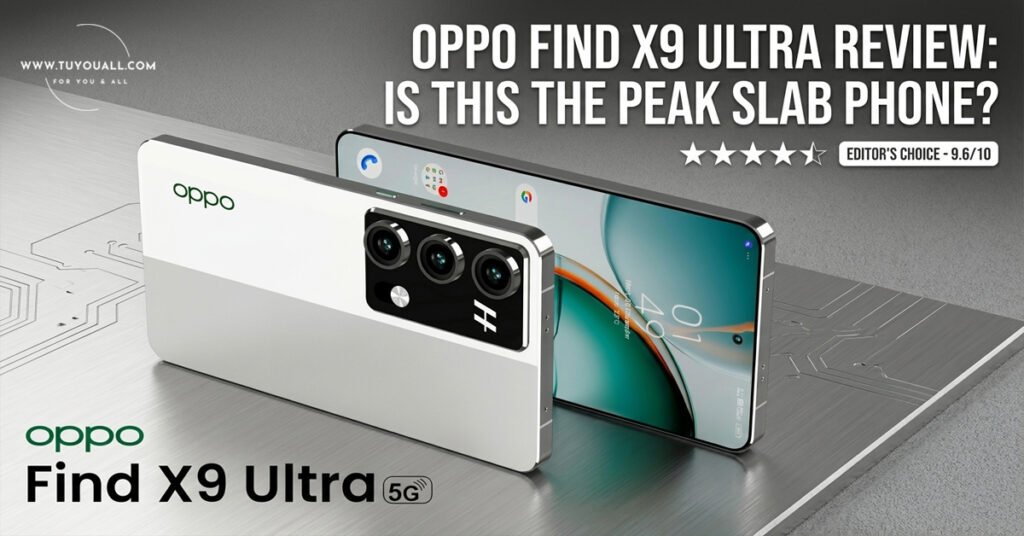
That is exactly what happened when I picked up the Oppo Find X9 Ultra. I have tested it for almost a month. This maxed-out flagship makes Samsung’s S26 Ultra feel less “ultra.” It packs a Snapdragon 8 Elite Gen 5 chip, a massive 7,050mAh battery, a 6.8-inch super-bright OLED, and an insane 200-megapixel camera system. It is ridiculous. And it got me thinking hard about one big idea: peak slab phone.
What Does “Peak Slab Phone” Even Mean?
“Peak slab phone” sounds like tech jargon. But it is actually simple. It is the idea that the standard candy-bar smartphone has reached its final, best form.
Think of it like a moving goalpost. Last month, I called the Oppo Find N6 the “peak foldable.” Why? Because engineers finally removed every downside. The bezels shrank. The crease disappeared. The cameras caught up. It became a great phone that just happens to fold.
But a slab phone is harder to define. Of course, a better one will come out next year. Still, when you look at the five pillars of a great smartphone, something strange is happening. We have basically achieved all of them except one. And honestly? We might never achieve that last one.
The Five Pillars of a Great Smartphone
For years, I have judged every flagship against five simple pillars:
- Great display
- Great battery
- Great build
- Great performance
- Great cameras
If a phone aces all five, it is a great phone. Each category improved at different speeds over the past 20 years. But now, four of them feel done. Let me show you what I mean.
Pillar 1: The Display – Box Checked ✓
Everyone wants a screen that just looks good. All the time. That is the watermark.
Smartphone displays have chased this dream forever. They got bigger, bezels got thinner, and curved edges came and went. Good riddance.
Now we have settled on something perfect. A large, flat, bright OLED with high refresh rate and high resolution. You get an under-display fingerprint reader and a tiny hole punch for selfies.
These screens hit insane brightness levels. You can use them in direct sunlight.
They also dim down to 1 nit with high-frequency PWM dimming. So they look great in the dark too.
Sure, we still see higher peak brightness numbers every year. And fancy features like privacy displays are neat. But for the most part? Flagship displays are already incredible. Box checked. Watermark achieved.
For Example: Imagine sitting at the beach trying to answer a text. Five years ago, you squinted at a dim screen. Today, the Oppo Find X9 Ultra blasts through the glare like it is nothing.
Pillar 2: Battery Life – The Watermark Is Here
What makes a great smartphone battery? Easy. You want it to last all day. No matter what.
Early 4G phones were terrible. I remember my HTC Thunderbolt dying before the school day ended. Batteries were tiny and inefficient.
Then phones got better. We crossed the 3,000mAh barrier. Then 3,500mAh.
Then 5,000mAh. Screen-on time climbed from two hours to three, four, and then five.
But the real game-changer arrived in the last two years: silicon carbon batteries. In just a few months, normal flagship batteries jumped from 5,000mAh to 6,000mAh. The Oppo Find X9 Ultra pushes that to a wild 7,050mAh.
This is a 7000mAh battery smartphone that simply refuses to die in one day. Regular use? No problem. Heavy use? You will still make it.
Last year, I gave my battery award to a phone that delivered seven to eight hours of screen-on time daily. That is basically a two-day phone.
I often end a normal day with 60% left. I do not even charge it overnight.
And if you somehow kill it? You have 100-watt wired charging. Or 50-watt wireless charging. The battery anxiety is gone. Box checked. Watermark reached.
For Example: Picture a busy travel day. You are navigating airports, streaming music, and taking photos. Your phone dies by lunch. With the Oppo Find X9 Ultra, you land with battery to spare.
Pillar 3: Performance – More Power Than You Need
Great performance is a little subjective. Software preferences vary. But generally, if you have a high-end chip, smooth animations, and a responsive screen, you are happy.
Year-over-year improvements now only matter in extreme cases. Think graphically intensive games. Or benchmark bragging rights. For daily tasks? Everything is instant.
The Oppo Find X9 Ultra runs the Snapdragon 8 Elite Gen 5. It is fast. It is smooth. It will get updates for years. Most people will never push it to its limit. And that is the point. Box checked.
For Example: You are switching between Instagram, Google Maps, and a video call. No lag. No stutter. It just works.
Pillar 4: Build Quality – Built Like a Tank
Great build quality used to be rare. Now it is standard.
Metal rails? Check. Slightly improved glass every year? Check. IP69 dust and water resistance? Check. These phones are built like tanks.
As long as the design is not ugly, we are good. The Oppo Find X9 Ultra feels premium and solid. The faux leather back even adds grip. Box checked.
For Example: You accidentally drop your phone getting out of the car. You wince. You pick it up. Not a scratch. That peace of mind is now normal.
Pillar 5: The Camera – The Last Frontier (But Is It Winnable?)
Here is where things get sticky. We all want great cameras. But what does that actually mean?
Look at any phone launch event. It used to be one or two slides about the camera. Now it is twenty slides. The camera has become the main battleground.
I recently ran an experiment. I took photos with every generation of the same phone. iPhones. Samsung phones. Google Pixels. I tested daylight, low light, and backlit scenes. The differences were fascinating. But one thing shocked me more than image quality: the physical size of these cameras.
We went from a tiny pinhole webcam to a massive multi-camera plateau dominating the entire back of the phone.
The Oppo Find X9 Ultra Camera Specs
The Oppo Find X9 Ultra is built around its camera. The design, the faux leather, the orange accents, the sideways Hasselblad text—it all screams “camera first.”
Here is what you get:
| Camera | Specification | Purpose |
| Main | 200MP, largest 200MP sensor ever, wide aperture, OIS | Everyday sharpness and detail |
| Telephoto 1 | 200MP, 3x zoom, largest telephoto sensor in a phone | Portrait and mid-range zoom |
| Telephoto 2 | 50MP, 10x zoom, sensor-shift stabilization | Extreme distance shots |
| Ultrawide | 50MP | Landscapes and group shots |
| Color Sensor | Dedicated “True Color” camera | Accurate white balance |
This is the most ridiculous camera system I have ever tested. And next year, someone will probably top it. But here is the hard truth.
Computational Photography vs. Physics
The new watermark people want is simple: a smartphone camera as good as a regular camera. Unfortunately, this is a battle against physics. And physics always wins.
Smartphone sensors get bigger every year. But so do professional camera sensors. The gap remains.
As much as phones like the Oppo Find X9 Ultra close the distance, they cannot fully win.
“The whole point of an incredible smartphone camera system is to be the most capable, versatile, convenient camera possible, no matter where you are, no matter what situation you’re in. This computer is going to try its absolute hardest to not let you take a bad picture or video. It’s why it’s called computational photography.” —Creator Name
Oppo clearly wants you to think of this as a Hasselblad camera. They bought the licensing. They use the accent colors. They added knurling around the camera ring. They even say it is based on the Hasselblad X2D Mark II.
But here is the irony. I actually own the Hasselblad X2D Mark II. These cameras could not be further apart.
“The smartphone will never, I’ll just say it, will never actually replace a high-end professional camera at what it does. Just physics, you know, they, these sensors get bigger and better every year, but so do these.” —Creator Name
A professional camera is deliberate. It does not use computational photography. It does not even have video mode. A smartphone is the opposite. It is a computer trying to save every shot.
You can learn more about the professional side on the official Hasselblad website.
The Self-Moving Basketball Hoop Analogy
This reminds me of the self-moving basketball hoop that Stuff Made Here built. You remember that? No matter how bad your shot is, the hoop moves and catches it. You cannot miss.
Computational photography works the same way. It minimizes misses. It maximizes makes. The phone uses software to defy physics. Portrait mode simulates a larger sensor. Hasselblad modes mimic bigger lens bokeh. The result? Every shot looks great.
“That’s what computational photography is trying to do. A lot of us, you know, enthusiasts, don’t love that look. So if you can do that without the over-processed look, then that would be great.” —Creator Name
Lens Attachments: Fun, But Still Mimicking
Oppo and Vivo are pushing boundaries with literal lens attachments. The Oppo Find X9 Ultra has a specialized case, a lens attachment, and even a battery grip with a two-stage shutter button. You can shoot 400mm zoom photos and say you used your smartphone.
It is fun. It is impressive. But at the end of the day, it is still mimicking the real thing.
It reminds me of people trying to turn an iPad into a laptop. You can kind of do it. You can multi-window. The browser is desktop-class. But nobody sane would call it a one-to-one replacement for a pro laptop.
However—and this is important—for regular use, it is as good as anyone needs. YouTube, social media, web browsing, light editing. The smartphone camera handles it all. Professional cameras will always have their place. That is what I shoot my videos with. But you can see exactly what the Oppo Find X9 Ultra footage looks like in this dedicated camera test.
So, Has the Slab Phone Really Peaked?
Let us look at the scorecard.
| Pillar | Status | Why |
| Display | ✅ Achieved | Bright, flat OLEDs look great everywhere |
| Battery | ✅ Achieved | 7,050mAh batteries last days with fast charging |
| Performance | ✅ Achieved | Chips are faster than daily needs require |
| Build | ✅ Achieved | Premium materials and IP69 are standard |
| Camera | ⚠️ Chasing | Great, but physics limits vs. pro cameras |
Four pillars are locked in. The camera is the only moving target. But the watermark has shifted. We are no longer chasing “replace a DSLR.” We are chasing “take a really good photo or video, anytime.”
And honestly? We are already there for 99% of users.
The Oppo Find X9 Ultra proves it. It is not just a phone. It is the current ceiling of what a slab smartphone can be. Next year will bring better specs. But the experience? This is about as good as it gets.
For a broader look at the market, check out our guide to the best smartphones of 2026.
Frequently Asked Questions (FAQ)
Q.1. What is a “peak slab phone”?
Ans. A peak slab phone is a standard non-folding smartphone that has reached its ideal form. It nails display, battery, performance, build, and camera so well that major improvements feel incremental rather than revolutionary.
Q.2. Can the Oppo Find X9 Ultra replace a professional camera?
Ans. No. Because of physics, smartphone sensors cannot match professional cameras. However, for everyday use, travel, and social media, the Oppo Find X9 Ultra delivers professional-looking results through computational photography.
Q.3. What makes the Oppo Find X9 Ultra camera special?
Ans. It features a 200MP main camera, a 200MP 3x telephoto, a 50MP 10x telephoto, a 50MP ultrawide, and a dedicated color sensor. Combined with Hasselblad tuning, it offers unmatched versatility.
Q.4. How long does the Oppo Find X9 Ultra battery last?
Ans. With its 7,050mAh silicon carbon battery, most users can easily get through two days of regular use. Even heavy users will finish a full day with plenty of charge left.
Q.5. Is the Oppo Find X9 Ultra worth buying in 2026?
Ans. If you want the most capable slab phone available today, yes. It represents the current peak of smartphone engineering, especially if camera versatility and battery life matter most to you.
Conclusion
The Oppo Find X9 Ultra is ridiculous in the best way possible. It has a display that works everywhere, a battery that refuses to die, and performance that never stutters.
It also offers a premium build and a camera system that bends physics to get the shot.
We have reached a point where flagship phones are as capable as any regular person could ever need. The slab phone has effectively peaked.
Cameras will keep improving, but the gap between “great phone photo” and “professional camera photo” will always exist. And that is okay.
The real win is versatility. Your phone is no longer a compromise. It is a tool that adapts to you, not the other way around.
So here is my question to you: If smartphones have truly peaked, what would it actually take for your next phone to feel exciting again?