This blog post is based on insights from a productivity coach’s YouTube video exploring systems thinking for balancing career, health, and personal life.
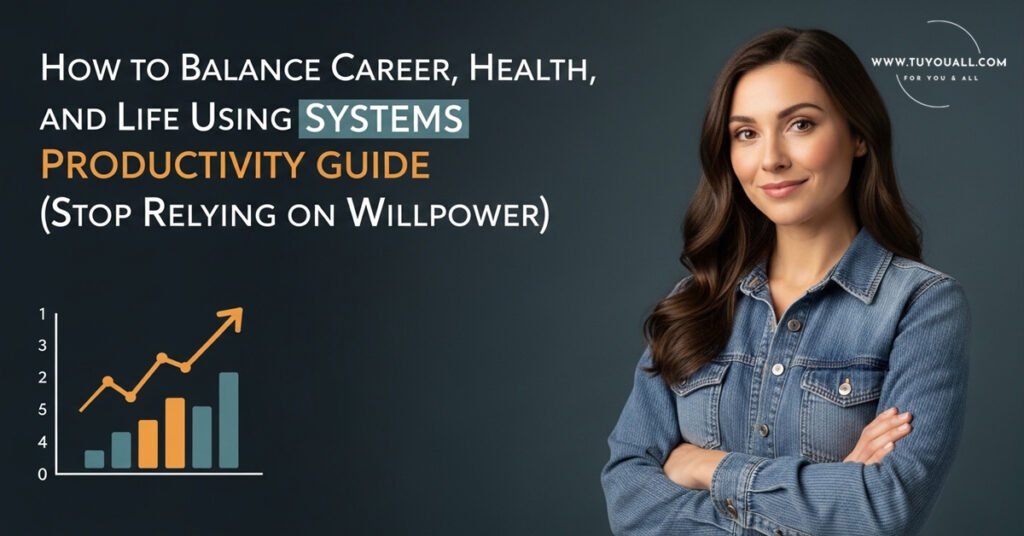
Learn how to balance Work, Learning, Health, and Relationships using Systems Thinking Productivity Guide. Stop relying on Willpower—Build Repeatable Processes that work even on bad days.
Have you ever looked at your overwhelming to-do list and wondered: How am I supposed to balance a full-time job, constant learning, exercise, quality sleep, family time, AND hobbies? Is that even possible?
You’re not alone. Millions of professionals feel stuck on a hamster wheel—constantly busy but making zero progress on what actually matters. Here’s the truth: Yes, it’s possible to have it all, but only if you stop thinking in terms of motivation and start thinking in systems.
After spending over a decade coaching thousands of professionals to learn efficiently while maintaining freedom, I’ve discovered one universal truth: Systems thinking is the secret to regaining control. It’s what allows you to escape the cycle of busyness without progress and finally build a life that works—even on your worst days.
In this guide, I’ll break down exactly what systems thinking means and share practical ways to build your own systems using the same principles I use with my coaching clients.
What Is Systems Thinking (And Why Most People Get It Wrong)?
The Problem with Intentions and Willpower
Most people operate on intentions and tasks. They think: “I need to exercise today” or “I need to get more sleep” or “I need to finish that course.” But when life gets busy, these intentions crumble.
Even proactive planners fall into the same trap. You might say: “I’m going to spend an hour every evening reading” or “When I get home from work, I’ll exercise every day.” But what happens when you’re too tired? What happens when traffic is brutal? What happens on day three when you realize you haven’t even started?
You feel frustrated. Disappointed. Like you’ve failed yourself—again.
The Systems Thinking Alternative
Systems thinking reduces your reliance on willpower and motivation. Instead of depending on these unreliable forces, you build processes that automatically produce results. Once you find processes that work, you chain them together—and now you have a system.
A system isn’t a rigid schedule. It’s a dynamic, adaptable framework that functions even when life throws curveballs. It’s about anticipating obstacles and engineering solutions before they derail you.
The Three Principles of Building Effective Systems
Principle 1: Think Holistically (Expect Your Plan to Fail)
The first principle of systems thinking is to look at your intention and examine every factor that could influence success. You’re not just planning for the best-case scenario—you’re proactively expecting your plan to fail.
Ask yourself:
- What will make me tired or lazy?
- What unexpected events could come up?
- What has blocked me before?
When I coach clients, one of my first questions is: “What have you tried in the past, and why didn’t it work?” I pay close attention not just to what they did, but how they responded to obstacles.
This list of potential barriers is gold. Your final system must account for these factors because they’ll inevitably appear.
Principle 2: Build for Repeatability (Design for Your Worst Day)
Your system should work on the worst day, not just when the stars align. Evaluate every plan by asking: “Does this rely on willpower or motivation to execute?”
For most of my clients, the answer is yes—and that’s a violation of the repeatability principle.
Your goal is to reduce friction. When you identify a high-effort solution (one requiring willpower), ask: “How can I make this easier?” Then return to Principle 1: “What challenges could this new approach face?”
You cycle between these two principles until you find a combination that locks in success.
Real-World Example: The Accountant Studying for CA Exams
I worked with an accountant last year who was studying for chartered accountancy exams while working full-time. His initial plan? Study every day after work as soon as he got home.
It failed constantly. Traffic exhausted him. Family responsibilities demanded attention. After dinner, he was too tired to focus.
The “try harder” solution? Dig deep and push through. But that’s neither sustainable nor pleasant.
Instead, we applied systems thinking:
| Obstacle | Band-Aid Solution | Systems Solution |
| Traffic fatigue | “Just push through” | Stay at work later, beat traffic, study in the office |
| Family dinner conflict | Skip studying | Negotiate with family to push dinner back by one hour |
| Evening exhaustion | Caffeine/stubbornness | Study before work (requires fixing sleep routine) |
We kept cycling through obstacles and solutions. Could he sleep earlier? What would need to change in his evening routine? Each iteration made the system more robust.
The key insight: Your first solution doesn’t need to be perfect. There IS a combination that works. Your job is to keep looking until you find it.
Principle 3: Peel the Band-Aids (Address Root Causes)
By now, if you’re cycling between Principles 1 and 2, you’ll succeed. Each iteration improves your system until obstacles disappear. But Principle 3 ensures your system evolves for life.
Your first system will be full of “band-aids”—temporary fixes that help short-term without solving underlying issues.
For example:
-
- Problem: Always tired, can’t focus
- Band-aid: Take daily naps, use focus timers
- Root cause: Poor sleep habits, weak attention span
Band-aids bloat your system. What if you can’t nap one day? What if your timer breaks? Your plan fails.
Better approach: Use band-aids temporarily WHILE working on root causes. Changing habits takes time (unlearning and retraining), so make habit-change part of your system.
In our example: Yes, use naps and timers for now. BUT simultaneously work on improving sleep hygiene and training your attention span. That becomes a new intention plugged into your system.
The result? A system that’s effective short-term AND long-term, growing simpler and more efficient over time.
Why Systems Thinking Feels Uncomfortable (And Why That’s Good)
Here’s something I’ve learned from repeating this process hundreds of times: Effective solutions often feel uncomfortable.
I personally used these principles to work full-time as a doctor while running a business full-time, completing my master’s degree, going to the gym, maintaining a social life, spending time with family, AND getting 8-9 hours of sleep nightly.
The discomfort of changing your nighttime routine to sleep earlier? That’s uncomfortable. But consider the alternative: living with constant stress, pressure, anxiety, and disappointment from never making progress on what matters.
This isn’t uncomfortable vs. comfortable. It’s uncomfortable vs. MORE uncomfortable.
When a solution feels different from what you’re used to, that’s exactly the point—you’re trying to get different results.
How to Start Building Your First System
Step 1: Pick One Intention
Don’t overhaul your entire life. Choose ONE area where you’ve been struggling (exercise, learning, sleep, etc.).
Step 2: List Every Past Failure
Write down every approach you’ve tried and exactly why it failed. Be specific.
Step 3: Design for Your Worst Day
Create a plan that requires zero willpower. If it won’t work when you’re exhausted, scrap it.
Step 4: Anticipate Obstacles
For your new plan, ask: “What could go wrong?” List every barrier.
Step 5: Engineer Solutions
For each obstacle, find a low-friction workaround. Cycle back to Step 4 to check for new issues.
Step 6: Identify Band-Aids
Recognize which solutions are temporary fixes. Create a parallel plan to address root causes.
Step 7: Iterate Weekly
Your first system won’t be perfect. Expect to refine it. Each iteration makes it stronger.
Frequently Asked Questions
Q: How long does it take to build a working system?
A: Initial systems often take 2-4 weeks to design and test. However, the time invested upfront saves hundreds of hours lost to failed intentions later. Most of my clients see significant improvement within one month of consistent iteration.
Q: What if my life is too unpredictable for systems?
A: Unpredictability is exactly why systems work better than rigid plans. A good system has contingencies: “If I’m tired, I’ll do X. If I’m not tired, I’ll do Y.” The more unpredictable your life, the more you need systems thinking—not less.
Q: Can I build multiple systems at once?
A: I recommend starting with one system until it runs smoothly (usually 4-6 weeks). Once the first system is automated, add another. Trying to overhaul everything simultaneously violates Principle 2 (repeatability)—you’ll burn out.
Q: What if my family/job won’t accommodate my system?
A: This is where holistic thinking matters. If your system requires others to change dramatically, it will fail. Instead, negotiate small adjustments (like the dinner example) or find solutions that don’t depend on others’ cooperation.
Q: How do I know if I’m using a band-aid solution?
A: Ask: “If I removed this element, would my plan still work?” If the answer is no, and the element doesn’t address a root cause, it’s a band-aid. Examples: excessive caffeine to compensate for poor sleep, alarms to compensate for procrastination, willpower to compensate for high friction.
Key Takeaways: Your Path to Sustainable Productivity
- Stop relying on willpower. It’s unreliable and depleting. Build processes that work automatically instead.
- Expect failure. Design systems that account for tiredness, emergencies, and bad days—not just ideal conditions.
- Cycle between solutions and obstacles. Keep refining until you find combinations that actually work.
- Embrace discomfort. Change feels weird because it IS different. That’s how you know you’re growing.
- Remove band-aids over time. Temporary fixes are fine initially, but always work toward addressing root causes.
- Think in combinations. There’s rarely one perfect solution. Success comes from stacking compatible workarounds.
- Commit to the search. Most people give up too early. The solution exists—keep looking longer than feels natural.
Final Thoughts: Freedom Through Systems
Building systems might seem like “a lot of work” compared to just “trying harder.” But here’s the truth: It’s the same amount of effort and discomfort either way. The only difference is where you direct that energy.
You can spend your effort fighting yourself every day, relying on motivation that waxes and wanes, feeling constantly behind. OR you can invest that energy upfront into designing a life that runs itself—freeing you to focus on what truly matters.
The choice is yours. But if you’re tired of the hamster wheel, systems thinking isn’t just an option. It’s the only way out.
What’s one area of your life where you’ve been relying too heavily on willpower? Drop a comment below—I’d love to hear what system you’re going to build first.
Source & Credit
This blog post is based on insights from a productivity coach’s YouTube video exploring systems thinking for balancing career, health, and personal life.
The original content has been translated, expanded, and repurposed for educational purposes.