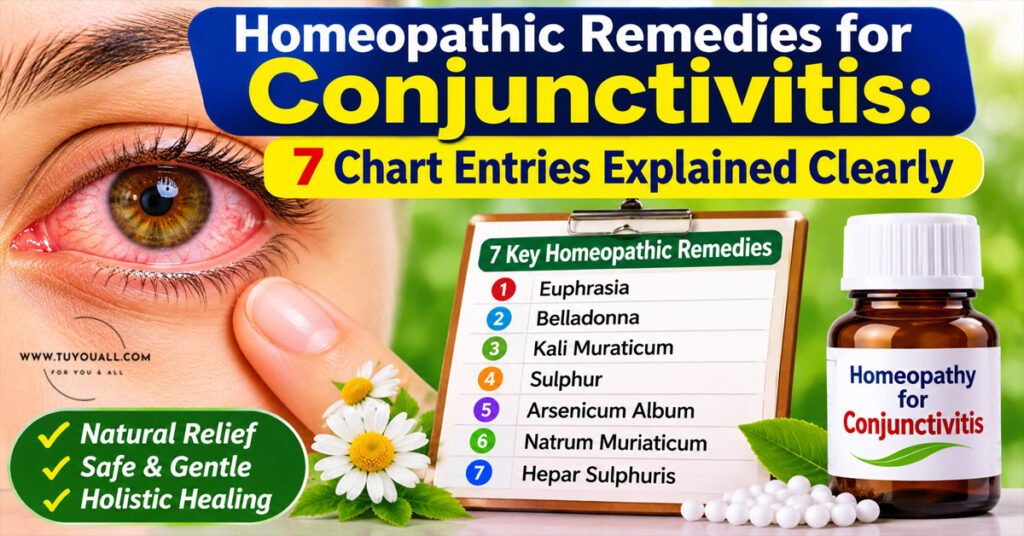
Homeopathic Remedies for Conjunctivitis: See the Chart’s Symptoms, Seven Entries, Care Tips, and Safety Notes before You Speak with a Health Professional.
Have you ever seen a remedy list and thought, “My symptom matches, so is this the right choice?”
That is exactly where caution matters. This guide examines homeopathic remedies for conjunctivitis as they appear in one supplied eye flu chart. It reorganizes the chart’s symptoms, probable diagnosis, care advice, seven entries, and follow-up note into plain English.
You will not find a promise that any listing will treat your eyes. Instead, you will learn what the image says, where its wording is incomplete, and which questions to take to a qualified healthcare professional.
Eye Flu Symptoms and Acute Conjunctivitis in the Chart
The source image is titled “CASE: CONJUNCTIVITIS (Eye Flu).” It begins with a short list of complaints and then gives a “most probable diagnosis.”
That wording is important. The chart presents a likely diagnosis, but it does not show an examination, test result, or confirmed cause.
The Five Complaints Listed
The chart lists these eye flu symptoms:
- Red eyes
- Watery or sticky discharge
- Itching or burning
- Photophobia
- Foreign body sensation
A foreign body sensation can be understood from the chart’s wording as a feeling that something is in the eye. However, the image does not explain how severe each symptom is or how long it has lasted.
It also does not say whether every symptom must appear together. Therefore, readers should not use one matching word to diagnose themselves.
What the Diagnostic Line Says
The image gives this most probable diagnosis:
Acute conjunctivitis (viral/bacterial)
The chart does not explain how to distinguish the viral and bacterial possibilities. It also provides no examination findings beyond the listed complaints.
For that reason, this article preserves the phrase “most probable.” It would be misleading to turn that line into a confirmed diagnosis.
For Example:
Imagine that you notice red eyes, burning, and watery discharge. Those details match part of the chart, but they do not confirm the cause. A careful next step is to record your symptoms and contact a qualified healthcare professional rather than selecting a remedy from the list alone.
Conjunctivitis Self-Care Advice From the Image
The chart includes a short care list beside its remedy entries. This advice can be discussed separately from the products because it appears under its own “Advice” heading.
The listed steps are:
- Use a cool compress.
- Avoid sharing towels.
- Wash your hands frequently.
- Do not rub your eyes.
The image does not provide a compress schedule, towel-washing instructions, or additional cleaning steps. Therefore, none should be invented from this chart alone.
Why These Simple Steps Are Easy to Overlook
A remedy table often attracts the most attention. However, the care advice takes up a separate and visible part of the image.
The advice is also practical during everyday routines. It touches on touching your eyes, washing your hands, and sharing household items.
For Example:
Suppose someone with eye discomfort normally rubs their eyes and shares a towel with a family member. The chart gives two direct reasons to pause those habits: “Don’t rub eyes” and “Avoid sharing towels.” Frequent handwashing and a cool compress complete its advice list.
These steps should not be treated as a replacement for professional assessment. They are simply the supportive measures shown in the source.
How the Chart Organizes Homeopathic Remedies for Conjunctivitis
The next section of the image contains seven numbered entries. Six involve pills, while the seventh lists Euphrasia Eye Drops.
The following homeopathic remedies for conjunctivitis appear in their original order. The numbers are not ratings, and the chart does not compare their results.
It also does not instruct readers to use all seven entries together. Each line pairs a product and schedule with a short descriptive note.
Updated Data for FY 2026–27: Seven Entries From the Chart
Update note: This FY 2026–27 label refers to the article’s updated presentation. The entries below are transcribed from the supplied image, not newly validated clinical data.
| No. | Entry as printed | Schedule as printed | Descriptive note as printed |
|---|---|---|---|
| 1 | Euphrasia 30 | 4 pills × QID × 5 days | Specific: acrid eye discharge, bland nasal |
| 2 | Apis Mellifica 30 | 4 pills × QID | Stinging burning, swelling, “> cold” |
| 3 | Argentum Nitricum 30 | 4 pills × TDS | Purulent discharge, swollen lids |
| 4 | Pulsatilla 30 | 4 pills × TDS | Thick bland yellow discharge |
| 5 | Belladonna 30 | 4 pills × QID | Sudden red hot eyes, photophobia |
| 6 | Mercurius Sol 30 | 4 pills × TDS | Acrid greenish discharge, ulceration |
| 7 | Euphrasia Eye Drops | 1–2 drops in each eye × TDS | No separate note provided |
The chart uses “QID,” “TDS,” and several descriptive phrases without defining them. This article does not expand those abbreviations because their meanings are not explained in the image.
A qualified healthcare professional or pharmacist should interpret the schedule before anyone acts on it.
Euphrasia 30 and Euphrasia Eye Drops
Euphrasia appears twice in the chart. First, Euphrasia 30 is listed as four pills multiplied by QID for five days.
Its note reads: “Specific: acrid eye discharge, bland nasal.” The wording stops there, so the image does not provide a fuller nasal symptom description.
The seventh entry is Euphrasia Eye Drops. Its schedule is one to two drops in each eye multiplied by TDS.
These are separate entries. One should not be substituted for the other based only on their shared name.
Within the homeopathic remedies for conjunctivitis list, Euphrasia is therefore not a single instruction. It appears in two different forms with two different schedules.
Apis Mellifica 30 and Argentum Nitricum 30
The chart pairs Apis Mellifica 30 with “stinging burning, swelling, > cold.” The symbol before “cold” is reproduced exactly, but the image does not explain it.
Readers should not guess at that shorthand. Its intended meaning is a useful question for the professional reviewing the chart.
Argentum Nitricum 30 appears next. Its note refers to “purulent discharge, swollen lids,” with a schedule of four pills multiplied by TDS.
These homeopathic remedies for conjunctivitis entries show that the chart uses more than eye redness. It also includes notes about discharge, burning, swelling, and eyelids.
Pulsatilla 30 and Belladonna 30
Pulsatilla 30 is paired with “thick bland yellow discharge.” The schedule shown is four pills multiplied by TDS.
Belladonna 30 has a different note: “sudden red hot eyes, photophobia.” Its schedule is four pills multiplied by QID.
The wording is descriptive, but it does not prove that a product is appropriate for a particular reader. It also does not explain how quickly or strongly a symptom should appear before an entry is considered.
For Example: Two people could both say, “My eyes are red.” One might also mention thick yellow discharge, while another mentions sudden hot eyes and photophobia. The chart uses different descriptive notes for those situations. That does not make self-selection safe; it shows why a complete professional assessment matters.
Mercurius Sol 30
The final pill entry among these homeopathic remedies for conjunctivitis is Mercurius Sol 30.
Its schedule is four pills multiplied by TDS. The accompanying note reads “acrid greenish discharge, ulceration.”
The chart does not explain the ulceration wording or connect this entry to an examination finding. Readers should therefore avoid treating that note as a self-diagnosis.
Safety Questions About Homeopathic Remedies for Conjunctivitis
A product name and a short symptom note may look simple. However, the chart contains several pieces of shorthand that need interpretation.
The safest way to read homeopathic remedies for conjunctivitis in this format is to separate transcription from personal guidance. The table tells you what the image says. It cannot tell you what you personally should use.
Four Limits to Keep in Mind
- Do not turn a symptom match into a diagnosis.
The chart itself calls the diagnosis “most probable.” - Do not invent missing durations.
Euphrasia 30 includes “5 days,” but most other pill entries do not show a duration. - Do not guess at abbreviations or symbols.
QID, TDS, “> cold,” and R/A are not defined in the image. - Do not use eye drops without professional guidance.
The chart alone does not establish whether a product is appropriate or safe for your eyes.
For Example:
A reader might see “4 pills × TDS” and assume that the abbreviation has an obvious schedule. Another reader might interpret it differently. Instead of guessing, both can show the original line to a qualified professional and ask for the instructions in plain language.
What Does “R/A 5–7 Days” Mean?
The bottom of the remedy section says “R/A 5–7 days.”
The image does not expand “R/A” or explain what should happen during that period. It is therefore best preserved as a follow-up note requiring clarification.
Do not treat it as a reason to wait when professional assessment is otherwise needed. Ask the prescriber what the abbreviation means and what follow-up they intend.
Why the Complications List Deserves Attention
The source image does not end with the remedies. It separately lists three complications:
- Keratitis
- Corneal ulcer
- Spread to others
The chart does not define these terms or provide risk figures. Accordingly, this article will not add definitions, probabilities, or warning timelines.
Their presence still changes how the chart should be read. Homeopathic remedies for conjunctivitis are only one part of the image; possible complications are another.
Keratitis and Corneal Ulcer
Keratitis and corneal ulcer appear under the red “Complications” heading. The source gives no further details about either one.
A reader should not use the remedy notes to decide whether either complication is present. That decision belongs with a qualified healthcare professional who can assess the situation properly.
Spread to Others
“Spread to others” is the final complication listed. The image separately advises frequent handwashing and avoiding shared towels.
Those points can be kept together without inventing a transmission route or adding new hygiene rules.
For Example:
If several people share a home, one person can avoid passing their towel around and follow the chart’s handwashing advice. They can also ask a healthcare professional what additional precautions are appropriate instead of relying on the short list alone.
Questions to Take to a Qualified Healthcare Professional
A chart becomes more useful when it helps you ask better questions. Consider taking the original image or a written copy to your appointment.
You might ask:
- Do my symptoms fit the chart’s “most probable” diagnosis?
- What information is needed to clarify the viral or bacterial possibility?
- What do QID, TDS, and R/A mean in this context?
- What does the “> cold” notation mean?
- Is any listed product appropriate for me?
- What duration applies where the chart does not state one?
- Are the listed eye drops appropriate for my eyes?
- What follow-up is intended by “R/A 5–7 days”?
- What precautions should I take because the chart mentions spread to others?
For Example:
You could write down your symptoms, note when they started, and place the seven chart entries beneath them. During your appointment, you can ask the professional to distinguish general chart information from advice intended for you.
Frequently Asked Questions
1. What eye flu symptoms does the chart list?
It lists red eyes, watery or sticky discharge, itching or burning, photophobia, and foreign body sensation. These complaints appear together in the source, but the chart does not say that every person will have all five.
2. Does the chart confirm acute conjunctivitis?
No. It calls acute conjunctivitis (viral/bacterial) the “most probable diagnosis.” The image does not provide an examination or test that confirms the diagnosis.
3. How many homeopathic remedies for conjunctivitis appear in the image?
There are seven entries: Euphrasia 30, Apis Mellifica 30, Argentum Nitricum 30, Pulsatilla 30, Belladonna 30, Mercurius Sol 30, and Euphrasia Eye Drops. Their inclusion is not proof that any one of them is right for you.
4. What conjunctivitis self-care advice is included?
The chart advises a cool compress, avoiding shared towels, frequent handwashing, and not rubbing the eyes. These measures should not replace professional guidance.
5. Should readers follow the QID, TDS, and R/A instructions without asking questions?
No. The source does not define those abbreviations. Ask a qualified healthcare professional or pharmacist to explain them before acting on any schedule.
References & Further Learning:
For additional clinical insights, materia medica explanations, and practical perspectives on homeopathic management, the information in this article/page has been cross-referenced with educational resources shared by qualified homeopathic practitioners and researchers in their YouTube Channel (Links given Below). Readers seeking deeper guidance on remedy selection, potencies, and holistic care may explore video lectures and case discussions by established homeopathic doctors as listed below with their YouTube Channel Link :
| SL No. | Channel / Doctor Name | Primary Focus & Clinical Background | YouTube Link |
| 1 | Dr. Kirti Vikram Singh | Covers disease-specific remedies, mother tinctures, German combinations, and daily live Q&A sessions. | https://www.youtube.com/drkirtivikramsingh |
| 2 | Dr. Pranjali Srivastava | Registered BHMS physician and certified nutritionist focusing on holistic disease management and lifestyle care. | https://www.youtube.com/@drpranjalihomeopathy
|
| 3 | Dr. Swapnil Sagar Jain | BHMS consultant at Niramay Homeopathy offering remedy guides for acute and chronic conditions. | https://www.youtube.com/@DrSwapnilSagarJain-NIRAMAY |
| 4 | Dr. Umang Khanna | Focuses on natural homeopathic treatments, chronic illness management, and educational health guides in Hindi. | https://www.youtube.com/@drumangkhanna |
| 5 | Shree Radhey Homeopathy | Hosted by Dr. Chakshu; features remedy explanations, patient case stories, and live consultation Q&As. | https://www.youtube.com/@ShreeRadhey |
| 6 | Dr. P.S. Tiwari | Senior D.M.S. homeopath with 36+ years of experience explaining classical Materia Medica and therapeutics. | https://www.youtube.com/@DrPSTiwari |
| 7 | Dr. Varun Kanwadia | BHMS, DNHE consultant sharing practical homeopathic solutions for skin, hair, respiratory, and digestive issues. | https://www.youtube.com/@varunkanwadia |
| 8 | Dr. Arpana Samanta | Gold Medalist BHMS (Delhi) & PGD (London) with 20+ years of experience covering chronic diseases like thyroid, PCOS, and skin disorders. | https://www.youtube.com/@dr.arpanasamanta |
| 9 | Dr. Rukmani Choudhary | Focuses on root-cause homeopathic treatments, comparative remedy selection, and live Q&A sessions. | https://www.youtube.com/@Dr.Rukmani-HomeopathyClinic |
| 10 | Dr. Santosh Kumar Padhy | Provides accessible homeopathic remedy suggestions and general health guidance for everyday ailments. | https://www.youtube.com/@dr.santoshkumarpadhy8888 |
Medical Disclaimer:
This article is educational. It is not a diagnosis, prescription, or recommendation to self-medicate. Consult a qualified healthcare professional before using a remedy, placing drops in your eyes, or making other health decisions. The safety and effectiveness of the listed entries have not been independently verified here.