Explore Homeopathic Remedies For Autism Spectrum Including Carcinosin, Baryta Carb, And Helleborus—Plus Essential Therapy And Early Intervention Guidance.
Does your child struggle to look you in the eye? Do they repeat the same actions over and over, or retreat into their own world when overwhelmed? Has someone mentioned “autism spectrum,” leaving you searching for ways to help your child connect and thrive? If these questions resonate, you are walking a path many parents have traveled before you.
Autism Spectrum Disorder touches millions of families worldwide. Each child’s experience is unique—some face significant challenges with communication and interaction, while others need support managing sensory sensitivities or repetitive behaviors. While early intervention therapies form the foundation of care, some families also explore homeopathic remedies for autism spectrum as a supportive complement to their comprehensive plan.
In this guide, we will explore what autism spectrum can look like, essential therapeutic interventions, and how specific homeopathic medicine for autism is traditionally discussed as an adjuvant—meaning a helper alongside—standard therapies and educational support.
Critical Understanding: Autism Spectrum Disorder is a neurodevelopmental difference, not a disease to cure. Homeopathy aims to support comfort, reduce distressing symptoms, and optimize function—not to eliminate autism. Early intervention therapies remain essential. This information is educational and requires professional guidance.
Understanding Autism Spectrum Disorder
Autism Spectrum Disorder (ASD) describes a range of developmental differences affecting how people communicate, interact, and experience the world. The “spectrum” reflects wide variation—no two individuals with autism are identical.
Common Characteristics on the Spectrum
Parents and professionals often notice these features:
- Delayed speech – Language development follows an unusual timeline or pattern.
- Poor eye contact – Difficulty with reciprocal gaze and social connection.
- Repetitive behaviour – Repeated movements, phrases, or intense interests.
- Social withdrawal – Preference for solitude, difficulty with peer relationships.
- Sensory issues – Over- or under-sensitivity to sounds, textures, lights, or smells.
The diagnosis Autism Spectrum Disorder applies when these characteristics significantly affect daily functioning and have been present since early childhood.
Essential Therapies: The Non-Negotiable Foundation
Homeopathic support—when chosen—always stands alongside comprehensive therapeutic intervention. These therapies are essential, not optional.
Core Therapeutic Supports
- Early intervention therapy – Intensive, individualized programming during the critical developmental window of ages 0-3.
- Speech therapy – Builds communication skills, whether verbal, gestural, or augmentative.
- Occupational therapy – Addresses sensory processing, motor skills, and daily living activities.
- Parental counselling – Supports family adjustment, advocacy skills, and emotional resilience.
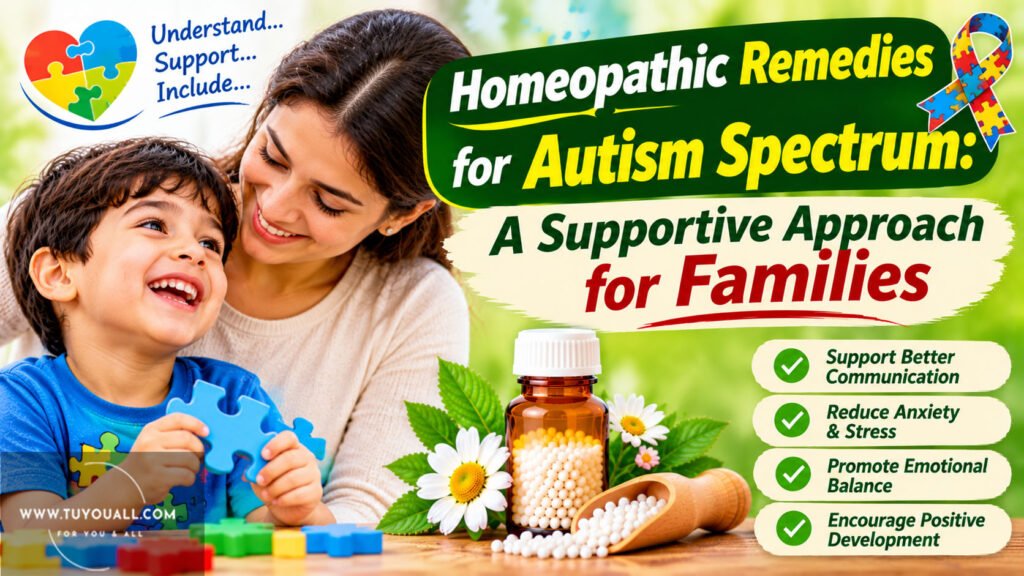
Important Note: The image explicitly states: “Homeopathy is adjuvant; continue all therapies and educational interventions.” This cannot be overstated. Homeopathy does not replace these essential services.
Homeopathic Remedies for Autism Spectrum: A Supportive Overview
Homeopathy treats the individual, not the diagnosis. Practitioners select remedies based on the child’s complete symptom picture, temperament, and physical characteristics. For ASD, remedies aim to ease specific distressing symptoms and support developmental processes.
The following table summarizes remedies traditionally discussed as adjuvant support for ASD.
| Homeopathic Remedy | Potency & Dosage | Traditional Indication & Symptom Pattern |
| Carcinosin | 200; 4 pills monthly for 6 months | Constitutional remedy frequently indicated in ASD; perfectionism, obsessive behaviors, sleeplessness, and history of parental cancer or suppressed grief in family. |
| Baryta Carbonica | 200; 4 pills weekly for 12 weeks | Developmental delay, shy and timid nature; difficulty understanding abstract concepts; physical and mental immaturity; poor social confidence. |
| Tuberculinum | 1M; 4 pills monthly | Constitutional remedy; history of recurrent infections; never well since illness; restless, dissatisfied, destructive tendencies; intellectual dissatisfaction. |
| Stramonium | 200; 4 pills weekly | Intense fears, especially of dark, water, or being alone; violent tantrums, sleep disturbance; earlier fearlessness replaced by terror; possible aggression. |
| Calcarea Phosphorica | 6X; 4 tablets QID | Supports brain and nervous development; specifically indicated for growing children with bone and mental developmental concerns; delayed milestones. |
| Helleborus | 30; 4 pills BD | Stupor, slow comprehension, emotional numbness; responds but seems internally slow; vacant expression, diminished emotional reaction. |
Abbreviations: BD = twice daily; QID = four times daily.
Understanding Each Remedy’s Unique Profile
Different presentations of ASD call for different supportive approaches. Here is how these remedies traditionally address specific patterns.
For Perfectionism and Family History Patterns
Carcinosin 200 is considered a constitutional remedy frequently matching children on the autism spectrum. Traditional indications include obsessive perfectionism, difficulty sleeping, and family history of cancer or suppressed emotional trauma. The remedy aims to address deep constitutional patterns rather than surface behaviors.
For Example:
Six-year-old Meera lines up her toys with mathematical precision and becomes distraught if disturbed. She has never slept through the night. Her grandmother died of breast cancer, and her mother carries unprocessed grief. The homeopath selects Carcinosin monthly, alongside her ongoing speech and occupational therapy, to address this constitutional picture.
For Shy Developmental Delay
Baryta Carb 200 suits children with clear developmental delays who are also socially timid. They may understand more than they can express and appear younger than their chronological age in both social and physical development.
For Infections and Restless Dissatisfaction
Tuberculinum 1M addresses the child who suffered repeated infections and seems perpetually dissatisfied. They may destroy beloved objects, move constantly, and resist comfort despite obvious distress.
For Terror and Sleep Disturbance
Stramonium 200 fits children who developed intense fears—of darkness, water, or separation—possibly after a frightening event. Sleep becomes fractured, and aggression may emerge from underlying panic.
For Nervous System Development Support
Calcarea Phos 6X functions as a tissue salt supporting brain and nerve development. Traditional use includes delayed milestones and growing pains alongside cognitive concerns.
For Stupor and Slow Comprehension
Helleborus 30 suits children who seem internally slow to process—present but not fully present, answering questions after long pauses, with diminished emotional engagement.
The Importance of Regular Follow-Up
ASD support requires patience and flexibility. Review every 4-8 weeks tracks developmental progress, behavioral changes, and remedy response. Adjustments happen based on observed shifts, not just symptom reduction.
Consistent monitoring also prevents the serious complications of unsupported ASD.
Complications of Inadequate ASD Support
Without comprehensive intervention, ASD can lead to significant challenges:
- Functional impairment – Limited independence, reduced quality of life.
- Family stress – Caregiver burnout, marital strain, financial burden.
- Co-morbid conditions – Anxiety, depression, seizures, gastrointestinal issues, and sleep disorders frequently co-occur.
These risks underscore why multi-disciplinary, sustained support matters.
Frequently Asked Questions (FAQ)
Q1: Can homeopathy cure autism spectrum disorder?
No. Autism is a neurodevelopmental difference, not a disease. Homeopathy aims to support comfort, reduce distressing symptoms, and optimize function alongside therapies. “Cure” is neither appropriate nor possible.
Q2: Which remedy is best for autism?
No single remedy fits all. Carcinosin is frequently mentioned constitutionally, but selection depends on individual symptom patterns. Professional homeopathic consultation is essential.
Q3: Is homeopathy safe for children with ASD?
Generally yes, due to high dilution. However, remedies should be prescribed by qualified practitioners familiar with neurodevelopmental conditions, working alongside pediatricians and therapists.
Q4: How long should we continue homeopathic remedies?
Duration varies. Constitutional remedies like Carcinosin or Tuberculinum may continue monthly for 6-12 months. Acute symptom remedies may be shorter. Regular review every 4-8 weeks guides continuation.
Q5: Can we use homeopathy instead of ABA or speech therapy?
Absolutely not. The image explicitly states homeopathy is “adjuvant”—meaning helper, not replacement. Therapies and educational interventions must continue. Homeopathy may complement; it never substitutes.
References & Further Learning:
For additional clinical insights, materia medica explanations, and practical perspectives on homeopathic management, the information in this article/page has been cross-referenced with educational resources shared by qualified homeopathic practitioners and researchers in their YouTube Channel (Links given Below). Readers seeking deeper guidance on remedy selection, potencies, and holistic care may explore video lectures and case discussions by established homeopathic doctors as listed below with their YouTube Channel Link :
| SL No. | Channel / Doctor Name | Primary Focus & Clinical Background | YouTube Link |
| 1 | Dr. Kirti Vikram Singh | Covers disease-specific remedies, mother tinctures, German combinations, and daily live Q&A sessions. | https://www.youtube.com/drkirtivikramsingh |
| 2 | Dr. Pranjali Srivastava | Registered BHMS physician and certified nutritionist focusing on holistic disease management and lifestyle care. | https://www.youtube.com/@drpranjalihomeopathy
|
| 3 | Dr. Swapnil Sagar Jain | BHMS consultant at Niramay Homeopathy offering remedy guides for acute and chronic conditions. | https://www.youtube.com/@DrSwapnilSagarJain-NIRAMAY |
| 4 | Dr. Umang Khanna | Focuses on natural homeopathic treatments, chronic illness management, and educational health guides in Hindi. | https://www.youtube.com/@drumangkhanna |
| 5 | Shree Radhey Homeopathy | Hosted by Dr. Chakshu; features remedy explanations, patient case stories, and live consultation Q&As. | https://www.youtube.com/@ShreeRadhey |
| 6 | Dr. P.S. Tiwari | Senior D.M.S. homeopath with 36+ years of experience explaining classical Materia Medica and therapeutics. | https://www.youtube.com/@DrPSTiwari |
| 7 | Dr. Varun Kanwadia | BHMS, DNHE consultant sharing practical homeopathic solutions for skin, hair, respiratory, and digestive issues. | https://www.youtube.com/@varunkanwadia |
| 8 | Dr. Arpana Samanta | Gold Medalist BHMS (Delhi) & PGD (London) with 20+ years of experience covering chronic diseases like thyroid, PCOS, and skin disorders. | https://www.youtube.com/@dr.arpanasamanta |
| 9 | Dr. Rukmani Choudhary | Focuses on root-cause homeopathic treatments, comparative remedy selection, and live Q&A sessions. | https://www.youtube.com/@Dr.Rukmani-HomeopathyClinic |
| 10 | Dr. Santosh Kumar Padhy | Provides accessible homeopathic remedy suggestions and general health guidance for everyday ailments. | https://www.youtube.com/@dr.santoshkumarpadhy8888 |
Medical Disclaimer:
This article is for educational purposes only. It does not replace professional medical advice, diagnosis, or treatment. Always consult a qualified healthcare provider or licensed homeopath before starting any new remedy, especially if you have underlying health conditions.