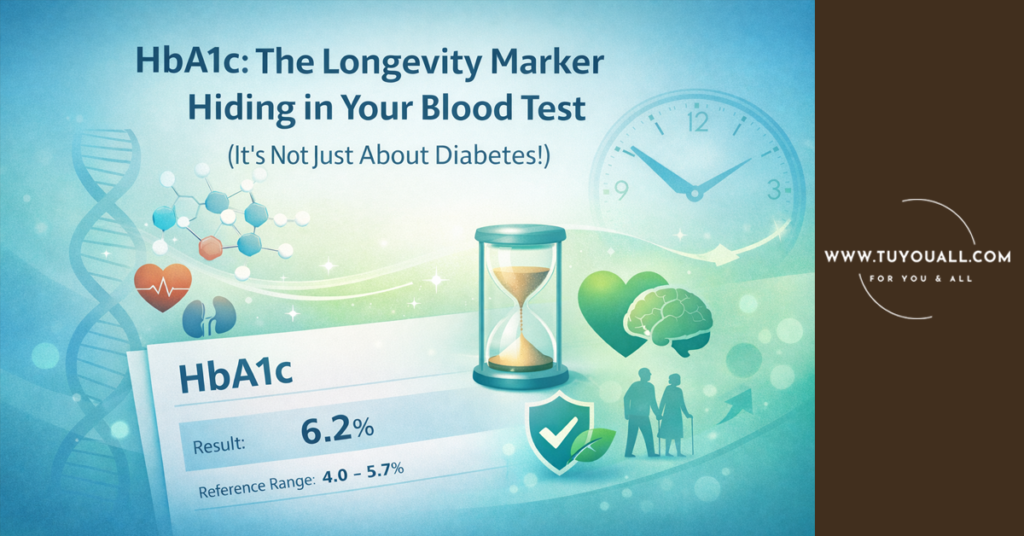
This blog post is based on insights from Dr. Mahesh Wadhawan‘s YouTube video: “HbA1c: The Longevity Marker Beyond Diabetes (Hindi)”.
When you get your blood work done, you probably glance at the HbA1c number, sigh with relief if it’s under 6.5%, and think, “Well, at least I don’t have diabetes.” But what if I told you that thinking is selling this tiny molecule short—way short?
That single number isn’t just a diabetes on/off switch. It’s actually a crystal ball showing how fast you’re aging, how stiff your arteries are getting, and whether you’re heading toward heart disease, kidney failure, or even dementia decades from now.
Dr. Mahesh Wadhawan, a cardiothoracic surgeon and founder of CDICS Opinion, puts it bluntly: “HbA1c is not just a marker for diabetes control. It is a surrogate indicator for your lifespan and every lifestyle-related disorder you can imagine.”
So grab your latest lab report. Let’s decode what your HbA1c is really trying to tell you about your future—and how dropping it by just one point could slash your disease risk by nearly one-third.
What Is HbA1c, Really? (Beyond the Basic Definition)
You’ve heard that HbA1c (or glycated hemoglobin) measures your average blood sugar. But let’s look under the hood to understand why this matters so much.
The Science of Sugar and Red Blood Cells
Your red blood cells (RBCs) live for about 90 to 120 days. During their lifespan, they float through your bloodstream like tiny rafts. Now, imagine glucose molecules in your blood as sticky grains of rice. As these RBCs travel around, glucose permanently glues itself to the hemoglobin protein inside them through a process called glycation.
Here’s the kicker: Once glucose sticks, it never unsticks. It’s like getting gum stuck in your hair—the bond is irreversible until that red blood cell dies and gets recycled.
Dr. Wadhawan explains: “When you measure HbA1c, you’re measuring what fraction of your hemoglobin is permanently handcuffed to sugar. If your hemoglobin is 15 and your HbA1c is 6.5, that means 6.5% of your hemoglobin is glycated.”
Why It’s a 3-Month Report Card
Unlike a fasting sugar test—which only shows your blood sugar at 8 AM on an empty stomach—HbA1c reveals your average glucose over the last three months. It’s like the difference between checking today’s weather versus looking at a season-long climate report.
For example, if you eat clean during the week but binge on sweets every weekend, your fasting test might look fine on Monday morning, but your HbA1c will spill the beans about those Saturday night ice cream parties.
Why HbA1c Is Your Body’s “Speed of Aging” Meter
Now comes the part that should make you sit up straight. That glycation process happening to your hemoglobin? It’s happening everywhere else in your body too.
The Hidden Damage of Glycation
When glucose sticks to proteins, it doesn’t just tag them—it physically changes their shape and function. Dr. Wadhawan describes this as a “quality change” that creates Advanced Glycation End Products (AGEs). These AGEs are literally markers of aging.
Think of it like this: Your body’s proteins are precision-engineered machines. Glycation is like pouring sand into the gears. The machine still looks like a machine, but it doesn’t work like one anymore.
This sticky, damaging process affects:
- Albumin (the protein that controls blood thickness)
- Globulins (your immune system proteins)
- Lipoproteins (the carriers moving your cholesterol around—yes, including LDL and HDL)
How Sticky Sugar Wrecks Your Arteries and Organs
When glucose glycates the walls of your blood vessels, it changes their elasticity. Your arteries go from being flexible garden hoses to rigid pipes. Result? High blood pressure and increased strain on your heart.
But it gets worse. That same sticky sugar coats:
- Kidney filters (nephrons), leading to diabetic nephropathy and eventual kidney failure
- Retina (the sensory layer of your eyes), causing vision problems
- Nerve sheaths, resulting in neuropathy (that tingling, burning sensation)
- Brain tissue, increasing dementia risk
As Dr. Wadhawan notes: “When glycation happens in your blood vessel walls, it changes the property of that wall. It changes its elasticity, stiffens arteries, and causes high blood pressure. This is how end-organ damage begins.”
For example, two people might have the same cholesterol levels, but if Person A has high HbA1c, their LDL particles are “glycated” and stickier, making them far more dangerous than Person B’s normal LDL.
The 30% Rule: How Lowering HbA1c Transforms Your Health Future
Here’s where the hope comes in. Your HbA1c isn’t just a diagnostic label—it’s a lever you can pull to change your destiny.
The Mathematics of Longevity
Research shows that every 1% drop in HbA1c reduces your risk of developing lifestyle diseases by 30%. Let that sink in. We’re talking about:
| Disease Risk | Reduction with 1% HbA1c Drop |
| Diabetic Nephropathy (Kidney Disease) | 30% lower risk |
| Cardiovascular Events | 30% lower risk |
| Dementia | 30% lower risk |
| Cancer Risk | 30% lower risk |
Dr. Wadhawan emphasizes: “Thirty percent is a huge figure. That’s why we say HbA1c is a surrogate for longevity.”
For example, if your HbA1c is 8.0 and you bring it down to 7.0—even without reaching “normal” levels yet—you’ve just cut your chances of kidney failure, heart attack, and memory loss by nearly one-third. Drop it from 7.0 to 6.0? Another 30% reduction on top of that.
The Direction Matters More Than Perfection
Don’t get discouraged if you can’t hit 5.5 immediately. Dr. Wadhawan points out that modern medicine considers it a win if a diagnosed diabetic moves from 6.5 to 6.0, or from 10.0 to 6.5. The trend is your friend. Every step down is buying you years of healthy life.
When HbA1c Lies: Conditions That Skew Your Results
Before you panic about a high number (or celebrate a low one), know that HbA1c isn’t perfect. Certain conditions can give you false readings.
When HbA1c Falsely Appears High
Your HbA1c might look worse than reality if you have:
- Iron deficiency anemia (low hemoglobin production)
- Vitamin B12 deficiency
- Pregnancy (especially first two trimesters)
- Chronic alcohol use
- Chronic kidney disease
When HbA1c Falsely Appears Low
Conversely, your number might look artificially good if you have:
- Thalassemia or Sickle Cell Anemia
- Chronic Liver Disease
- Recent blood transfusion (introduces young, unglycated cells)
- Long-term Vitamin C or Aspirin use
The Fix: If your HbA1c doesn’t match how you feel (or your other blood sugar readings), ask your doctor about the Fructosamine test. This measures glycated albumin (instead of hemoglobin) and isn’t affected by red blood cell lifespan issues. As Dr. Wadhawan mentions, “Fructosamine is a very interesting test for cases where HbA1c isn’t reliable.”
FAQs: Your HbA1c Questions Answered
Q1: If my HbA1c is 5.8, am I safe from lifestyle diseases? Not necessarily. While 5.8 is technically “prediabetic” rather than diabetic, Dr. Wadhawan explains that HbA1c exists on a spectrum of risk. Lower is generally better for longevity, provided you don’t have conditions that artificially lower the number.
Q2: How often should I check my HbA1c? Since red blood cells live 3-4 months, testing every 3 months gives you the most useful trend data. If you’re stable, every 6 months might suffice.
Q3: Can I lower my HbA1c without medication? Absolutely. Diet changes, exercise, sleep improvement, and stress management all lower average blood glucose. Even a 0.5% drop provides significant protection.
Q4: Why does my fasting sugar look normal but HbA1c is high? This suggests you’re having post-meal spikes that fasting tests miss. Your blood sugar might surge after lunch and dinner, then normalize by morning. Continuous glucose monitors (CGMs) can reveal these hidden spikes.
Q5: Is HbA1c related to aging even in non-diabetics? Yes. Dr. Wadhawan clarifies that glycation (the process HbA1c measures) is a fundamental mechanism of biological aging. Higher glucose accelerates aging in everyone, not just diabetics.
Conclusion: Your Blood Sugar Is Your Biological Clock
Here’s the truth bomb: Your HbA1c isn’t just a diabetes test—it’s a speedometer for how fast you’re aging. That sticky glucose isn’t just floating harmlessly; it’s caramelizing your arteries, clouding your kidneys, and stiffening your brain tissue.
The good news? You have control. Every percentage point you drop is a 30% reduction in disease risk. Every meal that doesn’t spike your blood sugar is an investment in clearer arteries at age 70, functioning kidneys at age 80, and a sharp mind at age 90.
As Dr. Wadhawan wisely puts it: “If I cloned myself and fed one version sweets morning and evening while the other ate normally, you’d see a 10 to 15 year difference in their biological age. That is proven by science.”
What’s your HbA1c number, and are you ready to buy yourself a few extra healthy decades?
Credit:
This blog post is based on insights from Dr. Mahesh Wadhawan‘s YouTube video: “HbA1c: The Longevity Marker Beyond Diabetes (Hindi)”. Dr. Wadhawan is the Founder of CDICS Opinion and Head of Department for Cardiothoracic & Vascular Surgery. For second opinions on heart and vascular procedures, visit his clinic near Golf Course Road, Gurugram.