This blog post is based on insights from Sunil Chhetri’s YouTube video discussing self-discipline, habits, and peak performance.
Have you ever promised yourself you’d wake up early tomorrow, only to hit snooze seven times? Or sworn you’d eat healthier, then found yourself elbow-deep in a bag of chips by 9 PM?
You’re not broken. You’re not lazy. You’re just human.
But what if I told you that India’s greatest footballer, Sunil Chhetri, struggles with the exact same feelings—and has cracked the code on how to push through anyway?
In a refreshingly honest conversation, Chhetri peeled back the curtain on what discipline actually looks like when nobody’s watching. No motivational posters. No “sleep when you’re dead” toxic hustle culture. Just real talk from someone who’s maintained elite performance for nearly two decades.
Here’s what he taught me about the real foundation of self-discipline—and why keeping your word to yourself might be the most addictive feeling in the world.
What Self-Discipline Actually Means (Hint: It’s Not What Instagram Tells You)
Let’s start with a reality check.
Chhetri begins with a simple but profound definition: “For me, what discipline means is—I have promised myself that I will do this. I will do it.”
Sounds basic, right? But here’s where most of us trip up.
We make promises to ourselves constantly. I’ll start Monday. I’ll go to the gym after work. I’ll sleep by 10 PM. And then… we don’t. We break our word to ourselves over and over until those promises become meaningless background noise.
Chhetri’s insight? “A lot of people make promises and can’t keep them. Even when they have to do something, they still don’t. Then it is their problem.”
The brutal truth: Every time you break a promise to yourself, you’re not just skipping a workout or eating junk food. You’re teaching your brain that your word doesn’t matter. That you don’t matter enough to follow through.
But flip that dynamic, and something magical happens.
Why Motivation Is a Liar (And What Actually Works)
Here’s where Chhetri gets really honest about the struggle:
“Being… doing the same thing, monotonously every day for one reason—is not easy. Because some days, you won’t feel like it. We are human. We act a lot on our hormones. Mood matters.”
He drops a truth bomb that fitness influencers hate to admit: “You can say whatever you want—we are not robots. At least not today. Who knows about the future? But today, we are not.”
Your feelings will fluctuate. You’ll have days when your pet died, when it’s someone’s birthday, when you’re just sick. “It matters. We are human. Say whatever you want—it matters.”
So if we can’t rely on motivation (because feelings are unreliable) and we’re not robots (so we can’t just switch off emotions), what’s the solution?
Consistency through identity, not intensity.
Chhetri explains why this is easier for him than for his friends: “Because I am very goal-oriented, hard work… this is my job. So whenever my friends who are not in football compare, I tell them—don’t compare, friend. Going to the gym is a task for you because it’s not your job. You want to do it to be healthy, and you should. Good. But it’s not your job.”
For Chhetri, training isn’t optional. It’s not a “should.” It’s a “must.” And that reframing changes everything.
For Example: Imagine you have a crucial work meeting at 9 AM. You don’t wake up and think, “Do I feel like going today?” You go because your job depends on it. What if you treated your health with the same non-negotiable status?
The “Second Nature” Secret: How Discipline Becomes Automatic
Here’s the part that should give you hope: It gets easier. Much easier.
Chhetri describes a phenomenon that neuroscientists call automaticity—when repeated behaviors become so ingrained they require zero willpower:
“Because I have done it thousands of days, it has become second nature. So on a good day, it’s easy. On a bad day, because you have done it so many times, your body understands. People around you understand. Your core group understands. They pull you. And you need that.”
This is the positive reinforcement loop in action. Every time you follow through—especially when you don’t feel like it—you’re not just completing a task. You’re building evidence that you can trust yourself.
And that evidence compounds.
Chhetri shares a powerful example from his own life with sugar:
“I told one of my very close friends—leave sugar. Yes. And then first of all, ‘What happens? Sugar is in everything!’ I said, ‘You know. Don’t worry. Anything that comes in front of you, look once. There is no lack of knowledge in today’s generation. We all have general knowledge. Look at what you’re eating once. Is there sugar in whatever you’re eating?'”
His friend quit sugar for 19 days. When Chhetri checked in, the response was telling: “I’m feeling good. Not a subtle change, but I’m feeling good. Won’t eat it now—body doesn’t crave it.”
Chhetri’s own sugar journey was even more dramatic. Six months prior, he was someone who “needed something sweet after every meal.” He planned to allow himself one cheat meal per month. Month one: success. Month two: success. By months three, four, five?
“Now, I don’t feel like eating sugar. It’s not that I’m craving it once a month. I don’t even remember when I last ate it, and why I ate it, and whether I’ll eat it or not. Like, I don’t even care.”
The lesson? Your body is “unbelievable,” as Chhetri puts it. Give it a habit for a long enough period, and it adapts. The struggle becomes the new normal. The new normal becomes preference.
The Two “Zero-Effort” Habits That Change Everything
Chhetri identifies two specific areas where discipline pays the highest dividends with the lowest barrier to entry:
1. Sleep: The Ultimate Life Hack
“I have been tracking my sleep. The day I sleep after eating sugar versus the day I don’t—how I wake up the next day, it gets better. It’s incredible.”
But here’s why he specifically recommends sleep to beginners:
“These are two things in your life for which you don’t have to do anything. If I tell you to wake up and come to the gym with me, it’s an effort. Energy spent. Waking up is this. Taking out that time is this. These two things—you don’t have to do anything.”
2. The “Zero-Effort” Framework:
- Don’t eat sugar = Not doing something (easier than doing something)
- Sleep by 10 PM = Not doing something (putting phone away, lying down)
For Example:
Chhetri breaks it down practically: “At 9 PM, put phone aside. Sleep at 10 PM. You don’t have to put in any effort. Imagine what happens from this. Because at the core of it, it’s such an easy task.”
Compare that to: “Boil broccoli and eat it.” That requires action. Telling your body to do something. But not eating sugar? Not scrolling till 2 AM? That’s just… stopping.
Of course, Chhetri acknowledges the internal battle: “You are fighting your demon inside. But you put the phone away, you slept. No effort.”
The Addictive Power of Keeping Your Word to Yourself
This is where Chhetri’s eyes light up. He describes a feeling that most people never experience because they break their own promises too quickly:
“The feeling that I say something and I can do it—is bloody powerful. Oh yes. It’s addictive. Oh, it’s powerful. Then you feel—I said it and I did it. It’s bloody powerful.”
But he clarifies something crucial: “I’m not saying power in the sense that people are watching—’Oh, what an attractive person.’ No. For yourself.”
This is internal validation, not external showmanship.
For Example:
Chhetri paints a vivid picture: “It can be small things. At 6 AM, I’ll wear these shoes and go out. I’ll walk for 10 minutes and come back. You do it for six months—you feel ‘Wow.’ You do it for two days and you love it. Yes. And imagine the power after six months. And you’re like ‘Wow.’ And you feel good about yourself.”
That feeling—what you feel about yourself matters more than what people think—becomes self-sustaining.
“What you think about yourself… it’s one of the most important things in your life. As far as I am concerned, you’ve got to feel good about yourself. Find your way. And this is one of the hacks that I give my easiest way to start.”
The hack? Start with “nothing” tasks:
- 9 PM: Phone aside
- 9:15 PM: Eyes closed
- Itchy? Can’t sleep? “Close your eyes, friend. Close your eyes.”
- Still awake at 1 AM? Tomorrow you’ll sleep at 12:45. Then 12:30. Then 12:00.
“Then it will come. And it will feel like I’m crossing a mountain. First one month—no one can do it. But after one month, it will be fine. 9 PM phone out, 10 PM sleep, 6 AM woke up.”
The Strange Attraction of Good Habits (And the Danger of Bad Ones)
Here’s a paradox Chhetri noticed: Good habits strangely attract good habits.
“And you know what happens? The good habit strangely attracts good habit. Only because you slept at 10 PM, you woke up at 6 AM. The moment you wake up at 6 AM… you won’t say ‘Let me meditate’ or ‘Whatever it can be, anything.’ It’s strange.”
The momentum builds organically:
- Wake up at 6 AM (because you slept at 10 PM)
- Drink warm water with lemon (because you’re already up)
- Speak a little kinder (because you feel good)
- Judge a little less (because your energy is stable)
- Eat a little less sugar (because you’re not craving the dopamine hit)
“Everything is a loop,” Chhetri emphasizes. “And the worst part is—even the bad habits, so-called bad habits, are also a loop.”
He illustrates the negative loop perfectly:
“Let’s do one thing today—watch TV till 2 AM. Had dinner at 9 PM. Body doesn’t need calories. We all know it. We all have the knowledge. Food is not needed, not required. But now a good movie is running, there’s nothing else… let’s take out some snacks. Body doesn’t need it because you ate till 2 AM. So at 3 AM you sleep, 6 AM you won’t wake up. 10 AM you woke up. What, man—bring whatever is there for breakfast.”
The moment that phrase enters your life—“I’ll manage whatever comes”—you’re in trouble. Chhetri warns: “The moment this answer comes in your life—whatever is there, bring it, I’ll do it—then achieving in sports is difficult. Achieving anywhere is difficult.”
In sports, especially, “margins are very small. What you eat—you become what you eat.”
How to Handle Bad Days (Without Destroying Your Progress)
This is where Chhetri’s advice gets nuanced and deeply empathetic.
He starts with a confession about his own wiring:
“On a bad day, we relax. You want to cry. If that’s the situation, you want to have a gulab jamun. You want to watch whatever TV at night. Be cozy in your quilt. Do it. But then when the good day comes, make sure you are as disciplined as possible.”
But then he admits: “Because I am opposite. When I have bad times, I go mad. Same. So… but I think we are an anomaly.”
Through maturity and experience, he’s learned that his “tough love” approach doesn’t work for everyone:
“When I was young, I used to judge it wrongly. Of course, I used to think—what is this, man? You’re doing this. If you’re sad, go to the gym. If you’re sad, go run. Then I realized when I… matured—no, friend. Every human is different. Every human’s motivation is different. Every human’s problems are different. You can’t… and how they feel that problem, that is also different.”
His evolved advice?
“Now when I talk to them, I say—it’s okay. When the day is bad, bring it. Blanket. It’s raining. You’re sad. Feel like crying. Feeling trapped. Not getting answers. Bring tea—with sugar, ginger. Bring samosas too. Bring jalebi too. Eat. Cry your heart out. Sleep peacefully. You do that.”
But with one critical condition:
“When tomorrow a good day comes—because it will come, that’s life, no matter what you have lost… relax. Live. Once that time ends, everything will be right. Relax.”
Chhetri personally operates differently—his “cheat meals” happen on good days, not bad ones:
“I am different. When I have bad times, all my cheat meals are good ones. Whenever I take cheat meal and liberty, it’s on a good day. Like today we really beat Mohun Bagan. There we reached quarterfinals. I keep like that. Because I am different.”
His logic? If he indulges when sad, he spirals: “If I want to have samosa, jalebi, etc., etc., whatever there is—if I am sad, then I’ll do it for a more prolonged time. If I am doing it and I am happy, it’s only for me.”
The key distinction: On happy days, he has a “cap”—I’ll do this, my cheat meal will be this, I’ll eat here, I’ll eat this with this. On sad days? “I am really guarded. Now won’t make mistake. Won’t think wrong. Try. It’s okay. Cry. Take today off. Let’s go tomorrow.”
He recognizes that many people can’t operate this way. So his universal advice stands: Rest on bad days. Attack on good days.
The Neuroscience Behind the “Do Something Harder” Hack
Chhetri shares a fascinating insight from neuroscience that sounds counterintuitive:
“A lot of neuroscientists have researched this. It’s called positive reinforcement loop. That when you are at absolute shit of your life. When you are shattered, lazy, you don’t want to do anything—do something which is extremely positive and hard.”
The mechanism:
- Sleep is a problem? You think it’s very hard?
- Running is much harder.
- Do that harder thing.
“That will release dopamine. Because of that dopamine, you will want more positive dopamine. And positive… once that loop starts, then your body will just force you to do positive things again and again and again. Which will make you far better.”
This is why Chhetri tells his friends: When you’re at your lowest, don’t default to the easiest option (food, alcohol, scrolling). Do something harder but positive. The dopamine hit from accomplishment outlasts the cheap dopamine from consumption.
Building Your Core Group: You Can’t Do This Alone
Throughout the conversation, Chhetri emphasizes one non-negotiable element: community.
“People around you understand. Your core group understands. They pull you. And you need that. Because… I don’t know about others, but I find it some days when it’s very difficult. My team—and it’s not only football team but the core team. My wife, my friend. And they will… they will help me.”*
This isn’t about broadcasting your goals on social media. It’s about having 2-3 people who understand your wiring, who know when to push and when to comfort.
For Example:
Chhetri describes the pre-season pressure cooker: “Suddenly Suresh Wangjam sends his six-pack photo in the group. I go… then someone else sends—’Now it’s competitive.’ Such fools these people are. They’re training in office also… You know, I mean, the competition is so high. Go chill, friend. And then you’re like—Sonam, leave it man, we’re not going out. I’m going to the gym.”
The peer pressure isn’t toxic—it’s accountability with love.
FAQ: Your Self-Discipline Questions Answered
Q: I always break promises to myself. How do I start trusting myself again?
A: Start ridiculously small. Chhetri’s “zero-effort” approach—putting your phone away at 9 PM, closing your eyes at 9:15—builds evidence that you can follow through. One kept promise is worth more than a dozen broken ambitious ones.
Q: What if I miss a day? Does my streak break forever?
A: Chhetri’s philosophy: “It’s okay. Cry. Take today off. Let’s go tomorrow.” Missing one day is data, not destiny. The danger is letting one day become two, then two become a week. Forgive yourself fast, but return faster.
Q: How long until a habit becomes “second nature”?
A: It varies by person and habit complexity, but Chhetri’s sugar example shows significant shifts around the 3-month mark, with deep automaticity forming around 6 months. His friend felt changes in 19 days. Trust the process longer than feels comfortable.
Q: Should I be harder on myself when I’m sad or happy?
A: It depends on your wiring. Chhetri is “guarded” on sad days and indulgent on happy days because sadness spirals him. Most people need the opposite—comfort on bad days, discipline on good days. Experiment to learn your pattern.
Q: Is discipline about never having fun?
A: Absolutely not. Chhetri takes cheat meals, enjoys food with friends, and celebrates wins. The difference? “I have a cap.” Discipline creates the structure that makes indulgence feel like celebration, not escape.
Conclusion: The Mountain You Think You’re Climbing
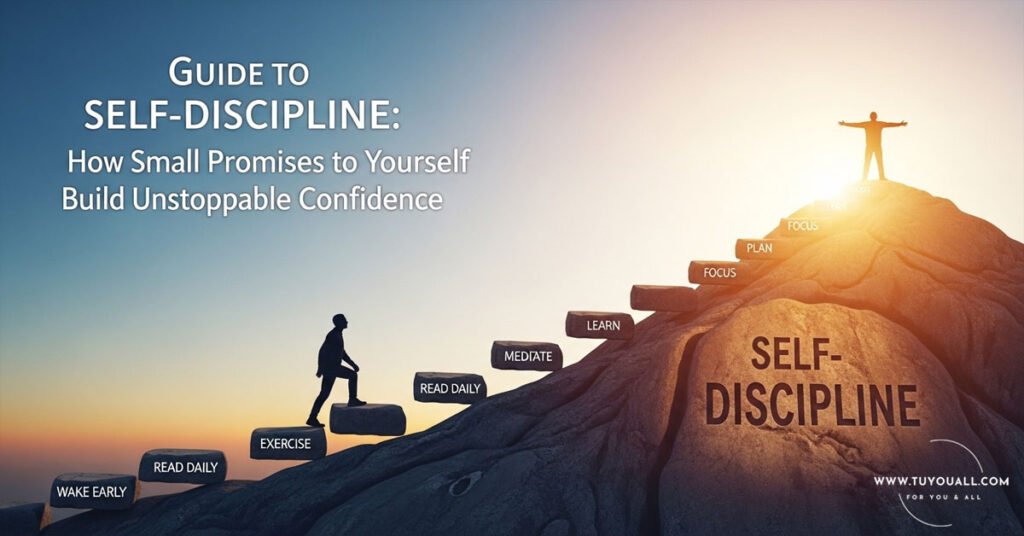
If you take one thing from Sunil Chhetri’s wisdom, let it be this: Self-discipline isn’t about becoming a robot. It’s about becoming someone you can trust.
The “mountain” you think you’re climbing when you start—that first month of putting your phone away, that first week of no sugar—that’s the steepest part. After that, you’re not climbing anymore. You’re flowing.
Chhetri’s entire philosophy boils down to a simple truth: When you keep your word to yourself, you don’t just change your habits. You change your self-concept. And that changes everything—how you wake up, how you speak, how you handle bad days, how you celebrate good ones.
You don’t need to be an elite athlete. You don’t need to wake up at 4 AM or eat boiled chicken six times a day. You just need to pick one small promise—so small it feels like “nothing”—and keep it.
Because as Chhetri says with a grin: “The feeling that I say something and I can do it—is bloody powerful. Oh yes. It’s addictive.”
What’s the first small promise you’re going to make to yourself today? And more importantly—what’s your plan for keeping it when you don’t feel like it?
Source & Credit
This blog post is based on insights from Sunil Chhetri’s YouTube video discussing self-discipline, habits, and peak performance.
The original content has been translated, expanded, and repurposed for educational purposes.
All direct quotes are attributed to Sunil Chhetri and have been translated from Hindi to English while preserving the original meaning and tone.