This blog post is based on insights from Vaibhav Sisinty‘s podcast appearance on Raj Shamani’s show: “AI Generalist: The Only Skill You Need in 2025 | Vaibhav Sisinty.”
The Job Market Is Shifting Beneath Your Feet—Here’s Your Survival Guide
What if everything you learned in college becomes obsolete before you get your first paycheck?
If you’re a 20-year-old student watching the job market crumble, or a working professional wondering how AI will impact your career, you’re asking the right questions. The harsh reality? Engineering placement rates in India have dropped from 10% to just 6% . IT companies that once hired hundreds of thousands are now replacing mid-level engineers with AI agents that write code 100x faster.
But here’s the twist: while template-based jobs are vanishing, a new category of opportunity is exploding. Vaibhav Sisinty—founder of Growth School and someone who has automated his entire business using AI—argues that we’re entering the era of the “AI Generalist.”
“The era of the specialist is fading. You don’t need to become a specialist in one thing anymore. You need to become someone who can solve any problem using AI.” —Vaibhav Sisinty
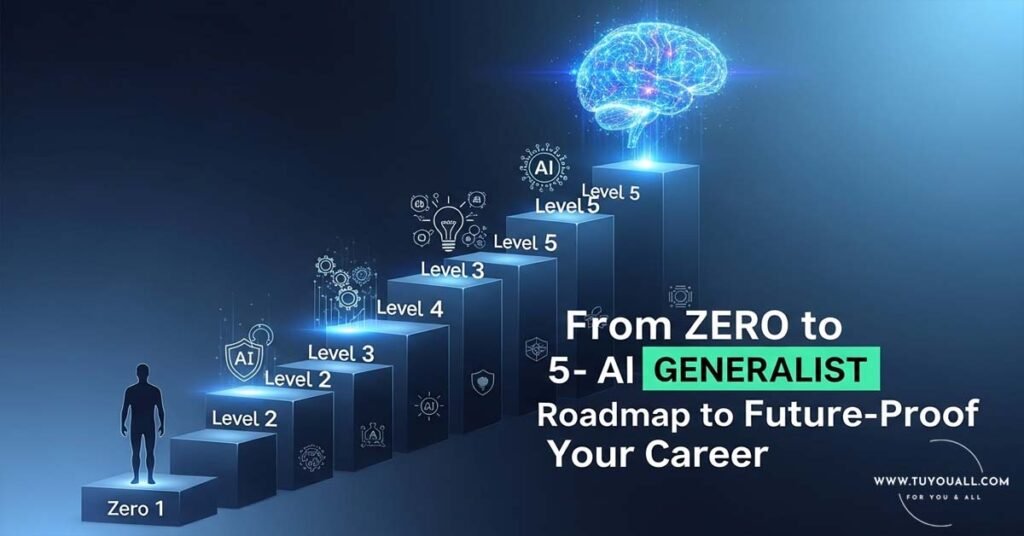
This isn’t about learning to code. It’s about learning to think and direct AI to do the coding, designing, marketing, and selling for you. In this comprehensive guide, we’ll walk through Vaibhav’s 5-Level AI Roadmap—the same framework he uses to run a business that ships more product with 5 engineers than he previously did with 15.
Level 0: Explore All AI Tools to Understand What’s Possible
Your mission: Before you build, you must see.
Most people fail with AI because they skip this fundamental step. They hear about ChatGPT, try it once for writing an email, decide it’s “okay,” and never return. That’s like visiting a library, reading one pamphlet, and declaring you’ve experienced literature.
The Exploration Method
For Example: Imagine you run a small kirana (grocery) store in Indore. Your father has been managing accounts on paper for 20 years. At Level 0, you don’t try to revolutionize his business immediately. Instead, you:
- Play with general-purpose AI: ChatGPT, Claude, Gemini—use voice mode to ask “Explain quantum computing like I’m 10” or “Write a WhatsApp announcement about mango season in Hindi”
- Discover specialized tools: Use There’s An AI For That (theresanaiforthat.com) to find domain-specific solutions
- Document what surprises you: When you see ChatGPT create a professional product image from a voice description, note that capability
| Tool Category | What to Try | What You’ll Learn |
| Text/Chat | ChatGPT, Claude, Gemini | How LLMs think, basic prompting |
| Spreadsheets | Numerous.ai, GPT for Sheets | AI on Excel/data analysis |
| Image Generation | Midjourney, ChatGPT 4o | Visual creation without design skills |
| Video/Audio | Runway ML, ElevenLabs | Multimedia content creation |
| Automation | Make.com, Zapier | Connecting apps without code |
Real-world application:
Vaibhav shares how his father now uses WhatsApp’s Meta AI for two things: asking for travel itineraries (“Plan a 3-day Dubai trip”) and translating English messages to Hindi. That’s Level 0 mastery—identifying specific, repeatable use cases before diving deeper.
“Play with all the tools. Because you don’t know what you want yet. But once you see what’s possible, you’ll get confidence.” —Vaibhav Sisinty
Level 1: Understand How AI Actually Works
Your mission:
Crack the black box. Understand the “why” behind the output.
This is where most casual users stop—and where serious practitioners separate themselves. You don’t need a computer science degree, but you need to understand:
Core Concepts to Master
- How LLMs generate text: They predict the next word based on patterns, not “thinking” like humans
- Different model types:
- GPT-4o (OpenAI): Great for emails, general writing, quick tasks
- o1/o3 (Reasoning models): Better for brainstorming, complex problem-solving, coding
- Open source models: Available on Hugging Face for customization
- Prompt engineering basics: There’s a method to the madness. “Write a poem about my dog” is Level 0. “Act as a creative writing coach. Write a 4-stanza poem about a golden retriever named Max who loves beaches. Use ocean metaphors. Tone: nostalgic but hopeful” is Level 1.
For Example:
When Vaibhav’s team creates content, they don’t just ask AI to “write a script.” They feed it:
- 300 previous scripts that performed well
- 300 that flopped
- Specific audience data
- The exact format (hooks, body structure, CTAs)
Then they ask it to rate new topic ideas on a scale of 1-10 based on this historical data. This is using AI with context, not just prompts.
Where to Learn These Mechanics
- OpenAI Playground / Google AI Studio: See internal settings like “temperature” (creativity control) and “P-values”
- Hugging Face: Explore open-source models and their capabilities
- Perplexity AI: For research-backed answers with sources
“Learn about prompting. Every AI tool has a different advantage. Inside ChatGPT 4.5, there’s another model called o3. One is a reasoning model, one is text generation. Their jobs are very different.” —Vaibhav Sisinty
Level 2: Master Prompting and Model Selection
Your mission:
Learn to talk to AI in its language.
By Level 2, you’re not just using AI—you’re collaborating with it. This means understanding that:
- Different models for different jobs: Don’t use a reasoning model (o1/o3) for simple emails. Don’t use GPT-4o for complex coding.
- Context is everything: The more context you provide, the better the output
- Chain-of-thought prompting: Ask AI to think step-by-step before answering
Practical Exercise:
Before your next important meeting, create a “grilling GPT.” Vaibhav does this before investor meetings:
- Upload your pitch deck
- Feed past investor conversations
- Prompt: “Act as a skeptical investor. Grill me on these numbers. Ask the toughest questions. If I answer incorrectly, correct me and explain why.”
He spends 2 hours being verbally grilled by AI before facing real investors. Result: He’s prepared for every objection.
Level 3: Go Beyond Text—Images, Video, and Audio
Your mission:
Become a true generalist by mastering multimodal AI.
Text is just one form of problem-solving. An AI Generalist must handle:
- Image generation: Using diffusion models (Stable Diffusion, Midjourney, ChatGPT 4o image generation)
- Video creation: Runway ML, Luma Labs, Dream Machine
- Audio/Voice: ElevenLabs for cloning, Vapi for voice agents
For Example:
Vaibhav’s content engine uses AI clones for his podcast promotion:
- Script generation: AI writes 5 hooks + 1 body per topic based on his past viral content
- Video clone: 11 Labs creates his video likeness
- Audio clone: Small AI generates his voice
- Merge: Both clones combine into a video editor’s workflow
- Testing: Content goes to 5 dummy profiles first to check initial metrics (3-second view rate, retention, share rate)
- Scale: Only top-performing hooks get posted to his main 600K-follower account
The result? 200 million views in 3 months, with Vaibhav spending just 10 minutes per day on content creation.
“In Level 3, you go deep into diffusion models. You learn how images work, how videos work, how audio works. Because when you’re solving problems, text isn’t the only problem-solving you do.” —Vaibhav Sisinty
Building Custom Models (Advanced Level 3)
Vaibhav has trained models on his own data:
- His voice and mannerisms for the AI clone
- His successful content patterns for script generation
- His decision-making style for business advice GPTs
This isn’t model creation from scratch—it’s fine-tuning existing models with your proprietary data.
Level 4: Build Products Using AI (Without Coding)
Your mission:
Create software solutions using “vibe coding.”
This is where the roadmap gets revolutionary. You can now build entire products without writing a single line of code.
The Vibe Coding Stack
| Tool | Purpose | Cost |
| Cursor | AI-powered code editor | ~$20/month |
| Windsurf | Collaborative AI coding | ~$20/month |
| Lovable.dev | AI app builder | Freemium |
| Bolt.new | Full-stack AI development | Freemium |
| Replit Agent | Deploy apps from prompts | Freemium |
For Example:
A 20-year-old with zero coding knowledge can build 5 tools for a podcaster in 5 hours:
- Caption writer for episodes
- Script idea generator from existing content
- Guest research assistant
- Thumbnail A/B tester
- Show notes automator
Charge ₹2-3 lakhs for the custom suite. The podcaster saves weeks of manual work. You just built a business without knowing Python.
Current Limitations (And Why They Don’t Matter)
Yes, today’s tools have constraints:
- They use slightly outdated models (Sonnet 3.7 instead of the latest)
- Context window limits: AI can only “remember” ~10,000 words at once (though Meta’s new Llama 4 offers 10 million tokens—game-changing)
But here’s Vaibhav’s point: “We’re not talking about 5 years from now. We’re talking about next year.” When unlimited context windows arrive, AI will understand your entire codebase and business logic. The only skill you’ll need is knowing how to operate these systems—knowing what works, what doesn’t, and how to direct the AI.
“The future programming language is English. But the real programming language in the backend will be something humans can’t understand. AI will create its own languages for efficiency.” —Vaibhav Sisinty
Level 5: Build and Deploy AI Agents
Your mission:
Create autonomous systems that run your business.
This is the final evolution—the shift from “AI user” to “AI orchestrator.” Vaibhav’s company now operates with:
- 20% humans, 80% AI agents
- 5 engineers doing the work of 15
- AI employees with names like “Jerry” (the voice agent that calls leads)
Real AI Agent Deployments in Vaibhav’s Business
| Function | Human Team (Before) | AI Agent System (Now) |
| Lead response | 40-person team, 45-min response time | AI voice agent “Jerry,” 10-min response |
| Pre-sales calls | Human qualification | AI calls, qualifies, schedules human handoff |
| Content research | 3 content strategists | Feedly → Make.com → GPT-4 API pipeline |
| Post-session feedback | Manual WhatsApp outreach | AI agent “Jerry” reaches out conversationally |
| Meeting attendance | Vaibhav in every meeting | AI attends, takes notes, answers questions via Slack |
How the Lead System Works:
- Lead fills form → Data hits CRM
- AI expands data into script (automatically)
- Voice agent “Jerry” calls within 10 minutes: “Hi Raj, this is Jerry from Growth School. I saw you applied for our program. Wanted to get a few more details…”
- AI captures all information, feeds back to CRM
- If lead is qualified (budget >$1000, etc.), human takes over
- If not, AI handles objection or schedules follow-up
The result? They scaled business without scaling team size. Lead connection time dropped from 45 minutes to 10 minutes. Conversion rates increased because speed matters.
Tools to Build Your Own Agents
- com (formerly Integromat): The “glue” between apps—no code required
- Zapier: Similar automation, more beginner-friendly
- Relevance AI: Build AI agents without coding
- n8n: Open-source automation
- Lindy: AI agent platform for specific tasks
- Vapi: Voice AI agents
“You can deploy 100, 200, 500 agents at once. They research companies in parallel, fill entire sheets with: company name, founder, email ID, what they posted about last week. Then craft personalized emails. All automated.” —Vaibhav Sisinty
Three Business Ideas You Can Start Today as a Solopreneur
Vaibhav outlined specific, actionable opportunities for the AI-native solopreneur:
1. AI Automation Agency
The arbitrage:
Big companies have TCS, Wipro, Deloitte. Small businesses (10-100 employees) have no one.
Your offer:
“I’ll automate your repetitive processes using AI agents.”
- Learn 4-5 tools (Make, Zapier, Relevance AI, Lindy)
- Charge ₹50,000-2 lakhs per automation project
- No coding required—just process mapping and tool configuration
2. Vibe Coding Studio
The opportunity:
People need custom software but don’t want to learn prompts or tools.
Your offer:
“Personal AI solutions built just for you.”
- Habit trackers, goal trackers, custom GPTs for specific workflows
- Charge ₹2-3 lakhs per custom build
- Build in 5 hours using Cursor/Windsurf
- Client uses it exclusively—you maintain it
3. Service-as-Software (Small Team Required)
The model:
Replace human customer support with AI voice agents, but keep humans for edge cases.
Your offer:
“AI phone agents for your business.”
- Build voice agents using Vapi that handle tier-1 support
- Human team handles only escalated issues
- Charge per-minute saved (traditional cost: ₹15/minute for Airtel-type centers)
- You need: Small dev team + BD team to land 2-3 major clients
“Building 10 businesses doing $1 million is much easier than building one business doing $10 million. Learn one SOP that makes ₹1 crore, then replicate it in different places.” —Vaibhav Sisinty
The Hard Truth: Why Degrees Are Becoming Worthless (Except One Thing)
Vaibhav didn’t mince words about traditional education:
“Your professors don’t know what ChatGPT is. They won’t let you use it because they think if you do assignments properly, you’ll get a job. Which you won’t. If they had jobs, they wouldn’t be teaching in regular colleges.”
The exception:
Elite institutions (IITs, IIMs, Harvard) retain value—not because of curriculum, but because of density of high-quality talent. The network, the signaling, the difficulty of entry.
For everyone else:
“Degrees are pieces of paper. It’s worthless. Please go get a degree, maybe it’ll be useful. But use your bloody time to build using AI. Don’t rely on your education system.”
Frequently Asked Questions
Is AI really going to replace software engineers?
AI will replace template-based coding jobs. Mid-level engineers doing repetitive refactoring are at high risk. However, “software scientists” who research how humans and AI agents communicate will thrive. The job evolves from “writing code” to “directing AI to write code and verifying business logic.”
What’s the most important skill to learn right now?
Become an AI Generalist—someone who can solve any business problem using AI. This combines:
- Domain expertise (marketing, sales, operations)
- Prompt engineering
- Tool fluency
- Business logic understanding
I feel overwhelmed by how fast AI is changing. How do I keep up?
Vaibhav’s method: “One hour every day, I just flirt with AI.” No agenda. Just explore new tools, try weird prompts, break things. This “play time” compounds faster than structured courses. Also, use AI to learn—upload podcast episodes to Meetlify.ai and chat with the content, or share your screen with Google AI Studio and have it teach you coding live.
Can small business owners really use AI without technical knowledge?
Absolutely. Start with:
- WhatsApp announcement channels for customer communication
- Voice mode in ChatGPT/Meta AI for creating marketing materials
- Photo-to-spreadsheet using ChatGPT: Snap photos of your handwritten accounts, ask AI to organize them into tables
What’s “vibe coding” and can I really build apps without coding?
Vibe coding = describing what you want in plain English and having AI generate the code. Tools like Cursor, Bolt.new, and Lovable.dev make this accessible. You don’t write code; you describe, test, and refine. Many successful indie makers are already doing $1M+ revenue as solo founders using this approach.
Conclusion: The Choice Is Yours—But Choose Quickly
We’re living through a shift as fundamental as the internet or mobile. The difference? This one is happening faster.
The playbook is clear:
- Stop specializing, start generalizing—become someone who can deploy AI across any domain
- Build your personal AI infrastructure—agents that handle your repetitive work
- Focus on original thinking—AI can replicate, but it can’t originate (yet)
- Start small, start now—one hour of daily AI exploration beats a weekend bootcamp
The job market is brutal for template-based workers. But for the AI Generalist? “You can kill it. You just need to know how to deploy AI in the right way.”
The question isn’t whether AI will change your industry. It’s whether you’ll be the one directing that change or the one replaced by it.
What’s the first AI tool you’ll explore today?
Source & Credit
This blog post is based on insights from Vaibhav Sisinty‘s podcast appearance on Raj Shamani’s show: “AI Generalist: The Only Skill You Need in 2025 | Vaibhav Sisinty.”
The original content has been translated, expanded, and repurposed for educational purposes. All direct quotes are attributed to Vaibhav Sisinty from the podcast transcript.