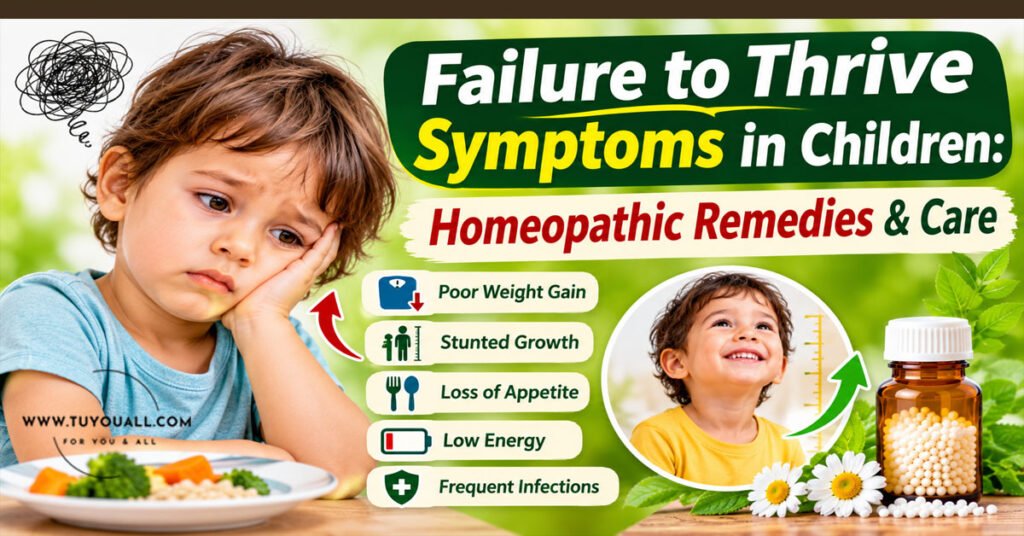
Learn About Failure To Thrive Symptoms in Children, Essential Medical Tests, And Homeopathic Remedies Like Calcarea Phos To Support Healthy Child Growth.
Is your little one falling behind on the growth chart? Do you find yourself stressing over every meal because your child simply refuses to eat? If so, you are not alone. Many parents watch their children struggle with poor weight gain, pale skin, and constant infections, wondering if something deeper is going on.
One possible explanation is failure to thrive (FTT)—a term doctors use when a child does not grow or gain weight as expected. While this condition sounds scary, early detection and the right care can make a huge difference. In this guide, we will walk through the common signs of FTT, the medical tests your pediatrician may recommend, and how certain homeopathic remedies for failure to thrive are traditionally discussed alongside conventional care to support a child’s development.
Important Medical Disclaimer: Failure to thrive is a serious pediatric condition that requires professional medical evaluation. Always consult a qualified pediatrician before starting any treatment plan. The information below is for educational purposes only and does not replace professional medical advice.
What Is Failure to Thrive?
Failure to thrive means a child is not growing at a normal rate compared to other kids their age. It is not a disease by itself. Instead, it is a signal that something is preventing proper growth. Doctors usually diagnose FTT when a child’s weight drops below the third percentile on standard growth charts, or when their growth pattern suddenly changes for the worse.
Common Signs Parents Should Watch For
Every child grows at their own pace. However, certain warning signs deserve immediate attention. Children with FTT often show:
- Poor weight gain – The most obvious red flag. Your child may look smaller or thinner than peers.
- Poor appetite – Refusing meals, playing with food, or showing zero interest in eating.
- Pale complexion – Looking unusually tired or lacking healthy skin color.
- Recurrent infections – Catching colds, ear infections, or stomach bugs more often than usual.
- Delayed milestones – Sitting, walking, or talking later than expected.
If you notice two or more of these signs, schedule a visit with your pediatrician right away. Early action prevents serious complications down the road.
The Medical Workup: Essential Steps Your Doctor Will Take
Before exploring any supportive therapies, a proper medical evaluation is critical. A responsible care plan for FTT usually combines several standard procedures to find the root cause.
1. Growth Chart Plotting
Your doctor will measure your child’s height, weight, and head circumference. Then they will plot these numbers on standardized charts. This visual tool quickly reveals whether growth has slowed, stalled, or dropped off entirely.
2. Laboratory Investigations
Basic tests help rule out hidden medical issues. Common screenings include:
- CBC (Complete Blood Count) – Checks for anemia or underlying infections.
- Stool Routine – Looks for parasites, poor fat absorption, or chronic diarrhea.
3. Nutritional Counselling
A registered dietitian can evaluate your child’s calorie intake. Sometimes FTT stems simply from not eating enough nutrient-dense food. Small changes—like adding healthy fats or offering smaller, frequent meals—can help tremendously.
4. Worm Prophylaxis
Intestinal worms steal nutrients from a growing body. In many regions, doctors recommend periodic deworming to ensure your child actually absorbs the food they eat.
These conventional steps form the backbone of failure to thrive treatment. No alternative approach should ever replace them.
Understanding Homeopathic Perspectives on Growth Delays
Homeopathy is a system of alternative medicine founded on the principle of “like cures like.” Practitioners use highly diluted natural substances to stimulate the body’s self-healing response. While mainstream scientific evidence for homeopathy remains limited, many parents and practitioners explore these remedies as complementary support under professional supervision.
When it comes to poor weight gain homeopathy, practitioners look at the child’s complete symptom picture rather than just the scale. The goal is not to replace nutrition or medical care, but to address underlying constitutional weaknesses that may slow development.
Commonly Discussed Remedies in Homeopathic Literature
The following table summarizes remedies often mentioned in homeopathic texts for children with growth and developmental concerns. Remember, remedy selection should always be individualized by a licensed homeopath.
| Homeopathic Remedy | Potency & Dosage | Traditional Indications & Symptom Picture |
| Calcarea Phos | 6X; 4 tablets QID for 12 weeks | Considered specific for failure to thrive; supports bone development and overall growth. |
| Silicea | 200; 4 pills weekly for 8 weeks | For underweight children with sweaty heads, weak nails, and low stamina. |
| Natrum Mur | 200; 4 pills weekly for 8 weeks | For thin children who crave salt and show slow physical or mental development. |
| Baryta Carb | 200; 4 pills weekly | For late development both mentally and physically; shyness or learning delays may appear. |
| Tuberculinum | 1M; 4 pills monthly | For children with recurrent infections or a family history of tuberculosis. |
| Alfalfa Q (Mother Tincture) | 5 drops in water TDS | Traditionally used as an appetite stimulant to encourage better food intake. |
| Withania Q (Mother Tincture) | 5 drops in water BD | Used as a general growth tonic to support weight gain and vitality. |
Abbreviations: QID = four times daily; TDS = three times daily; BD = twice daily; Q = mother tincture.
How Might These Remedies Help?
For Example:
Imagine a 3-year-old named Arjun who is noticeably smaller than his playgroup friends. He pushes away his plate at every meal, looks pale, and has had three chest infections this year. After his pediatrician rules out serious illness and starts nutritional counseling, his parents consult a homeopath. The practitioner prescribes Calcarea Phos 6X for general growth support, along with Alfalfa Q to gently stimulate his appetite. They return every month to track his weight on the growth chart and adjust the plan as needed.
This scenario illustrates how homeopathic support might fit into a broader care plan. It is not a standalone cure, but rather one piece of a larger puzzle that starts with proper nutrition and medical supervision.
Why Regular Monitoring Matters
Whether you choose conventional care alone or integrate homeopathic support, one rule never changes: monitoring is essential. Your doctor should see your child regularly—often monthly—to check weight, height, and overall development. A flat or downward trend on the growth chart demands immediate attention and a possible change to the treatment plan.
Tracking progress prevents the serious complications of untreated FTT.
Possible Complications of Untreated Failure to Thrive
Ignoring growth delays can lead to long-term consequences. Potential complications include:
- Stunted growth – The child may never reach their genetically expected height.
- Cognitive delay – The brain needs proper nutrition to develop. Chronic malnutrition can affect learning and memory.
- Weakened immunity – Leading to a cycle of recurrent infections that further drain the body.
These risks highlight why combining medical supervision with nutritional support—and, if desired, homeopathic care—is so important.
Frequently Asked Questions (FAQ)
Q1: Can homeopathy cure failure to thrive on its own?
There is no strong scientific evidence that homeopathy alone can cure failure to thrive. It should only be viewed as a complementary approach alongside proper pediatric care, nutrition, and medical treatment.
Q2: How long does it take to see results with homeopathic remedies?
Growth is a slow process. Most practitioners suggest evaluating progress over 8 to 12 weeks, with monthly weight checks. If no improvement occurs, the treatment plan needs reassessment by your doctor.
Q3: Are these homeopathic remedies safe for toddlers?
Homeopathic remedies are generally considered low-risk due to their high dilution. However, giving any remedy to a child—especially one with FTT—requires guidance from both a pediatrician and a qualified homeopath.
Q4: What is the best appetite stimulant for a child with poor weight gain?
Conventional doctors focus on calorie-dense foods and feeding schedules first. In homeopathic practice, Alfalfa mother tincture is traditionally used to stimulate appetite, but evidence is anecdotal. Always prioritize professional nutritional counseling.
Q5: When should I worry about my child’s delayed milestones?
If your child is significantly behind in sitting, walking, or talking compared to standard milestones—and especially if combined with poor weight gain—see a pediatrician immediately. Do not wait to see if supplements work first.
References & Further Learning:
For additional clinical insights, materia medica explanations, and practical perspectives on homeopathic management, the information in this article/page has been cross-referenced with educational resources shared by qualified homeopathic practitioners and researchers in their YouTube Channel (Links given Below). Readers seeking deeper guidance on remedy selection, potencies, and holistic care may explore video lectures and case discussions by established homeopathic doctors as listed below with their YouTube Channel Link :
| SL No. | Channel / Doctor Name | Primary Focus & Clinical Background | YouTube Link |
| 1 | Dr. Kirti Vikram Singh | Covers disease-specific remedies, mother tinctures, German combinations, and daily live Q&A sessions. | https://www.youtube.com/drkirtivikramsingh |
| 2 | Dr. Pranjali Srivastava | Registered BHMS physician and certified nutritionist focusing on holistic disease management and lifestyle care. | https://www.youtube.com/@drpranjalihomeopathy
|
| 3 | Dr. Swapnil Sagar Jain | BHMS consultant at Niramay Homeopathy offering remedy guides for acute and chronic conditions. | https://www.youtube.com/@DrSwapnilSagarJain-NIRAMAY |
| 4 | Dr. Umang Khanna | Focuses on natural homeopathic treatments, chronic illness management, and educational health guides in Hindi. | https://www.youtube.com/@drumangkhanna |
| 5 | Shree Radhey Homeopathy | Hosted by Dr. Chakshu; features remedy explanations, patient case stories, and live consultation Q&As. | https://www.youtube.com/@ShreeRadhey |
| 6 | Dr. P.S. Tiwari | Senior D.M.S. homeopath with 36+ years of experience explaining classical Materia Medica and therapeutics. | https://www.youtube.com/@DrPSTiwari |
| 7 | Dr. Varun Kanwadia | BHMS, DNHE consultant sharing practical homeopathic solutions for skin, hair, respiratory, and digestive issues. | https://www.youtube.com/@varunkanwadia |
| 8 | Dr. Arpana Samanta | Gold Medalist BHMS (Delhi) & PGD (London) with 20+ years of experience covering chronic diseases like thyroid, PCOS, and skin disorders. | https://www.youtube.com/@dr.arpanasamanta |
| 9 | Dr. Rukmani Choudhary | Focuses on root-cause homeopathic treatments, comparative remedy selection, and live Q&A sessions. | https://www.youtube.com/@Dr.Rukmani-HomeopathyClinic |
| 10 | Dr. Santosh Kumar Padhy | Provides accessible homeopathic remedy suggestions and general health guidance for everyday ailments. | https://www.youtube.com/@dr.santoshkumarpadhy8888 |
Medical Disclaimer:
This article is for educational purposes only. It does not replace professional medical advice, diagnosis, or treatment. Always consult a qualified healthcare provider or licensed homeopath before starting any new remedy, especially if you have underlying health conditions.