This blog post is based on insights from the original creator’s YouTube video: “The 6 Levels of Thinking Every Student Should Master” with additional research on Bloom’s Revised Taxonomy and the misinterpreted effort hypothesis.
Discover Bloom’s Taxonomy Study Method (Revised). Why Most Students Study Wrong? 6 Levels of Thinking That Top Learners Use to Master Any Subject.
Introduction: Are You Studying at the Wrong Level?
Have you ever spent hours rereading your textbook, only to blank out during the exam? Or maybe you’ve crammed hundreds of flashcards but still can’t solve problems when the context changes slightly?
If this sounds familiar, you’re not alone—and you’re probably not “bad at learning.” According to educational research, most students struggle because they’re thinking at the wrong cognitive level .
Here’s the truth that transformed my academic performance: The way you think while studying matters more than how long you study. I used this framework to achieve top results in medical school and my Master’s in Education, despite not being a “genius” .
The secret? A 70-year-old framework called Bloom’s Revised Taxonomy that most students have never heard of, let alone used strategically .
In this guide, you’ll discover:
- The six levels of thinking and why most students get stuck in the bottom three
- Why “harder” studying actually creates stronger memories (and why your brain tricks you into avoiding it)
- A counterintuitive “top-down” approach that saves time while improving retention
- Practical prompts you can use with AI tools to generate level-appropriate practice questions
By the end, you’ll know exactly which level you currently operate at—and why you probably need to aim higher than you think.
What Is Bloom’s Revised Taxonomy? (And Why It Still Matters in 2025)
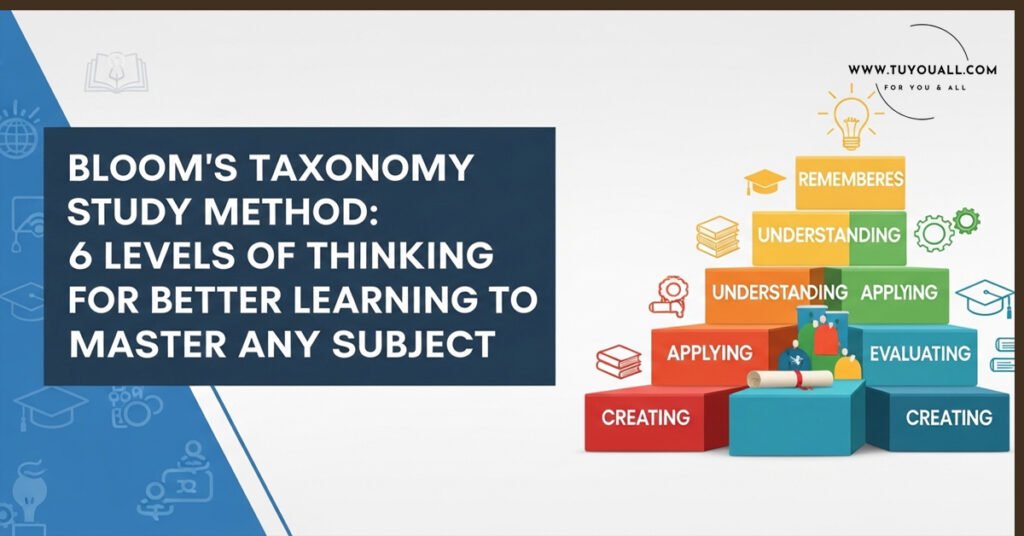
In 1956, educational psychologist Benjamin Bloom created a framework to classify learning objectives. In 2001, researchers Lorin Anderson and David Krathwohl revised it, changing the original nouns (Knowledge, Comprehension, Application) into action verbs (Remember, Understand, Apply) and swapping the top two levels .
The result? Six hierarchical levels of cognitive processing, from basic recall to creative synthesis:
| Level | Cognitive Process | What It Means | Example Question |
| 1 | Remember | Recalling facts and basic concepts | “List the symptoms of diabetes.” |
| 2 | Understand | Explaining ideas in your own words | “Explain why insulin resistance occurs.” |
| 3 | Apply | Using knowledge in new situations | “Calculate the insulin dosage for this patient.” |
| 4 | Analyze | Breaking information into components; comparing and contrasting | “Compare Type 1 and Type 2 diabetes mechanisms.” |
| 5 | Evaluate | Making judgments based on criteria and standards | “Justify which treatment approach is best for this specific patient.” |
| 6 | Create | Producing new or original work | “Design a novel intervention protocol for diabetic patients.” |
The framework isn’t just academic theory—international curricula and exam boards design assessments using this taxonomy . That means understanding these levels allows you to predict exam questions and study more strategically.
The Six Levels of Thinking: Why Most Students Never Make It Past Level 3
Level 1: Remember – The “Regurgitation” Trap
The Process: Memorizing through repetitive rereading, rewriting, and flashcard drilling.
The Result: You can list, define, and state facts—but that’s about it.
This is where most students start and, unfortunately, where many stay. It’s tedious, often makes you feel drowsy, and here’s the kicker: despite being called “Remember,” this level is actually terrible for long-term retention .
For Example:
A medical student memorizes the steps of patient assessment without understanding why each step matters. They can recite the procedure but struggle to adapt when a real patient’s presentation doesn’t match the textbook.
Level 2: Understand – Wrapping Your Head Around Concepts
The Process: Reading to comprehend, not just to memorize. Asking “What is this actually saying?”
The Result: You can explain concepts in your own words.
Here’s the crucial distinction: Two students can look identical from the outside—both sitting with textbooks open. But mentally, they’re worlds apart. The Level 2 student reads to understand; the Level 1 student reads to memorize .
For Example:
Instead of memorizing that “oxygen therapy treats hypoxia,” you understand why hypoxia damages cells and how supplemental oxygen reverses that process .
Level 3: Apply – Solving One-to-One Problems
The Process: Using learned concepts to solve straightforward problems.
The Result: You can solve “One-to-One” problems where one concept maps directly to one solution.
This is where many students feel comfortable. You learn a formula, you apply it to a problem that requires exactly that formula. In coding, this might mean building a simple function with basic variables .
However, Level 3 is where many students plateau—and where exam difficulty starts to ramp up in university.
Level 4: Analyze – The Gateway to Higher-Order Thinking
The Process: Comparing, contrasting, finding similarities and differences between concepts.
The Result: You can break complex information into components and see relationships.
This is where top students separate themselves from the pack. Level 4 thinking requires looking at information in relation to other information, not in isolation .
For Example:
In microbiology, instead of just knowing the characteristics of two bacteria, you analyze: “Compare the cell wall structures of Gram-positive and Gram-negative bacteria and explain how these differences affect antibiotic susceptibility.”
Study Techniques for Level 4:
- Venn diagrams comparing concepts
- Tables showing similarities and differences
- Mind maps connecting related ideas
- Summary notes that explicitly compare topics
Level 5: Evaluate – The Skill That Defines Top Performers
The Process: Making judgments, justifying decisions, asking “So what?” and “Why does this matter?”
The Result: You can prioritize information and defend your conclusions.
Level 5 is where you start thinking like a professional. You’re not just comparing options—you’re deciding which is better and why .
This level requires jumping between sources, questioning assumptions, and wrestling with ambiguity. It’s mentally exhausting, which is exactly why most students avoid it.
For Example:
“Evaluate the most appropriate psychological intervention for a patient with uncontrolled Type 2 diabetes, considering their socioeconomic context and patient preferences” .
Level 6: Create – Synthesizing New Knowledge
The Process: Generating novel solutions, hypotheses, or products from existing knowledge.
The Result: You can hypothesize and innovate.
Level 6 is less critical for most students because few assessments require it unless you’re in advanced graduate studies or research roles . This level involves identifying gaps in knowledge and creating potential answers.
For Example:
Designing a new diagnostic test for a disease or proposing a modified surgical technique for complex cases .
The “Misinterpreted Effort Hypothesis”: Why Your Brain Tricks You Into Bad Study Habits
Here’s the psychological trap that prevents most students from reaching Levels 4 and 5: When studying feels hard, you assume you’re learning poorly.
Researchers call this the misinterpreted effort hypothesis . Studies show that learners consistently avoid effective strategies (like interleaved practice or retrieval) because the mental effort makes them feel like they’re not learning well—even though these strategies produce better long-term retention .
The paradox: The strategies that feel easiest (rereading, highlighting) create weak memories. The strategies that feel hardest (analyzing, evaluating, retrieving) create strong, durable learning .
“As soon as you jump from level three to level four, you will 100% notice that this level of thinking requires more mental effort… some people think that means they’re doing something wrong.” — Original Creator
Signs you’re operating at Level 4 or 5 (the “good” kind of hard):
- You’re going back and forth between materials
- You’re asking “Why does this matter?” repeatedly
- You’re jumping between lectures, textbooks, and search engines to answer questions
- The process feels slower and more mentally taxing
If studying feels too easy, you’re probably not learning deeply enough.
The Counterintuitive “Top-Down” Strategy: Start at Level 5, Not Level 1
Most students study bottom-up: Master Level 1, then Level 2, then Level 3, and so on. This seems logical, but it doesn’t work in reality .
The problem with bottom-up learning:
- It takes too long to reach higher levels
- While you’re working on Level 2 and 3, your Level 1 knowledge is decaying (thanks to the forgetting curve)
- You spend most of your time relearning what you’ve forgotten
The better approach: Start at Level 5 and work down.
Here’s why this works: Your brain processes and stores information more strongly when you engage in higher-order thinking. When you aim for evaluation and analysis, you naturally achieve understanding and memory as side effects .
But the reverse isn’t true—if you study only to memorize, you won’t automatically gain the ability to analyze or evaluate.
How to Implement Top-Down Learning
Step 1: Instead of starting with flashcards or rereading, start with evaluation questions.
Step 2: Use this AI prompt to generate Level 5 practice questions:
“Give me questions at [your educational level, e.g., second-year university] for [your subject, e.g., microbiology] at Bloom’s Revised Taxonomy Level 5 (Evaluate).”
Step 3: Wrestle with these hard questions first. You’ll be forced to analyze, understand, and remember in the process.
Step 4: Only use lower-level techniques (flashcards, memorization) to fill specific gaps revealed by your high-level practice.
Practical Study Techniques for Each Level
| Level | Technique | Example |
| Remember | Flashcards, spaced repetition | Anki decks for medical terminology |
| Understand | Self-explanation, teaching others | “Explain this concept to an 8th grader” |
| Apply | Practice problems, case studies | Solving past exam questions |
| Analyze | Comparison tables, Venn diagrams, mind maps | Compare/contrast two theories |
| Evaluate | Critical appraisal, judgment prompts | “Which approach is better and why?” |
| Create | Research proposals, novel solutions | Design a study to test a hypothesis |
Remember: The technique matters less than the thinking behind it. You can make a mind map at Level 1 (just connecting words) or Level 5 (critically evaluating which relationships matter most) .
Frequently Asked Questions (FAQ)
Q.1. What is Bloom’s Revised Taxonomy used for?
Bloom’s Revised Taxonomy is a framework that classifies cognitive learning into six levels of increasing complexity: Remember, Understand, Apply, Analyze, Evaluate, and Create. Educators use it to design curricula and assessments, while students can use it to study more strategically by targeting higher-order thinking skills .
Q.2. Why is higher-order thinking better for memory?
Research shows that deeper cognitive processing (analyzing, evaluating) creates stronger, more durable memories than surface-level processing (memorizing). This is because complex thinking requires your brain to form more connections and process information more thoroughly, leading to better long-term retention .
Q.3. What is the misinterpreted effort hypothesis?
The misinterpreted effort hypothesis is the tendency for learners to avoid effective study strategies because they feel mentally effortful. Students mistake the difficulty of deep thinking for poor learning, when in fact, this “desirable difficulty” leads to better long-term retention .
Q.4. How can I apply Bloom’s Taxonomy to my studying?
Start by identifying what level your exams require. Then, use the “top-down” approach: begin with Level 5 (evaluation) questions using AI prompts, which will force you to engage with Levels 4, 3, 2, and 1 naturally. Focus on comparing, contrasting, and justifying rather than just memorizing .
Q.5. Which level of Bloom’s Taxonomy is most important?
For most students and professionals, Level 5 (Evaluate) is the sweet spot. Level 6 (Create) is mostly relevant for advanced researchers. Levels 4 and 5 are where you’ll find the complex problems typical of university assessments and professional challenges .
Conclusion: The Level You Need Is Higher Than You Think
If you take one thing from this guide, let it be this: The mental strain of deep thinking isn’t a sign you’re doing it wrong—it’s a sign you’re doing it right.
Most students stay stuck in the lower levels of Bloom’s Taxonomy not because they can’t think at higher levels, but because it feels easier and safer to memorize than to evaluate. But that comfort comes at a cost: wasted time, forgotten knowledge, and frustration when complex problems arise.
The research is clear: When you aim for Level 5 (Evaluate), you achieve Levels 1-4 as byproducts. When you aim only for Level 1 (Remember), you stay at Level 1—and watch your knowledge decay .
So here’s your challenge for your next study session: Don’t start with flashcards. Start with a judgment. Ask yourself: “Why does this matter? How does this compare to what I already know? Which approach is better and why?”
Your brain will protest. It will feel slower and harder. That’s exactly how you’ll know you’re on the right track.
What’s one subject where you’ve been stuck memorizing when you should be evaluating? Share in the comments below, or try the AI prompt technique and see what Level 5 questions reveal about your understanding.
Source & Credit
This blog post is based on insights from the original creator’s YouTube video: “The 6 Levels of Thinking Every Student Should Master” with additional research on Bloom’s Revised Taxonomy and the misinterpreted effort hypothesis.
The original content has been translated, expanded, and repurposed for educational purposes.