Tired After Sleeping? Learn How To Rest Properly: Low-Effort Rest Like Scrolling Makes Exhaustion Worse. Discover 4 Science-Backed Ways To Truly Recover Your Energy And Feel Human Again.
Do you wake up tired, even after a full night’s sleep? Do you spend your weekends “resting” on the couch, only to feel more exhausted on Monday morning?
You are not alone.
For years, I thought rest meant doing nothing. I would crash on the sofa, scroll through social media, and watch TV for hours. I believed that low effort equaled good rest. But the truth is, I felt worse afterward. My brain felt foggy, my body felt heavy, and my energy never came back.
It turns out, there is a huge difference between rest and recovery. And if you want to stop feeling like a zombie, you need to learn how to truly recover.
In this guide, we’ll break down the science of why you feel so tired, the common mistakes people make when trying to relax, and simple, practical ways to get your energy back. This advice comes from insights shared by Justin Sung, a former medical professional and productivity expert who worked over 100 hours a week for a decade—and finally figured out how to feel human again.
Let’s fix your exhaustion, for good.
Why You Feel Tired After “Resting” (Rest vs. Recovery)
Here is the biggest mistake most of us make: we think rest is the same as recovery. But they are completely different.
- Restusually means being passive. Lying down, watching Netflix, or doing nothing.
- Recoverymeans actively helping your brain and body heal.
Imagine you just ran a marathon. If you rest, you sit on a chair. But to recover, you might go for a slow walk or do some light stretching. That small amount of effort actually helps your muscles heal faster.
The same rule applies to your brain.
When you work hard all day—making decisions, solving problems, taking care of kids or customers—your brain builds up waste chemicals called neurotransmitters. Think of them like smoke from a fire. If you don’t clear the smoke, it just sits there, making everything hazy and heavy.
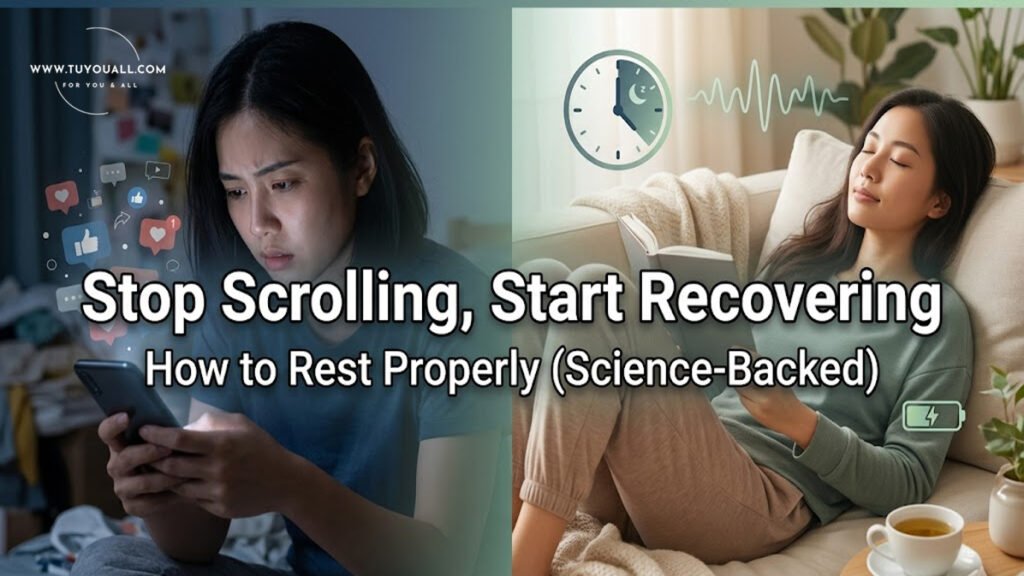
Low-effort activities like scrolling TikTok, watching the news, or playing mobile games do not clear this smoke. In fact, they add more smoke.
The Problem with Scrolling (It’s Not Relaxing)
For example: You spend 30 minutes on Instagram. You are not physically working hard. But your brain is:
- Making micro-decisions (swipe up, tap, scroll).
- Handling emotional ups and downs (funny video, sad news, a friend’s vacation).
- Getting small hits of dopamine (the “feel-good” chemical).
This creates something called low-effort agitation. You are not relaxed. Your brain is still running a race. By the end, you are even more exhausted than when you started.
“Low effort and relaxation are not actually that related to each other. Something like scrolling on your phone is low-effort agitation.” — Justin Sung
The Science of Cognitive Fatigue (And Why Sleep Isn’t Enough)
You might be thinking: “Okay, but if I just sleep more, I’ll be fine, right?”
Not exactly.
Sleep is amazing for physical exhaustion. If you run a race or lift heavy boxes, a good night’s sleep will fix you up. But cognitive fatigue (mental and emotional tiredness) is different.
Cognitive fatigue happens in the prefrontal cortex—the part of your brain behind your forehead that handles planning, focus, and self-control. When you use this part of your brain too much without a real break, it gets tired.
Here’s the scary part: mental exhaustion can actually sneak into your dreams. It lowers the quality of your sleep. And unlike a sore muscle that heals overnight, cognitive fatigue can stick around for weeks.
That is why you can sleep for 10 hours and still wake up feeling like a brick.
The Only Way to Clear Brain Fog
To feel better, you must lower the activity level in the part of your brain that is tired. If your work is mentally draining, you need to do something that is mentally low in activity—even if that thing requires physical effort.
That is the secret. Sometimes, a high-effort activity like exercise or painting is actually more relaxing for your brain than lying on the couch.
Psychological Detachment: How to Actually Switch Off
The number one predictor of good recovery is something called psychological detachment. That is a fancy way of saying: leaving your work problems at work.
But for most of us, this is really hard. I get it. You care about your job. You worry about your family. You feel like if you stop thinking about problems, you are being lazy or irresponsible.
Here is the truth that changed my life: You cannot pour from an empty cup.
I remember working a late shift as a junior doctor. We had a never-ending list of patients. I was rushing to the elevator to see the next one, and my senior doctor, Dr. Mike Hayes, pulled me aside. He said:
“First we need to get dinner. You cannot treat your patients if you become the patient.”
That message stuck with me. The people who need you—your family, your boss, your friends—they don’t need a tired, angry, irritable version of you. They need the best version of you. And to be that person, you must protect your energy like it is a precious treasure.
The Recovery Paradox (Why You Can’t Relax When You Need To)
Researchers have found something frustrating called the recovery paradox.
It says: People recover the least when they need it the most.
When your workload is heaviest and you feel the most exhausted, it is nearly impossible to detach from work. Your tired brain wants to keep worrying. It feels dangerous to let go. This is a normal human response, but it traps you in a cycle of exhaustion.
So, how do we break out?
4 Dimensions of True Recovery (Beyond Just Relaxing)
Researchers named Sonnentag and Fritz discovered that recovery has four parts. Most people only know the first two. But the last two are often the most powerful.
| Dimension | What It Means | Low-Effort Example | High-Effort (Better) Example |
| Relaxation | Low activity level in the tired system | Watching TV | A slow walk in nature |
| Psychological Detachment | Mentally switching off from work | Not checking emails | Playing a board game with family |
| Mastery | Learning or improving at something | Watching a tutorial | Actually practicing a new skill |
| Control | Choosing what to do with your free time | Following an algorithm’s feed | Deciding to read a book you picked |
Let’s break down the two big ones: Mastery and Control.
Mastery: Get Better at Something (Even If It’s Hard)
A mastery experience is any activity where you feel a sense of progress. You are learning. You are getting better.
For me, that is going to the gym. Every week, I try to lift a little more or do one more rep. That feeling of progress floods my brain with good chemicals and helps me mentally switch off from work.
For you, it might be:
- Learning to play the guitar.
- Doing a jigsaw puzzle.
- Gardening or taking care of houseplants.
- Cooking a new recipe.
- Learning a new language.
Important note: Mastery often requires high effort at the start. Your tired brain will tell you, “No, don’t do that. You’re too exhausted.” But that is a lie. The effort is the medicine. It feels hard because you are tired, but doing it is what will actually make you less tired.
Control: Do What YOU Want, Not What the Algorithm Wants
The fourth dimension is control. This means spending your free time doing something you intentionally chose to do.
When you scroll on social media, you are not in control. An algorithm is feeding you content. You are reacting, not acting.
But when you say, “I am going to spend 20 minutes drawing,” or “I choose to go for a walk,” just the act of choosing gives you energy.
Even 15 minutes of self-directed activity can be a powerful recovery tool. You are giving yourself permission to take control of your own time. That is not selfish—it is necessary.
Practical Tips to Feel Rested and Energized (Even When You’re Busy)
Knowing the science is great, but how do you actually do this when you have no energy? Here is a simple, step-by-step plan.
1. Remove the Planning Barrier
Remember: when your prefrontal cortex is tired, you struggle to make complex plans. That is why you choose the couch over the gym.
The fix: Decide in advance. Remove the thinking.
- Schedule it.Put “Gym” or “Painting Time” on your calendar a week ahead. That decision is already made.
- Lower the starting cost.Do not think about the whole workout. Just think: “Get changed and get there.” That is it. Once you are there, the rest is easy.
2. Create a “Relaxation List”
Keep a note on your phone. Anytime you see something interesting—a hobby, a place to walk, a recipe to try—write it down. When you are tired, you won’t be able to think of ideas. So plan ahead.
3. Use the 10-Minute Rule
You do not need two hours to recover. Start with just 10–15 minutes in the evening.
- Read a physical book.
- Write in a diary.
- Listen to an audiobook while stretching.
- Work on a puzzle.
It does not matter if you are “good” at it. Just do it. The act of doing something you chose is what heals you.
4. The Magic Pill? It’s Nature.
If you are so exhausted that you cannot even think about this list, do just one thing:
Find your nearest spot of nature and exist there for 30 minutes.
No phone. No music. Just sit under a tree, walk through a park, or stand by a river.
Scientists call this soft fascination. Nature effortlessly grabs your attention in a gentle way. This restores your brain’s working memory and attention span.
Research shows the best results come from 30 minutes of nature exposure in one go, or about 120 minutes total per week. More is even better.
I once did an overnight hike with no cell service. No phone. No internet. Just trees and birds. When I came out, I felt like a completely new human. That is the power of nature.
Dimensions and Strategies of Effective Rest and Recovery
| Recovery Dimension | Description | Examples of Activities | Cognitive or Physical Benefit | Implementation Strategy | Inferred Effort Level |
| Relaxation | Activities characterized by low activation for the physical or cognitive systems currently being recovered. | Listening to audiobooks, writing in a diary, or going for a walk. | Facilitates clearance of neurotransmitters accumulated during tasks; prevents low-effort agitation. | Protect relaxation as a non-negotiable part of the routine; focus on reducing stimulation rather than just effort. | Low effort |
| Control | The degree of autonomy an individual has to decide which activities to pursue during non-work time. | Self-directed reading, choosing specific exercise times, or taking 10 minutes for a desired task. | The act of exercising agency over one’s time serves as a recovery experience and prevents burnout. | Selfishly protect a small window of time (15-20 minutes) to do exactly what you want to do. | Low effort |
| Psychological Detachment | The ability to mentally disengage completely from work-related or life-related problems. | Nature exposure, spending 30 minutes in a park, or avoiding checking work emails at home. | Leads to higher life satisfaction, reduced burnout, and improved engagement when returning to work. | Acknowledge human limits (the ’empty cup’ analogy); use routines to create a boundary between work and home. | High effort |
| Mastery | Engaging in challenging activities that provide a sense of progress or involve learning new skills. | Learning a language, playing an instrument, weightlifting, or solving jigsaw puzzles. | Triggers psychological detachment, activates relaxation, and builds ‘hobby assets’ for future energy. | Start small (10-15 minutes); keep materials ready to remove friction; focus on progression over perfection. | High effort |
Frequently Asked Questions (FAQ)
Q: Is watching TV a bad way to rest?
It depends. If you actively choose a movie you love and pay attention to it, that can be a form of control and relaxation. But if you mindlessly channel-surf or scroll your phone while the TV is on, that is just low-effort agitation. Your brain is still working.
Q: How long does it take to fix chronic exhaustion?
If you have been tired for months or years, do not expect one good night to fix it. Cognitive fatigue takes time to heal. Start with one small change (like a 15-minute walk outside) every day. Within 2-3 weeks, you should feel a noticeable difference.
Q: I have kids and zero free time. What can I do?
Look for micro-moments of control. Even 5 minutes of deep breathing in the bathroom while you choose to be calm counts. Or involve your kids in mastery activities, like building LEGOs or drawing together. That counts as recovery for you, too.
Q: What if my stress is from family problems, not work?
That is harder, because you cannot “leave” family at the office. In this case, focus on mastery and control. Find one small hobby that is just for you. It creates a mental “wall” between the stress and your identity. You are not just “the person with problems.” You are also a painter, a walker, or a musician.
Conclusion: You Deserve to Feel Human Again
Feeling exhausted is not a personality flaw. It is not a sign that you are weak or lazy. It is a biological signal that your current recovery habits are not working.
The good news is that you can fix it.
- Stop confusing low effort with real relaxation.
- Stop scrolling when you are tired (it makes it worse).
- Start scheduling small moments of masteryand control.
- Let nature do its magic on your brain.
Remember what Dr. Mike Hayes said: You cannot treat your patients if you become the patient. Whether your “patients” are your customers, your children, or just yourself, you owe it to them to protect your energy.
Try one tip from this article today. Just one. See how you feel tomorrow. And then try another.