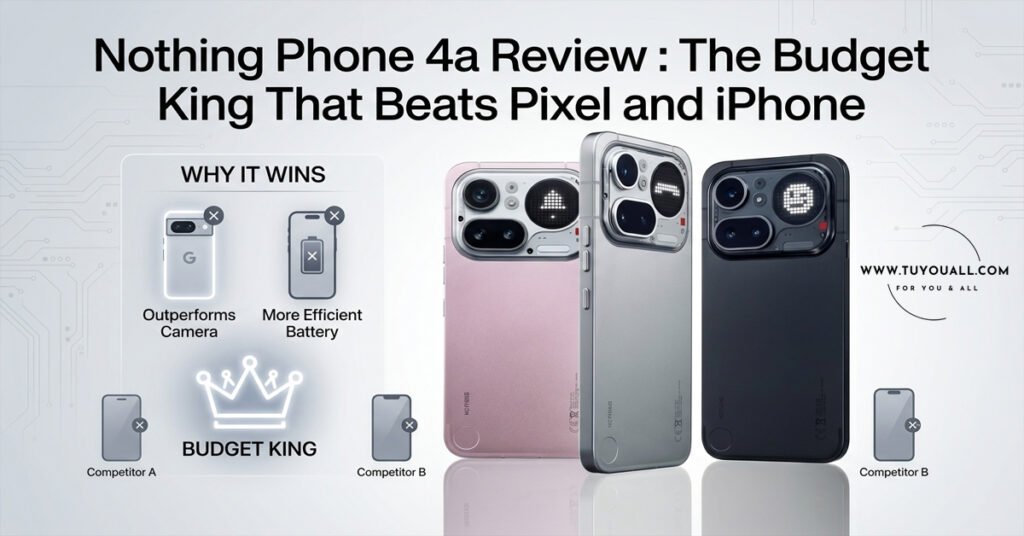
Discover why the Nothing Phone 4a is the best budget smartphone this year. Our review covers specs, Nothing OS 4.1, Glyph interface, and real value.
Are you tired of paying flagship prices for features you barely use? You’re not alone. This year, Nothing did something radically different. They skipped the expensive flagship race entirely. Instead, they launched the Nothing Phone 4a and 4a Pro. These two devices aim to dominate the mid-range market. And according to top tech reviewer Marques Brownlee, they might just succeed.
Nothing’s strategy is clear. They want to offer premium experiences without premium price tags. The Nothing Phone 4a starts at just €349. The Pro model begins at $499. At these prices, they directly challenge Google’s Pixel 10a and Apple’s iPhone 17e. But do they deliver? Let’s find out.
Why Nothing Skipped the Flagship Game This Year
Here’s a theory that makes perfect sense. Nothing intentionally avoided building a traditional flagship phone. Brownlee explains it best: “They just don’t want to make a high-end competitive flagship phone right now because they can’t.” —Marques Brownlee
The smartphone market is brutal for smaller companies. Samsung, Apple, and Xiaomi place massive component orders. They get volume discounts. Nothing cannot match those prices. Plus, RAM costs have skyrocketed recently. Bigger brands locked in older prices through long-term contracts. Nothing lacks that buying power.
CEO Carl Pei addressed this openly. In a recent video, he stated: “We’re not going to make a new flagship phone every single year just for the sake of it.” —Carl Pei This framing sounds thoughtful. However, the business reality is simple. Building a phone with a top-tier chip and massive RAM would cost too much. It would price Nothing out of competition.
Therefore, Nothing chose a smarter path. They focused on mid-range hardware. They paired it with exceptional software polish. The result? Phones that feel expensive without actually being expensive.
Nothing Phone 4a: Premium Looks on a Budget
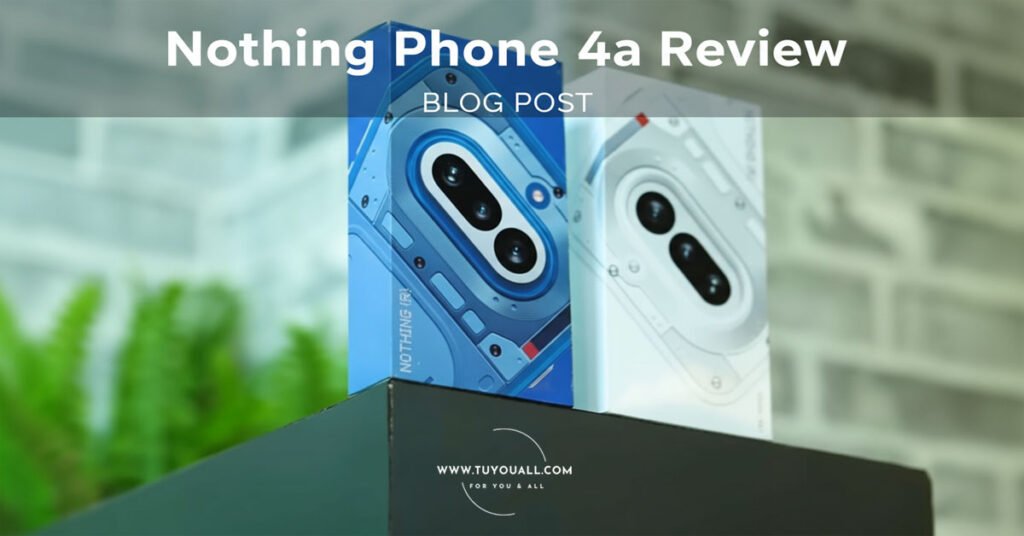
The Nothing Phone 4a is arguably the best-looking device Nothing has ever made. It features a stunning matte blue finish. The semi-transparent back reveals dotted text and textured shapes. You get Gorilla Glass 7i on the front. The sides are matte blue plastic. It looks far more expensive than €349.
Key Specifications
| Feature | Nothing Phone 4a |
| Processor | Snapdragon 7S Gen 4 |
| Display | OLED, 120Hz, up to 4500 nits peak |
| Battery | 5000+ mAh |
| Storage | 128GB UFS 3.1 |
| Cameras | 50MP main, 8MP ultrawide, 3.5x telephoto |
| Build | Plastic back, Gorilla Glass 7i front |
| Water Rating | IP64 |
Performance That Surprises
Don’t let the “S” in Snapdragon 7S Gen 4 fool you. This chip handles daily tasks smoothly. Nothing paired it with UFS 3.1 storage. Apps open faster. Animations feel snappy.
Brownlee noticed this immediately. He said the “snappy factor is super high.” You would struggle to tell the difference between this and a flagship during normal use. Unless you play intensive games or run benchmarks, the 4a feels premium.
Battery and Display
The 5000+ mAh battery easily lasts a full day. The OLED display supports a 120Hz refresh rate. Scrolling feels smooth. Colors look vibrant. At 4500 nits peak brightness, outdoor visibility is excellent.
Nothing Phone 4a Pro: Flagship Vibes for $499
The Pro model takes everything good about the 4a and adds flagship flavor. It starts at $499. For that extra money, you get meaningful upgrades. However, some features are purely aesthetic.
Build Quality: Metal Matters
Pick up the 4a Pro, and you immediately feel the difference. It uses unibody aluminum construction. Brownlee describes it perfectly: “You’re holding cold metal every single time, which is awesome.” —Marques Brownlee The camera plateau looks like something from an ultra-premium device.
The clear cutout around the cameras and Glyph Matrix adds visual flair. However, the metal body attracts fingerprints. Cleaning it can be annoying.
The Glyph Matrix: More Than Just Lights
The standard 4a has a simple LED bar. The Pro gets the full Glyph Matrix. This is a dot-style LED array on the back. It is brighter and fully customizable.
For example:
You can assign specific icons to notifications. Miss a Slack message? A custom icon appears. Get a text from your partner? A heart lights up. You can even use custom images.
Brownlee appreciates the practicality. He notes: “It encourages you to basically just keep your phone face down most of the time.” —Marques Brownlee You see only the notifications worth your attention. This reduces screen time naturally.
Specs Comparison: 4a vs. 4a Pro
| Feature | Nothing Phone 4a | Nothing Phone 4a Pro |
| Price | €349 | $499 |
| Processor | Snapdragon 7S Gen 4 | Snapdragon 7 Gen 4 |
| Display | 120Hz OLED, 4500 nits | Up to 144Hz OLED, 5000 nits |
| Build | Plastic + recycled materials | Unibody aluminum |
| Glyph | LED bar (7 dots) | Full Matrix display |
| Water Rating | IP64 | IP65 |
| Max Zoom | 70x | 140x |
| Wireless Charging | No | No |
The 144Hz Catch
The Pro lists a 144Hz refresh rate. That sounds impressive. However, Brownlee discovered a catch. The phone rarely actually hits 144Hz. Even with peak refresh rate forced, it stays at 120Hz. Only a couple of supported games bump higher. For daily use, you will never notice the difference.
Similarly, the 5000-nit peak brightness sounds better than the 4a’s 4500 nits. Side by side, however, the difference is barely visible.
Nothing OS 4.1: Software That Feels Alive
Both phones run Nothing OS 4.1 on top of Android 16. This is where Nothing truly shines. The software experience has improved gradually over time. Now, it stands out as a major selling point.
Smoothness Above All
Nothing prioritizes animations and responsiveness. Budget phones often feel sluggish. Nothing avoids this trap. The refined animations make the interface feel alive.
Brownlee confirms this: “Phones without super high-end chips still feel really nice to use.” —Marques Brownlee The combination of optimized software and fast storage creates a flagship-like experience.
Playground Widgets
Nothing introduced Playground. This is a community-driven widget store. Users create custom widgets for home screens. Some are genuinely wild.
For example:
You can add a functional arcade game to a 1×1 home screen box. Or you can use a widget that counts down time left in your day, week, month, and year. These features add personality no other Android skin offers.
AI: Less Is More
Neither phone bombards you with AI features. Nothing keeps things minimal. They offer an Intelligence Toolkit. Inside, you find an AI wallpaper generator and some ChatGPT widgets. They also retain the Essential Space shortcut button.
For users tired of AI overload, this is refreshing. You get useful tools without the bloat.
The Glyph Interface: Gimmick or Game-Changer?
Nothing’s signature feature returns this year. The 4a uses a straight bar of seven LED dots. The bottom one glows red. This red dot blinks as a video recording indicator. More phones should copy this feature.
The LED bar also works as a volume indicator. Flip your phone over during music playback. The lights show your volume level. You can also use it as a progress bar for Uber arrivals or Google Calendar events.
The Pro’s Matrix takes this further. You can display entire icons and images. However, Brownlee wishes he could draw directly on the matrix. Hopefully, a future software update adds this feature.
Camera Reality Check: Triple Lenses, Average Results
Both phones feature triple camera setups. This beats the iPhone 17e’s single camera and the Pixel 10a’s dual setup. However, do not expect miracles.
The Setup
Both phones share similar focal lengths:
- 50MP main sensor
- 8MP ultrawide
- 5x telephoto
The Pro uses slightly bigger sensors. It also includes a 140x ultra zoom feature. Brownlee is unimpressed. He calls it “just digital crop.” The standard 4a already offers 70x zoom. The extra reach does not justify the Pro’s higher price.
Real-World Performance
Photos come out serviceable. However, they often look overly HDR-processed. Noise appears in shadow areas. Neither phone shoots 4K video from the ultrawide. Why? The 8MP sensor simply lacks the resolution.
For casual Instagram posts and family photos, these cameras work fine. For photography enthusiasts, look elsewhere.
The Verdict: Which Nothing Phone Should You Buy?
The choice is simpler than it seems.
Buy the Nothing Phone 4a if: You want maximum value. At €349, it delivers smooth performance, great battery life, and a unique design. It handles everyday tasks flawlessly. You get 90% of the Pro experience for much less money.
Buy the Nothing Phone 4a Pro if: You love premium materials. The aluminum unibody feels fantastic. The Glyph Matrix offers more customization. You live in the US, where the standard 4a is unavailable.
Brownlee’s conclusion is clear. The 4a Pro is “less of a pro version of the phone and more of a slightly upbadged upfeatured version of the same thing for 150 bucks more.” —Marques Brownlee The standard 4a represents the better deal for most buyers.
Frequently Asked Questions
Q.1. Is the Nothing Phone 4a good for gaming?
Ans. The Snapdragon 7S Gen 4 handles casual and mid-tier games well. However, demanding titles may require lower settings. For serious mobile gaming, consider a dedicated gaming phone instead.
Q.2. Does the Nothing Phone 4a support wireless charging?
Ans. No. Neither the 4a nor the 4a Pro includes wireless charging. You must use wired charging for both devices.
Q.3. What makes Nothing OS different from regular Android?
Ans. Nothing OS focuses on minimalism, smooth animations, and unique customization. Features like the Glyph interface and Playground widgets create a distinct personality. It avoids the heavy bloatware found on many competitors.
Q.4. How does the Nothing Phone 4a compare to the Pixel 10a?
Ans. The Nothing Phone 4a costs less while offering triple cameras and a larger battery. The Pixel 10a may win in computational photography. However, Nothing wins in design, software character, and overall value.
Q.5. Will Nothing release a flagship phone this year?
Ans. According to CEO Carl Pei, Nothing will not release a flagship in 2026. They prefer waiting until they can deliver meaningful upgrades. This strategy keeps prices competitive and avoids unnecessary yearly iterations.
Conclusion
Nothing made a bold choice this year. They skipped the expensive flagship race. Instead, they perfected what budget phones can be. The Nothing Phone 4a proves that smart software beats raw specs. It offers style, speed, and sanity at €349. The 4a Pro adds metal and matrix lights for $499. However, the base model remains the smarter purchase.
If you want a phone that stands out without draining your wallet, Nothing delivers. The Glyph lights remind you to stay present. The smooth software makes daily use enjoyable. And the price leaves money in your pocket.