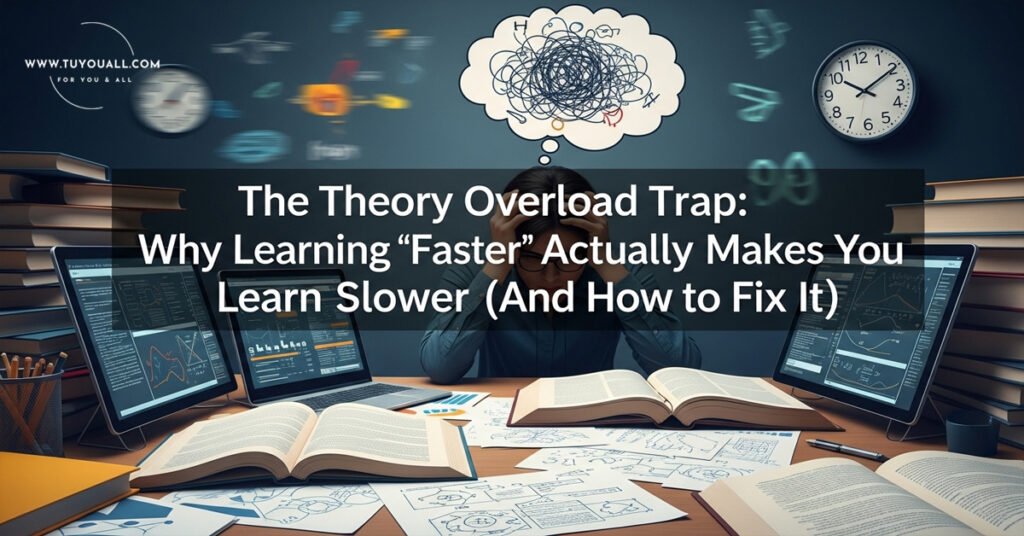
“Discover why Theory Overload kills your learning progress. Master the experiential cycle and balance theory with practice to learn any skill faster—backed by real student case studies.”
Have you ever spent hours watching tutorial videos, reading how-to guides, and consuming every piece of advice about a new skill—only to find that you still can’t actually do it?
You’re not alone. In fact, this approach guarantees failure almost 100% of the time.
For the last decade, I’ve been obsessed with finding the fastest and easiest ways to master new skills. After years of teaching thousands of students and diving deep into learning research, I’ve identified one critical mistake that sabotages progress before it even begins. I call it “theory overload.”
Here’s the counterintuitive truth: The fastest way to learn any skill is to learn more slowly.
Let me show you why—and how you can escape this trap today.
What Is the Experiential Cycle? (The Hidden Engine of All Learning)
Before we dive into theory overload, we need to understand the fundamental mechanism that makes learning possible in the first place: the experiential cycle.
Think of learning archery. When you release an arrow, you can’t control it mid-flight. Where it lands depends entirely on everything you did before you let go—your grip, stance, breathing, and aim. The same principle applies to learning itself. Your exam results, memory retention, and depth of understanding all depend on the processes you used while studying.
Here’s how the experiential cycle actually works:
- Act – You perform the skill (shoot the arrow, take the test, practice the technique)
- Observe – You see the result (where the arrow lands, your score, the outcome)
- Reflect – You analyze what needs to change to improve
- Experiment – You try again with the adjustment to see if it works better
Without this cycle, you cannot learn any new skill. Period.
The problem? Most people break this cycle without realizing it. They keep “firing arrows randomly”—consuming information without observing results, reflecting, or experimenting. They might get lucky occasionally, but they never build consistent competence.
The Theory Overload Trap: Why More Information = Less Learning
Now here’s where most learners get stuck. Whether you’re learning archery, cognitive skills, or “learning how to learn” itself, there’s a dangerous trap waiting for you: trying to learn too much, too fast.
Let me share a real example from my teaching program that illustrates this perfectly.
Case Study: Suresh vs. Enzo—The Surprising Truth About Speed
In my program that teaches efficient learning strategies, I can track student behavior and progress closely. Look at these two students and guess who became more successful:
| Student | Time on Program | Course Progress | Starting Baseline | Final Results |
| Suresh | 5 weeks | 31% complete | 80% | 71% (got worse) |
| Enzo | 54 weeks | 20% complete | 62% | 92% (major improvement) |
Despite covering less than two-thirds of the course material, Enzo improved dramatically while Suresh actually declined.
Why did Suresh get worse after five weeks of dedicated work? The answer is theory overload.
Your Brain Has Limited RAM (And You’re Probably Exceeding It)
Imagine your brain is like a bowl with limited capacity. This represents your cognitive resources—the mental energy and working memory available for learning.
When you learn a new skill, every new concept you encounter requires resources to hold in your mind:
- “Hold the bow more tightly”
- “Stabilize my core”
- “Keep shoulders relaxed”
- “Breathe slowly”
- “Aim lower”
Each instruction fills up your mental bowl. On top of that, performing the unfamiliar skill itself requires significant cognitive effort. When a skill eventually becomes a habit, the resource drain decreases—but during learning, everything feels awkward, difficult, and resource-intensive.
The result? Your bowl overflows. You’ve overloaded your brain’s ability to process information effectively.
In learning research, this is called multiple element interactivity—and it’s a primary cause of cognitive overload.
Why Cognitive Skills Are Even More Vulnerable
Here’s the critical difference between physical and cognitive skills:
- Physical skills (like archery) burn energy through your muscles
- Cognitive skills (like learning strategies) burn effort through your brain
The act of learning itself—understanding new information, processing it, organizing it, creating memories—is innately resource-intensive. As the original content explains: “If we didn’t feel this effort, we wouldn’t have any memory. That would be called passive learning.”
This means cognitive skills push you toward overload much faster than physical ones. Adding just a few extra concepts can tip you from productive struggle into complete mental gridlock.
The Solution: Balance Theory with Practice (The 5:1 Rule)
So what’s the best way to learn a new skill, especially a cognitive one?
Only experiment with one or two new things at a time.
Suresh, who raced through 31% of the program in five weeks, learned over a dozen new techniques. Each technique had two or three components to manage. He was juggling 20-30 cognitive elements simultaneously—completely overwhelming his mental capacity. His brain couldn’t actually learn anything; it was too busy just trying to keep up.
Meanwhile, Enzo took a year to cover just 20% of the material. He realized he formed habits slowly, so instead of the standard ratio, he used 15-20 hours of practice for every 1 hour of new theory. On the surface, he looked slow. In reality, his skill growth was optimal because he never let himself get overloaded.
The Secret Formula: Theory-Practice Balance
The key principle is simple: Always balance new theory with practice.
| Approach | Result |
| Practice without theory | Aimless, inefficient progress |
| Practice with too much theory | Cognitive overload, guaranteed failure |
| Balanced theory + practice | Optimal skill growth, sustainable progress |
When skills become habits through repetition, your brain finds efficient shortcuts. What once required intense concentration becomes automatic. This frees up cognitive resources for the next layer of theory.
The rule of thumb: For every 1 hour of theory, aim for at least 5 hours of practice.
However, this ratio adjusts based on:
- Complexity of the skill (complicated skills need more practice time)
- Your personal habit-forming speed (some people need weeks, others need hours)
How to Know You’re Ready for More Theory
You can tell new habits are forming when:
- Tasks feel easier and faster without sacrificing accuracy
- You get faster without consciously trying to speed up
- The skill requires virtually no thinking to execute correctly
When you notice these signs, you have the mental space to add new theory. Until then, keep practicing what you’ve already learned.
Practical Application: Adjusting Theory Intake to Your Schedule
Here’s how this looks in real life with different time commitments:
Scenario 1: Limited Time (5 Hours/Week)
- Practice: 5 hours
- New Theory: 1 hour maximum
- Strategy: Focus on cementing one or two techniques into habits before adding anything new
Scenario 2: Dedicated Learning (20 Hours/Week)
- Practice: 20 hours
- New Theory: Up to 4 hours
- Strategy: Increase theory proportionally, but monitor for overload signals
Remember: Five hours of practicing a complex skill like efficient learning strategies is not the same as five hours practicing a simple skill like a new way to tie shoelaces. Complex skills require more practice time per theory hour.
FAQ: Common Questions About Theory Overload
Q.1. What exactly is theory overload?
Theory overload occurs when you consume more new information than your brain can process and convert into practical habits. It’s like pouring water into a cup that’s already full—everything spills out and nothing is retained.
Q.2. How do I know if I’m experiencing cognitive overload?
Signs include: feeling mentally exhausted after study sessions, inability to recall what you just learned, making careless mistakes on tasks you “should” know, and frustration that despite putting in time, you’re not improving.
Q.3. Can theory overload happen with physical skills too?
Yes, but it’s less common. Physical skills drain energy through muscles; cognitive skills drain mental resources. Since learning itself is cognitively demanding, mental skills are more vulnerable to overload.
Q.4. Is there such a thing as too much practice without theory?
Absolutely. Practice without any guidance is aimless—you might reinforce bad habits or plateau without knowing how to improve. The goal is balance, not elimination of theory.
Q.5. How long does it take to form a new habit?
It varies dramatically by individual and skill complexity. Some habits form in hours; others take weeks or months. Monitor your own progress: when tasks feel automatic and effortless, you’re ready for more theory.
Conclusion: Slow Down to Speed Up
The research is clear, and the real-world evidence is undeniable: Theory overload has an almost 100% failure rate. Conversely, nearly 100% of learners who balance their theory intake with their practice and habit-forming rate achieve smooth, rapid skill acquisition.
The paradox of learning is that rushing guarantees slowdown. By taking the time to let each concept become automatic before adding the next, you actually reach mastery faster than those who try to cram everything in at once.
Key takeaways:
- Your brain has limited cognitive resources—respect that limit
- Use the experiential cycle: act, observe, reflect, experiment
- Follow the 5:1 practice-to-theory ratio as a starting baseline
- Adjust based on your personal habit-forming speed
- Watch for signs of automation (effortless execution) before adding new theory
This is, without question, one of the most important principles for learning any skill effectively.
What’s one skill you’ve been trying to rush through? Could slowing down and focusing on practice actually get you to your goal faster?