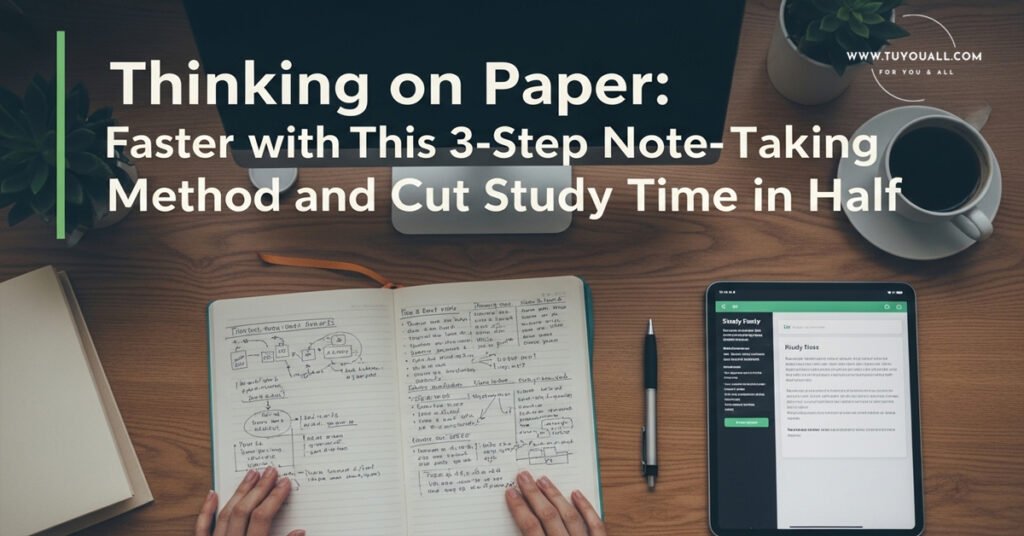
Discover “thinking on paper”—a powerful learning technique that cuts study time by 50%. Learn the 3 principles to boost retention and reduce overwhelm.
Have you ever spent hours reading a book, only to realize you can’t remember a single key idea? Or sat through a meeting feeling overwhelmed by information, desperately trying to keep all the “puzzle pieces” in your head?
If this sounds familiar, you’re not alone. Most of us were taught to “take notes” in school, but nobody ever taught us how to think while doing it. The result? We write down everything (or nothing at all), feel less confused temporarily, but fail to actually learn anything.
Here’s the counterintuitive truth: the way most people take notes actually stops them from learning.
There’s a better way. It’s called thinking on paper—a method I discovered that cut my learning time by at least half. Problems that used to take me days to solve now take one afternoon. Whether you’re studying medicine, business, AI, or just trying to make better decisions faster, this technique will transform how your brain processes information.
In this guide, you’ll learn:
- What “thinking on paper” actually means (and why your current note-taking might be backfiring)
- The 3 simple principles to apply it effectively
- Why this method creates deeper understanding and lasting memory
Let’s dive in.
What Does “Thinking on Paper” Actually Mean?
To understand what thinking on paper is, let’s first look at what it’s not.
The Problem with Passive Consumption
Not thinking on paper looks like this: You pick up a dense book—say, one on cognitive neuroscience of memory—and start flipping through pages. You try to understand it while keeping all your thoughts, questions, and connections trapped in your head.
As you consume more information, two things happen:
- Information load increases → Confusion and overwhelm increase (this is natural)
- You write everything down to feel better → You bypass actual learning (this is self-sabotage)
Here’s why the second part is so damaging: When we feel overwhelmed, our instinct is to “dump” everything onto paper to relieve mental pressure. But this bypasses the cognitive processing your brain needs to turn information into true knowledge.
“It is the learning equivalent of going for a run to get more fit, but then halfway through you feel tired and so you jump in a car and drive to the finish line. You’re no longer feeling tired, but you also kind of defeated the entire point of the exercise.”
Thinking on paper solves both problems simultaneously. It reduces confusion and overwhelm without skipping the mental work that creates deep understanding and memory.
The 3 Principles of Thinking on Paper
The method boils down to three simple principles that are easy to remember:
| Principle | Core Action | Purpose |
| Make it wrong | Jot down messy, imperfect keywords quickly | Overcome paralysis and prime your brain |
| Make it shorter | Distill into concise keywords only | Speed up pattern recognition |
| Make it again | Reorganize and restructure your notes | Strengthen memory through active processing |
Let’s break down each one.
Principle #1: Make It Wrong
If what you write is “right” immediately, you’re doing it wrong.
When learning something new, confusion happens because you’re trying to connect too many “dots” (concepts) while your brain struggles to hold them all. Thinking on paper gets those dots out of your head and onto the page so you can see them.
But here’s the trap: If you try to make your notes perfect from the start—ensuring every connection is correct, every grouping is logical—you’ll freeze. You’ll stare at the page wondering “Where do I begin? What keyword do I write first?”
The solution: Embrace imperfection. Get the wrong ideas down quickly.
For Example:
Imagine you’re learning learning science terminology for the first time. You encounter words like encoding, retrieval, memory, cognitive load, thalamus, explicit memory, working memory, long-term memory.
Instead of trying to organize them mentally, you simply scatter keywords on the page:
| plain |
| encoding retrieval memorycognitive load thalamus brainexplicit memory working memory long-term memory |
It’s messy. Nothing connects. That’s exactly right.
Next, you make guesses at relationships:
- “Encoding and retrieval both relate to memory somehow”
- “Memory is influenced by cognitive load”
- “Thalamus is part of the brain”
- “Explicit, working, and long-term memory feel like… types of memory?”
These guesses might be wrong. That’s the point. The act of guessing primes your brain so that when you encounter the correct information later, you absorb it faster and deeper.
Key Takeaways for Principle #1:
- Write down keywords quickly — don’t wait for clarity
- Look at what you’ve written and guess at connections — even if you’re wrong
- Maintain high self-awareness — notice when perfectionism kicks in and remind yourself: “We’re not making a masterpiece; we’re organizing thoughts”
Principle #2: Make It Shorter
Here’s a hard truth: The act of writing notes does not innately create better understanding. In fact, lengthy notes can make learning harder by creating a second overwhelming pile of information you now need to sort through.
With AI tools today, you don’t need comprehensive reference notes—you can query documents instantly. Your notes should serve one purpose: making it easier for your brain to find patterns and extract learning.
The rule: No full sentences. Get as close to single keywords as possible.
For Example:
Instead of writing:
“Write down key words quickly, look at what you’ve written, make some guesses at connections or groups”
You write:
Fast → Examine → Guess/Connect
These keywords act as memory anchors—triggers that remind you of the full concept without requiring you to re-read paragraphs.
Why this works (the science): Research shows that retention and depth of understanding decrease as word count increases. Why?
- Writing more = processing less — It takes more cognitive effort to summarize into a keyword than to copy a full sentence
- Less text = faster pattern recognition — Your brain spends time thinking about connections instead of reading sentences
“It is harder to write concisely than waffle for a page.”
Practical tips to make it shorter:
- Replace phrases with single words (“fast” instead of “quickly write down keywords”)
- Don’t make it pretty—messy handwriting is fine if you can read it
- Push yourself to distill even complex technical concepts into keywords
Principle #3: Make It Again
This is where the real magic happens. Most of your deep learning, solid memory, and ability to use knowledge comes from reorganizing your notes—not from creating them.
After 15-20 more minutes of reading or listening, your initial messy map will face two problems:
- It gets messier — More keywords appear, creating visual chaos
- You find mistakes — Some of your initial “guesses” were wrong
For Example:
You initially grouped “explicit memory,” “working memory,” and “long-term memory” under “types of memory.” But as you learn more, you realize: explicit memory actually overlaps with working memory and long-term memory in some cases. Your initial grouping doesn’t reflect reality.
The solution: Make it again. Reorganize, regroup, rearrange, reconnect.
Here’s what that process looks like:
| Stage | What It Looks Like | Mental State |
| Initial dump | Scattered keywords, random guesses | “I have no idea how this connects” |
| First reorganization | Grouped concepts, some connections drawn | “This makes more sense, but it’s getting messy” |
| Second reorganization | Cleaner structure, corrected relationships, removed errors | “I can see the big picture clearly” |
“The act of reorganizing all the ideas is actually what strengthens the memory. This process of cleaning it up—even though we’re not learning any new information—is actually where the benefit of the learning is going to come from.”
Key actions for “making it again”:
- Regroup — Put ideas in different, more accurate categories
- Rearrange — Literally move things around on the page for visual clarity
- Reconnect — Add or remove connections based on updated understanding
After this process, you should feel your initial overwhelm and confusion decreasing. The information isn’t trapped in your head anymore—it’s organized on paper, and the act of organizing it has cemented it in your memory.
Why Thinking on Paper Is So Powerful
Let’s connect the dots on why this method accelerates learning so dramatically:
1. It Offloads Cognitive Load
Your brain has limited working memory. By externalizing thoughts onto paper, you free up mental bandwidth to focus on processing rather than storing information.
2. It Forces Active Processing
Unlike passive highlighting or transcription, thinking on paper requires you to:
- Select keywords (active filtering)
- Guess relationships (active prediction)
- Reorganize (active restructuring)
These actions create deeper neural pathways than simply “saving” information.
3. It Embraces Desirable Difficulties
The “make it wrong” and “make it again” principles introduce productive struggle. Research in learning science shows that some difficulty during learning—reorganizing information, correcting errors—actually improves long-term retention.
4. It Creates Visual Clarity
Complex relationships become visible. You can see how concepts connect, which is far more powerful than trying to hold abstract relationships in working memory.
FAQ: Thinking on Paper Method
Q1: Can I use this method for digital note-taking, or does it have to be physical paper?
Absolutely! While the original method emphasizes physical paper for the tactile, spatial benefits, you can apply the same three principles using digital tools like Obsidian, Notion, or even simple text documents. The key is the process (wrong → shorter → again), not the medium.
Q2: How long should I spend “making it again”? Is once enough?
There’s no fixed rule—reorganize whenever you feel overwhelmed by messiness or discover errors. For complex topics, you might reorganize 3-4 times. Each iteration strengthens memory. As the creator notes: “This is not the final version either… as we continue to learn more, we make it again.”
Q3: What if I’m in a fast-paced meeting and can’t pause to reorganize?
Use a “capture then process” approach. During the meeting, quickly dump keywords (Principle #1). Immediately afterward—while memory is fresh—spend 5-10 minutes making it shorter and reorganizing (Principles #2 and #3). This post-meeting processing is where real learning happens.
Q4: Does this work for creative work, or just academic learning?
Thinking on paper works for any complex cognitive task: strategic planning, problem-solving, decision-making, writing, coding. Anytime you need to navigate multiple variables or ideas, externalizing and reorganizing them accelerates clarity.
Q5: I tend to be a perfectionist. How do I get comfortable with “making it wrong”?
Start with low-stakes practice. Pick a YouTube video on a topic you know nothing about and deliberately create “wrong” notes. Notice how the guesses prime your attention. Build evidence that imperfection leads to faster learning than paralysis does.
Conclusion: From Overwhelm to Mastery
Thinking on paper transforms note-taking from a passive storage exercise into an active learning engine. By following the three principles—make it wrong, make it shorter, make it again—you:
- Reduce overwhelm without bypassing the cognitive work that creates understanding
- Accelerate pattern recognition by distilling information to its essence
- Build lasting memory through the active process of reorganizing and correcting
Whether you’re studying for exams, navigating complex work decisions, or mastering a new skill, this method will help you achieve clarity in significantly less time.
The next time you feel that familiar confusion rising as you consume new information, resist the urge to either (a) keep it all in your head or (b) transcribe everything perfectly. Instead, grab a pen, embrace the mess, and start thinking on paper.
What’s one complex topic you’ve been struggling to master? Try the “make it wrong” principle for just 10 minutes today, and notice how it changes your learning speed.
Source & Credit
This blog post is based on insights from Ali Abdaal‘s YouTube video: “How to Learn Anything Faster (My Thinking on Paper Method)”
The original content has been translated, expanded, and repurposed for educational purposes.
Ready to revolutionize your learning? Bookmark this guide and apply these principles to your next study session, meeting, or complex problem-solving challenge.