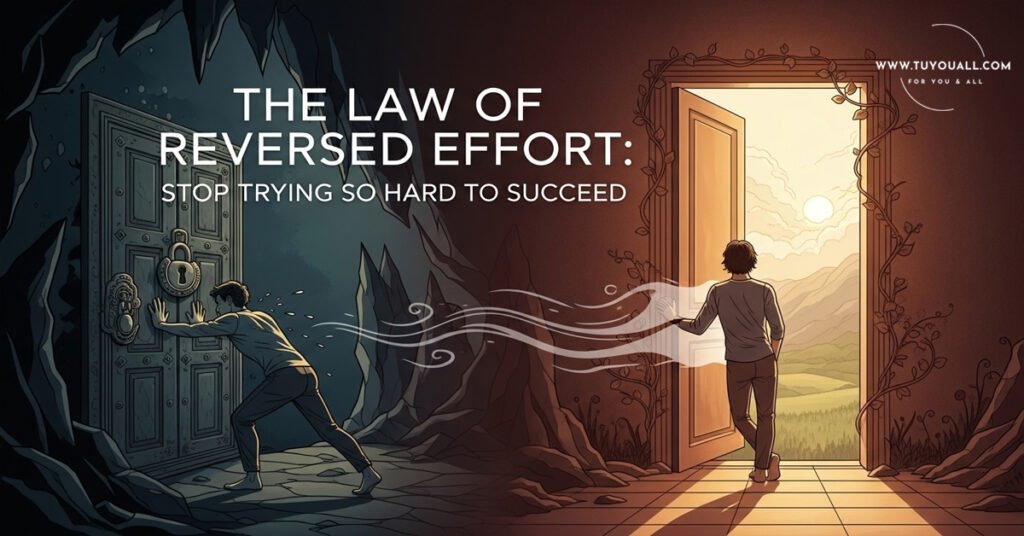
Discover the paradox of reversed effort: why chasing success, sleep, or love often backfires. Learn how to achieve more by trying less using psychology and ancient wisdom.
The Cat That Taught Me Everything About Success
Have you ever tried to pet a cat, only to have it dart away every single time you reach out?
You take one step forward—it bolts. You try again—it watches you from a safe distance. You make a third attempt—it disappears entirely.
But here’s the twist: a few hours later, when you’ve completely forgotten about the cat and immersed yourself in something else, guess who shows up? That same cat walks right over, jumps into your lap, and starts purring like you’re best friends.
This isn’t just about cats. This is the secret mechanism behind almost every area of human performance.
We’ve been sold a lie that “effort equals results.” That the harder we grind, the more we force, the better we do. And yes, effort matters—but there’s a hidden dimension that high performers have known for centuries: sometimes, trying too hard is the very thing that guarantees failure.
Welcome to the Law of Reversed Effort—a psychological paradox that explains why the best things in life (sleep, creativity, attraction, peak performance) slip away the moment we chase them too desperately.
In this guide, we’ll explore how this backwards law works, why your brain sabotages you when you hyper-fixate, and how to harness “effortless effort” to achieve what actually matters.
What Is the Law of Reversed Effort?
The Law of Reversed Effort was coined by English writer and philosopher Aldous Huxley, best known for Brave New World. He discovered a maddening truth about human psychology:
“The harder we try with the conscious will to do something, the less we shall succeed. Proficiency and the results of proficiency come only to those who have learned the paradoxical art of doing and not doing, or combining relaxation with activity, of letting go as a person in order that the immanent and transcendent unknown quantity may take hold.”
—Aldous Huxley
In plain English? The more you white-knuckle your way toward a goal, the worse you perform.
This isn’t woo-woo philosophy. It’s backed by psychology, neuroscience, and the lived experience of elite performers across every field—from Olympic athletes to jazz musicians to writers like Charles Bukowski.
The law reveals that achievement isn’t just about doing; it’s about knowing when to stop doing. It requires the intelligence to recognize that some outcomes cannot be forced—they must be allowed.
The Insomnia Trap: Why You Can’t Force Sleep (And What Actually Works)
Let’s start with the most universal example: sleep.
If you’ve ever struggled with insomnia, you know this pattern intimately:
| Stage | What Happens | The Result |
| 1. Effort | You try to force sleep, counting sheep, controlling breathing | You feel more awake |
| 2. Frustration | You check the clock, calculate hours left until morning | Anxiety spikes |
| 3. Desperation | You try harder—supplements, strict routines, sleep apps | Sleep becomes impossible |
| 4. Surrender | You give up, accept being awake, read or stare at ceiling | You finally doze off |
For Example:
Imagine it’s 2 AM. You’ve been lying in bed for three hours, obsessing over a presentation tomorrow. You try breathing exercises. You try progressive muscle relaxation. You try telling yourself “I must sleep now.” The harder you work at sleeping, the more alert your brain becomes.
Then, something shifts. You accept defeat. You turn on a lamp and start reading a boring book with zero expectation of sleep. Within ten minutes, your eyes grow heavy. You stopped trying to sleep—and sleep arrived.
This happens because sleep is the ultimate form of relaxation. Trying to sleep is like trying to relax on command—it’s a contradiction in terms. You’re making an effort to achieve effortlessness, which creates tension that prevents the very state you want.
The Attraction Paradox: Why Clinginess Repels and Mystery Attracts
The Law of Reversed Effort doesn’t just apply to sleep—it governs human connection too.
Think about attraction. Have you noticed that the person who texts back instantly, always available, constantly pursuing… often gets friend-zoned? While the person who’s slightly elusive, busy with their own life, not trying to impress anyone… somehow becomes irresistible?
This isn’t playing games. It’s psychology.
Attraction isn’t a choice we make through effort. It emerges naturally from a complex mix of mystery, autonomy, and emotional space. When we chase someone desperately, we signal:
- Scarcity mindset (“I need you to be complete”)
- Anxiety (which is contagious and uncomfortable)
- Lack of self-worth (my time isn’t valuable)
As the old proverb goes: “Absence makes the heart grow fonder.”
For Example:
Sarah meets two people at a party. Person A texts her five times the next day, asks about her weekend plans immediately, and seems always available. Person B waits a day, responds thoughtfully but briefly, and mentions being busy with a hiking trip. Who creates more intrigue? Person B—because they demonstrate that their life is full without her, making their attention feel valuable rather than desperate.
The moment you stop chasing and focus on your own path, you become the cat that walks away—and often, that’s when they follow.
Performance Anxiety: When Trying Too Hard Guarantees Failure
Psychiatrist and Holocaust survivor Viktor Frankl observed this phenomenon in his clinical practice and called it “anticipatory anxiety.”
Here’s his insight: When we hyper-focus on achieving a specific outcome (or preventing a bad one), we often generate the exact situation we’re trying to avoid.
Frankl documented a case of a stutterer who desperately tried not to stutter. The more he focused on speaking fluently, the more anxious he became about slipping up—and the worse his stutter grew. His intention to avoid stuttering created the anxiety that caused it.
This applies everywhere:
- Public speaking: The more you fear freezing up, the more likely you are to freeze
- Sexual performance: Fixating on “performing well” creates pressure that blocks natural response
- Sports: Thinking about your technique mid-game disrupts muscle memory
- Creativity: Staring at a blank page demanding brilliance guarantees writer’s block
For Example:
A tennis player is serving for the match. If they start thinking about their grip, their stance, and how important this point is, they’ll likely double-fault. But if they’re in the zone—relaxed, focused on the process rather than the outcome—the serve flows naturally. The conscious mind becomes the enemy of the trained body.
Viktor Frankl’s Solution: Paradoxical Intention
Frankl didn’t just diagnose the problem—he created a practical solution called “Paradoxical Intention.”
Instead of fighting anxiety by trying to prevent the feared outcome, you flip the script and actively wish for it.
- Can’t sleep? Try to stay awake instead
- Afraid of stuttering? Try to stutter on purpose
- Anxious about blushing? Try to blush as much as possible
Why this works: When you stop resisting the negative outcome, you remove the fear that was creating the tension. If you’re trying to stutter, there’s no pressure to be perfect—so you relax. And when you relax, your natural fluency returns.
For Example:
A student has severe test anxiety. Every exam, their mind goes blank despite knowing the material. Using paradoxical intention, they walk into the next exam telling themselves: “I’m going to forget everything and fail spectacularly. Let’s see how badly I can do this.” By embracing the worst-case scenario, their anxiety evaporates. With no pressure to perform, their memory works perfectly—and they ace the test.
This technique leverages the Law of Reversed Effort: by stopping the desperate struggle against a negative outcome, you often prevent it from happening.
The Flow State: When You Become the Dance
If the Law of Reversed Effort has an opposite—a positive state where performance peaks—it’s what psychologists call “flow.”
The Taoists called it “wu-wei” (effortless action). Athletes call it “being in the zone.” Jazz musicians call it “being in the pocket.”
Whatever the name, the experience is the same:
- Time distorts (slows down or speeds up)
- Self-consciousness disappears
- Action and awareness merge
- The ego steps aside
Retired basketball legend Bill Russell described his flow states this way: “It was almost as if we were playing in slow motion. During those spells, I could almost sense how the next play would develop and where the next shot would be taken.”
For Example:
A pianist performing a complex concerto isn’t thinking about each individual finger movement. If they started consciously monitoring their technique—“Is my thumb positioned correctly? Am using enough wrist action?”—they’d stumble immediately. Instead, after years of practice, their body knows what to do. The conscious mind (the “personal self,” as Huxley called it) gets out of the way, and the music flows through them.
The danger: The moment you become aware that you’re in flow and think, “Wow, I’m doing great!”—you pop the bubble. Self-consciousness returns. The magic dissipates.
This is why trying to achieve flow guarantees you won’t find it. Flow emerges from relaxation, not pursuit.
The Iceberg Mind: What You’re Not Aware Of Controls You
Swiss psychiatrist Carl Jung gave us another piece of this puzzle. He compared the conscious mind to the tip of an iceberg—visible, rational, but tiny compared to the massive unconscious beneath the surface.
| Conscious Mind | Unconscious Mind |
| Logical thinking | Intuition and pattern recognition |
| Language and analysis | Creativity and insight |
| Deliberate effort | Automatic skills and habits |
| Ego and self-image | Deep motivations and fears |
Most of your intelligence operates below the surface. When you “sleep on a problem” and wake up with the answer, that’s your unconscious processing. When you have a “gut feeling” about someone, that’s pattern recognition happening outside your awareness.
Aldous Huxley expanded on this, distinguishing between consciousness (the vast ocean) and the personal conscious (your little island of ego). To perform at your best, you must relax that small, striving self so the “wider self”—with all its accumulated wisdom and skill—can emerge.
For Example:
A writer spends three hours staring at a screen, forcing sentences that feel dead. Frustrated, they take a shower. Mid-shampoo, the perfect opening line appears fully formed. They didn’t think it up—their unconscious, finally given space to operate without the ego’s interference, delivered the gift.
Charles Bukowski’s Bug: The Art of Waiting
When asked how he wrote and created, poet Charles Bukowski gave the perfect summary of the Law of Reversed Effort:
“You don’t try. That’s very important: not to try, either for Cadillacs, creation or immortality. You wait, and if nothing happens, you wait some more. It’s like a bug high on the wall. You wait for it to come to you. When it gets close enough you reach out, slap out and kill it. Or if you like its looks, you make a pet out of it.”
—Charles Bukowski
This isn’t laziness. It’s strategic patience.
Bukowski understood that creativity (and peak performance in any domain) isn’t manufactured on demand. It arrives on its own schedule. Your job is to be ready when it comes close—but you can’t chase it down.
For Example:
A salesperson makes 100 cold calls with desperation in their voice, pushing for the close on every call. Result: 0 sales. Another salesperson makes 20 calls with genuine curiosity, focusing on whether the prospect is actually a good fit, willing to walk away if not. Result: 5 sales. The second person isn’t trying less overall—they’re just not trying to force outcomes. That relaxation creates trust.
The Middle Path: Combining Action with Non-Action
Here’s where it gets tricky. The Law of Reversed Effort doesn’t mean stop doing everything. If you never practice the piano, you’ll never play well. If you never approach anyone, you’ll never build relationships. If you never study, you’ll fail the test.
The paradox: You need conscious effort to build skills, but you need to release conscious effort to execute those skills.
Think of it like learning to drive:
| Stage | Conscious Effort | Result |
| Learning | High—checking mirrors, remembering pedals, thinking through every action | Clunky, stressful, slow |
| Practicing | Moderate—some actions become automatic, others still require attention | Smoother but still deliberate |
| Mastery | Low—unconscious competence takes over | Smooth, fast, almost effortless |
The piano teacher says “relax.” The golf pro says “relax.” The singing coach says “relax.” But how do you relax while performing a complex skill?
The answer: You practice until you don’t have to think about it, then you trust the practice.
How to Apply the Backwards Law in Your Life
Ready to stop sabotaging yourself with over-effort? Here are practical applications:
1. For Better Sleep
- Stop trying: If you’re awake after 20 minutes, get up and do something boring
- Paradoxical intention: Try to stay awake instead of forcing sleep
- Relax the personal self: Accept that tonight might not be perfect
2. For Creative Work
- Set the stage: Show up consistently, but don’t demand output
- Embrace boredom: Creative insights often arrive when you’re not trying
- Follow Bukowski: Wait for the bug to come close, then act
3. For Relationships
- Cultivate your own life: Become interesting by being interested in your own growth
- Release the grip: Attachment creates anxiety; autonomy creates attraction
- Be the cat: Walk away sometimes and let them come to you
4. For Performance (Sports, Speaking, Music)
- Focus on process, not outcome: Execute the next action, not the final result
- Trust your training: You’ve done the work—now let it happen
- Use paradoxical intention: If nervous, try to perform badly and watch the pressure dissolve
5. For Anxiety and Fear
- Stop resisting: What you resist persists
- Invite the fear: “Give me your worst, anxiety” removes its power
- Shift from avoidance to acceptance: Paradoxically, this often prevents what you feared
Frequently Asked Questions (FAQ)
Q: Is the Law of Reversed Effort just an excuse to be lazy?
A: Absolutely not. This law applies to people who are already putting in effort and hitting a wall. You can’t “not try” your way to skill—you have to practice first. But once the skill is built, execution requires relaxation, not force.
Q: How do I know if I’m trying too hard or not hard enough?
A: Check your emotional state. Healthy effort feels engaged but not desperate. Over-effort feels anxious, tight, and obsessive. If you’re white-knuckling, forcing, or fixating on outcomes, you’re in reversed effort territory. If you’re bored and unchallenged, you need more engagement.
Q: Can this law help with serious anxiety disorders?
A: Paradoxical intention (a direct application of reversed effort) is a recognized therapeutic technique. However, clinical anxiety disorders often require professional treatment. Use these concepts as complementary tools, not replacements for medical care.
Q: Does this mean I should stop setting goals?
A: No—set goals and work toward them. But hold them lightly. Focus on the actions within your control rather than obsessing over outcomes. As Lao Tzu asked: “Can you remain tranquil until right action occurs by itself?”
Q: How long does it take to master “effortless effort”?
A: It’s a lifelong practice. Start by noticing when you’re forcing outcomes. Pause. Ask: “What would it look like to allow this instead of chasing it?” Each moment of awareness builds the skill of relaxed performance.
The Tranquil Conclusion
The Law of Reversed Effort reveals a profound truth about human nature: we are not machines that perform better under maximum pressure. We are organic, complex systems that require a balance of preparation and release, effort and ease, doing and allowing.
To summarize what we’ve learned:
- The harder you try to force certain outcomes (sleep, attraction, creativity, flow), the more they elude you
- Anxiety and hyper-intention create the very failures we fear—Viktor Frankl’s “anticipatory anxiety”
- Paradoxical intention flips the script: wishing for what you fear removes its power
- Flow states emerge when the ego steps aside and trained skills operate automatically
- The “wider self” beneath your conscious mind holds more wisdom than your striving ego
- Mastery requires both conscious practice and unconscious execution—you need the work, then you need to let go
The cat doesn’t come when chased. Sleep doesn’t arrive when demanded. Love doesn’t grow when squeezed. Performance doesn’t peak when forced.
Instead, as Aldous Huxley taught, we must learn “the paradoxical art of doing and not doing.” We prepare, we practice, we show up—and then we relax. We trust. We allow.
The backwards law isn’t about giving up. It’s about giving space.
What area of your life are you currently white-knuckling? What might happen if you stopped trying to force the outcome and simply… allowed it to unfold?
Source & Credit
This blog post is based on insights from the YouTube channel Einzelgänger and their video exploring the Law of Reversed Effort from the perspective of performance psychology.
The original content has been translated, expanded, and repurposed for educational purposes.