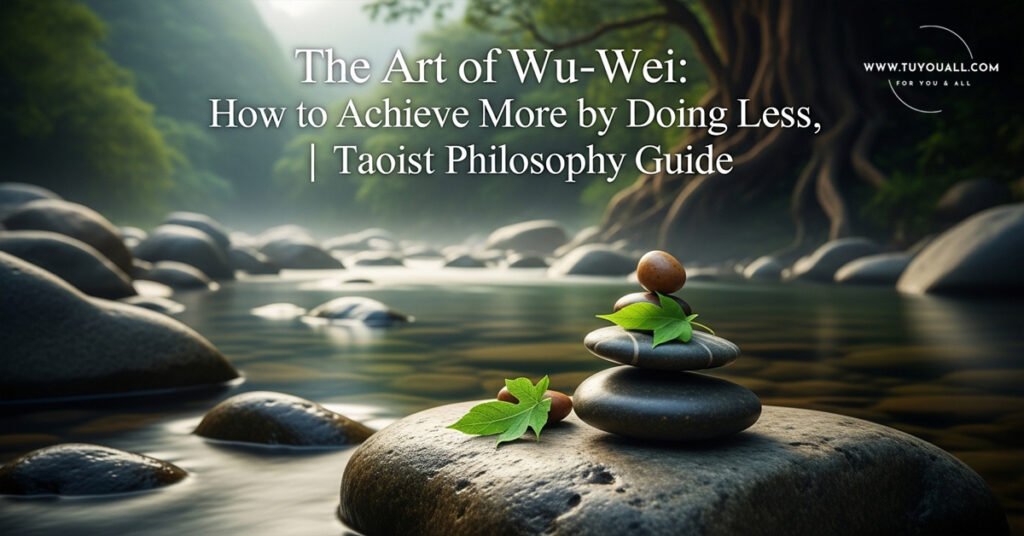
Discover wu-wei, the ancient Taoist secret of “effortless action.” Learn why forcing success backfires and how aligning with nature leads to better outcomes.
Have you ever felt like you’re pushing a boulder uphill—working harder and harder, yet getting nowhere? What if I told you that the harder you try to force success, the more likely you are to destroy it?
This is the paradox at the heart of wu-wei (無為), an ancient Taoist philosophy that has baffled and transformed minds for over 2,500 years. While modern culture worships “hustle,” “grind,” and “no days off,” Taoist sages like Lao Tzu and Zhuangzi proposed something radically different: the art of letting things happen.
In this guide, we’ll explore how this counterintuitive approach can reduce your stress, improve your results, and help you navigate life with the fluid grace of water flowing around rocks—not smashing against them.
What Is Wu-Wei? Unpacking the Paradox of “Non-Action”
When we first encounter the term wu-wei, confusion is natural. Depending on the translation, it means:
- “Non-action”
- “Doing nothing”
- “Actionless action”
- “Effortless action”
So which is it? Are we supposed to sit on the couch and wait for the universe to deliver our dreams?
Not quite. As the source material explains, wu-wei isn’t about passivity—it’s about alignment. It’s about recognizing that nature has its own rhythm, its own intelligence, and that our best results come from cooperating with that flow rather than fighting it.
“When you arrive at non-action, nothing will be left undone.”
— Lao Tzu
This quote captures the essence of the paradox. By stopping our frantic, ego-driven pushing, we actually allow things to reach completion naturally. Think of it this way: you can’t force a seed to sprout by yelling at it or pulling on the stem. But if you plant it, water it appropriately, and step back, growth happens—effortlessly, perfectly, completely.
The Novice Farmer: A Cautionary Tale of “Hustle Culture” Gone Wrong
To illustrate this principle, let’s look at the story of a well-meaning but misguided novice farmer—a character who represents many of us in the modern world.
For Example:
After binge-watching motivational videos about “effort” and “hustle culture,” this farmer became convinced that more action = more results. He walked onto his farm “fired up” and determined to force success into existence.
Here’s what happened:
- He pulled on his crops to make them grow faster. They died.
- He doubled the watering, hoping to speed up growth. He drowned them.
- He tried to micromanage nature, and nature rebelled.
The lesson? Acting in opposition to nature is counterproductive, no matter how much effort you invest.
Despite our smartphones, AI, and space travel, humanity remains utterly dependent on natural systems. We cannot grow a plant in complete isolation from natural processes. We can influence and guide, but we cannot replace nature’s role. The farmer’s crops needed time, soil, sun, and water in their proportions—not his forced schedule.
Why “Forcing the Flow” Always Backfires
Lao Tzu warned that “using force always leads to unseen troubles.” Importantly, he wasn’t talking about literal physical violence. He meant “forcing the flow of nature”—trying to bend reality to our will through sheer ego and effort.
The Modern Sisyphus Problem
Today’s society celebrates conscious human effort above all else. We wear busyness like a badge of honor. We push rocks uphill just for the sake of pushing, like modern versions of Sisyphus.
But here’s the uncomfortable truth: Making an effort is one thing; intelligently making an effort is another.
Yes, hard work is sometimes necessary. Action is sometimes appropriate. But on many occasions, it isn’t. It depends on:
- The rhythm of the game
- The cards you’re dealt
- Whether or not it’s your turn
Acting out of turn means going against the flow. And when we force things—when we push our luck beyond nature’s constraints—we experience ruin in the long run.
For Example:
Consider someone who, desperate for a relationship, goes on five dates a week, forces conversations, and tries to make every interaction “perfect.” They come across as desperate, inauthentic, and exhausting. Meanwhile, someone who focuses on being genuinely present, who lets connections develop organically, often finds meaningful relationships with what looks like “no effort.”
“The Tao never acts with force, yet there is nothing that it cannot do.”
— Lao Tzu
When we align with nature, everything runs smoothly. The farmer’s true task is simple: sow the seeds, let nature do the growing, and reap when ready. That’s optimal. That’s wu-wei.
The Three Layers of Wu-Wei: From Letting Go to Egoless Action
Taoist philosophy offers several layers of understanding wu-wei. Let’s explore them from surface to depth.
Layer 1: Aligning with Nature (The Art of Timing)
The most common interpretation of wu-wei is aligning our actions with nature and not forcing anything. This means:
- Acting when it’s suitable
- Resting when it’s not
- Recognizing that situations often solve themselves when we don’t intervene
The novice farmer simply needed to leave his crops alone and be patient. Nature would do the rest. But when harvest time came? Then it was appropriate to roll up his sleeves and work hard.
Key Insight: Wu-wei isn’t about never acting. It’s about not acting when action is inappropriate.
Layer 2: Effortless Action (Going, Not Doing)
Going deeper, we encounter “effortless action”—perhaps the most accurate definition. This suggests we’re not so much “doing” as “going.”
Imagine embarking on a river stream without obsessing over the destination. You’re setting sail into uncharted territory, but you don’t let the unknown terrify you. You swim with the current, not against it. Your journey becomes smooth, devoid of the “stammers and hiccups” that come from resistance.
Swimming against the current takes effort. So does holding onto a rock. When we force things, problems arise.
For Example:
Think about a first date. The other person wants one thing: to meet you—the real you in that moment. But many people overprepare, overanalyze, and rehearse speeches. The result? Nerves kick in, they overcompensate, appear disingenuous, and come across as staged.
Why? Because they’re focused too much on the results.
Zhuangzi explored how attachment to outcomes distorts our actions and emotional states. In his famous parable of the archer (explored in the video “Win Without Trying”), he showed how wanting to win creates tension that makes winning impossible.
When we enter a date utterly unprepared—without time to overthink—we act natural, spontaneous, and present. And most people love that authenticity. By letting go of results, we act more effortlessly and responsively, just for the act itself.
Layer 3: The Fasting of the Heart (Returning to the Uncarved Block)
The deepest layer of wu-wei involves the ego and emptiness.
Through past experiences, social conditioning, and ideologies, we mold ourselves into “knowledgeable, cultured human beings” who fit our contexts—whether religious communities, countries, or professions. Generally, we see this as good.
But there’s a downside: The ego distorts our perception of reality.
When we approach a situation—say, a conversation with a spouse—the ego fills in unknown gaps with prejudices, fantasies, and convictions. The larger the ego, the more it dominates the situation, closing us off from what’s truly going on.
People with strong convictions experience great difficulty seeing the world outside their “intellectual prison.”
For Example:
A manager who “knows” that younger employees are lazy will interpret every mistake through that lens, missing the actual causes (poor training, unclear instructions, etc.). Their ego filters reality to confirm their bias.
Lao Tzu urges us to return to “the uncarved block”—a state unencumbered by intellectual baggage, where our vision becomes clear.
Dr. Woei-Lien Chong, a Dutch philosopher and sinologist, describes this in her interpretation of wu-wei:
“And so the whole practitioner is able to, from the clarity of his egoless center, observe all relevant forces in a certain situation in their being, undistorted, so he can respond to them flawlessly.”
This isn’t just “going with the flow.” It’s a bold move requiring courage. We must let go of what we’ve learned, throw our normative frameworks in the trash, and flush our assumptions away.
“Renounce knowledge and your problems will end. What is the difference between yes and no? What is the difference between good and evil? Must you fear what others fear? Nonsense, look how far you have missed the mark!”
— Lao Tzu
The Fasting of the Heart: A Story from Zhuangzi
To illustrate this deepest layer, Zhuangzi tells a story about Confucius and his pupil Yen Hui.
Yen Hui wanted to travel to the kingdom of Wei, which was suffering under a tyrannical ruler. He planned to use his knowledge and wisdom to lecture the king and “steer the kingdom in the right direction.”
Confucius persuaded him not to go, explaining that his plans were too ego-driven and wouldn’t work. After all, no one—especially not a self-absorbed tyrant—waits eagerly for a know-it-all to appear and tell them how to run their business.
But Confucius offered an alternative: the “fasting of the heart.”
He described this as a form of meditation leading to:
- Letting preconceptions go
- Making room to receive
- Developing an open and receptive attitude
With this mindset, Yen Hui would learn about Wei and its king—their customs, beliefs, and the situation as it actually played out. Only then could he truly help.
In this understanding of wu-wei, we let go of the ego to act in accordance with the situation as it is. We let things happen and respond spontaneously, unrestrained by limited, preconceived ideas.
“No matter if it’s about politics, governance, diplomacy, or any other activity: what Zhuangzi calls wu-wei is this ultimate receptive and responsive way of action, from a crystal clear openness in yourself, one with the breathing of the cosmos.”
— Dr. Woei-Lien Chong
Practical Applications: How to Practice Wu-Wei in Modern Life
Understanding wu-wei intellectually is one thing. Living it is another. Here are practical ways to apply this philosophy:
| Situation | “Forcing” Approach (Counterproductive) | Wu-Wei Approach (Effortless) |
| Career Advancement | Working 80-hour weeks, burning out, networking desperately | Focusing on mastery, letting recognition come naturally, building genuine relationships |
| Creative Projects | Forcing inspiration, staring at blank pages, self-criticism | Creating conditions for flow, taking walks, consuming art, trusting the process |
| Relationships | Trying to change partners, controlling interactions, jealousy | Accepting people as they are, communicating openly, letting trust build organically |
| Health/Fitness | Extreme diets, overtraining, obsessing over metrics | Listening to your body, sustainable habits, enjoying movement |
| Learning | Cramming, rote memorization, anxiety about grades | Curiosity-driven exploration, spaced repetition, trusting the brain’s natural absorption |
The Wu-Wei Checklist
Before taking action, ask yourself:
- [ ] Am I acting with the natural flow of this situation, or against it?
- [ ] Is my ego demanding this action (to look good, be right, or control outcomes)?
- [ ] Would waiting or doing less actually be more effective?
- [ ] Am I trying to replace nature’s process, or simply support it?
- [ ] Can I approach this with an “uncarved block” mind—free of prejudices?
Frequently Asked Questions (FAQ)
Q.1. What does wu-wei literally mean?
Wu-wei (無為) literally translates to “non-action” or “without action,” but this is misleading. Better translations include “effortless action,” “actionless action,” or “acting without forced effort.” It means aligning with the natural flow rather than forcing outcomes through willpower.
Q.2. Is wu-wei just another word for laziness?
Absolutely not. Laziness is avoidance; wu-wei is intelligent engagement. A lazy person refuses to act when action is needed. A practitioner of wu-wei acts precisely when action is appropriate—and refrains from interfering when it’s not. The farmer who practices wu-wei works hard at planting and harvesting, but doesn’t pull on the crops to make them grow.
Q.3. How can I practice the “fasting of the heart”?
Start with mindfulness meditation focused on observing thoughts without attachment. Practice suspending judgment in conversations—truly listening without planning your response. Regularly question your assumptions by asking “What if the opposite is true?” Cultivate beginner’s mind (shoshin) by approaching familiar situations as if experiencing them for the first time.
Q.4. Does wu-wei mean we shouldn’t set goals?
Not necessarily. It means holding goals lightly rather than clutching them desperately. Set intentions, create conditions for success, then release your grip on the specific outcome. As the Tao Te Ching suggests, the Master “does nothing, yet leaves nothing undone.” Goals guide direction; wu-wei determines how you move.
Q.5. Can wu-wei work in competitive environments like business or sports?
Yes, but it requires nuance. In these contexts, wu-wei manifests as being “in the zone” or achieving flow states. A tennis player in wu-wei isn’t passive—she’s highly active—but her responses are spontaneous, unforced, and perfectly timed. In business, it means making decisions from clarity rather than panic, and innovating organically rather than forcing trends.
Conclusion: The Wisdom of Water
The Tao Te Ching compares the Tao to water:
- Water is soft yet can carve canyons through stone.
- Water flows downhill without struggle, yet reaches the ocean.
- Water finds the lowest places, yet nourishes all life.
This is the essence of wu-wei. Not weakness, not passivity, but intelligent alignment with reality as it is.
We’ve explored how the novice farmer learned that forcing growth destroys it. We’ve seen how attachment to outcomes creates the very tension that prevents success. We’ve delved into the “fasting of the heart”—the courage to empty ourselves of ego and prejudice so we can respond to life with flawless clarity.
The world, as Lao Tzu noted, governs itself. It doesn’t need our frantic intervention. Our task is simpler: sow the seeds, create the conditions, and allow nature to do what it does best.
What area of your life are you currently “pulling on the crops” in? Where might stepping back, letting go of results, and returning to your “uncarved block” state actually achieve more than your hardest hustle?
Consider this: the next time you feel that familiar urge to force, push, or control, pause. Breathe. Ask if there’s a wiser, more water-like way to flow toward your goal.
Source & Credit
This blog post is based on insights from Einzelgänger‘s YouTube video: “ Wu-wei | The Art of Letting Things Happen”
The original content has been translated, expanded, and repurposed for educational purposes.
The ideas presented here draw from classical Taoist texts including the Tao Te Ching (attributed to Lao Tzu) and the Zhuangzi (Chuang Tzu), as well as modern interpretations by scholars such as Dr. Woei-Lien Chong.