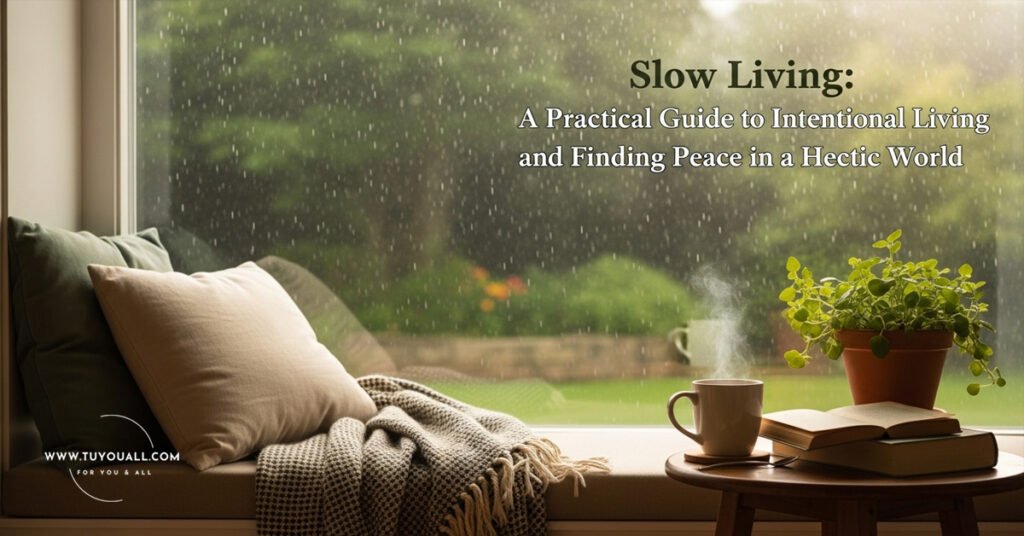
Discover the transformative power of slow living. Learn ancient philosophical wisdom and practical tips to simplify your life and embrace the present moment.
In a world obsessed with efficiency and speed, have you ever stopped to wonder why you feel more burned out than blessed? We live in an age where slow living has become a radical act of rebellion—a conscious choice to prioritize depth over breadth, and presence over productivity. While modern technology allows us to do more in less time, it often leads to a superficial engagement with life that diminishes our mental well-being and genuine joy.
The slow living movement advocates for a profound shift from quantity to quality by prioritizing intentionality and mindfulness over haste. This isn’t about moving at a snail’s pace through every task; it’s about reclaiming your attention from the chaos of “hurry sickness” and aligning yourself with a more natural, unhurried rhythm. By examining the wisdom of historical thinkers and applying practical lifestyle changes, you can discover that true contentment stems from simplifying your desires and savoring the present moment.
The Hidden Cost of Our High-Speed Existence
We live in an era where speed is treated as a virtue: the faster, the better. You’re hungry? Your smartphone allows you to order food from countless restaurants and have it delivered in no time. You want entertainment? Streaming services bring the latest films into your living room with the push of a button. Thanks to dating apps, we have access to an unprecedentedly large pool of potential connections whenever we unlock our screens.
This ability to speed up life’s processes seems like a blessing. We can live more efficiently, get more done in less time, be more productive, and consume more entertainment. But does doing more in less time equal better, more pleasurable experiences?
When we’re constantly in a rush, we may not have the time or mental space to engage fully with the activities we’re participating in. We rush through meals, conversations, and experiences without fully savoring them, making them feel less enjoyable or fulfilling.
For example:
Imagine visiting a world-class museum but spending only 30 seconds in front of each masterpiece because you’re trying to see the entire collection in one hour. You might check every exhibit off your list, but you won’t remember any of them. The art becomes background noise rather than a source of inspiration.
Living life at a fast pace can also lead to overstimulation and overwhelm. When we’re always on the go, we don’t give ourselves enough downtime to process our experiences, making them feel less meaningful or memorable. Going fast comes with a price: it can harm our mental health and well-being, leading to burnout, anxiety, and depression. We become so focused on achieving goals that we neglect the simple things that truly bring happiness and fulfillment.
What Is Slow Living, Really?
Slow living is a counter-movement that opposes the fast-paced life aiming for many experiences in a short time. Living at high speed often means living hastily, chaotically, superficially, and with a lack of appreciation for the moment.
Instead, slow living encourages us to prioritize what truly matters and take time to digest it. It includes simplifying one’s life and savoring the present moment. While interpretations vary, core values that define a mindful lifestyle include:
- Simplicity: Reducing clutter—both physical and mental—to focus on essentials
- Balance: Creating harmony between work and rest, consumption and creation
- Intentionality: Making conscious choices rather than running on autopilot
- Mindfulness: Paying full attention to the present experience
The idea of slowing down isn’t new. For centuries, philosophers have advocated for living at a slower pace as a path to genuine happiness and tranquility.
Ancient Wisdom for Modern Calm
Throughout history, great thinkers have recognized that intentional living requires us to resist the cultural pressure to rush. Their insights provide the philosophical foundation for today’s slow living movement.
Epicurus and the Art of Static Pleasure
The ancient Greek philosopher Epicurus preached living a simple life, enjoying contentment with little rather than the endless chase of vain pleasures. His philosophy shows that the things we need to live happily—simple foods, shelter, and tranquility—are easy to come by.
Epicurus distinguished between two types of pleasure:
- Moving pleasures: Fleeting and temporary, such as the enjoyment of entertainment, food, and excitement. These require constant replenishment.
- Static pleasures: The pleasure of having our desires satisfied, of no longer being in need or want. This is a state of contentment that doesn’t require further action.
“Engagement in static pleasure is the ultimate form of slow living,” the source explains, “as experiencing static pleasure requires us to slow down and stop chasing.” The simpler our pleasures are, the easier we achieve a contented state.
Thoreau’s Experiment in Deliberate Living
The 19th-century American philosopher Henry David Thoreau’s book Walden describes his experience of living a simple life near Walden Lake. He emphasized the importance of slowing down one’s life and living deliberately, believing that society’s fast-paced lifestyle hindered authentic living.
“I went to the woods because I wished to live deliberately, to front only the essential facts of life, and see if I could not learn what it had to teach, and not, when I came to die, discover that I had not lived.” —
Thoreau believed that by slowing down and simplifying our lives, we could become more in tune with nature and our own inner selves. He encouraged people to disconnect from the distractions of modern life, such as technology and consumerism, and instead focus on the simple pleasures of life, like engaging in meaningful work, spending time in nature, and cultivating deep relationships.
Lao Tzu and the Flow of Nature
The ancient Chinese philosopher Lao Tzu showed the importance of slowing down and living in harmony with nature. In the Tao Te Ching, he famously stated that nature does not hurry, yet everything is accomplished.
Accomplishment doesn’t require speed. Natural processes like growing plants or the formation of rivers are slow, but the results don’t lie. If we force things, trying to speed them up in unnatural ways, we’ll only get in trouble.
The concept of ‘Wu Wei’ (translated as effortless action or non-action) encourages us not to force things and, in many cases, to slow down to embark on the natural flow. Slowing down, the Taoists see as a means not to force the ways of nature, which we might be doing when we’re rushing.
Schopenhauer on Escaping the “Hurry and Bustle”
The 19th-century philosopher Arthur Schopenhauer believed that the pace of modern life is detrimental to human well-being. In his essay “The Wisdom of Life,” he argued that we are so busy pursuing our goals and desires that we make ourselves miserable:
“The most important of all for happiness is the avoidance of those voluntary evils that are unnecessary to our existence; and the prime cause of this is the hurry and bustle that mark our existence, the rapid alternation of excitement and ennui, and the constant stimulation that results from our complex social and economic arrangements. For it is to these that we owe that fevered restlessness which throws us into the arms of the manifold illusions we mistake for happiness.” —Creator Name
Schopenhauer distinguished between pleasures of the will (satisfying desires like hunger and thirst—fleeting and unsatisfying) and pleasures of the intellect (contemplating science, art, and philosophy). Intellectual pleasures are superior because they are more sustainable, provide lasting fulfillment, and are relatively cheap. Importantly, intellectual pleasures are, by nature, ‘slow.’
Marcus Aurelius and Essentialism
Marcus Aurelius, the Stoic emperor of the ancient Roman Empire, gave himself straightforward advice that applies perfectly to slow living:
“If you seek tranquillity, do less. Or (more accurately) do what’s essential—what the logos of a social being requires, and in the requisite way. Which brings a double satisfaction: to do less, better. Because most of what we say and do is not essential. If you can eliminate it, you’ll have more time, and more tranquillity. Ask yourself at every moment, ‘Is this necessary?'” —Creator Name
Doing too many things at once generates stress. By doing less, we can pay closer attention to the things we choose to do and work on them more slowly and precisely.
Practical Ways to Embrace Slow Living Today
Philosophy without practice is just theory. Here are concrete ways to simplify your life and embrace slowness in a world that never stops accelerating.
Simplify Your Schedule
Our lives can become overly busy and complicated, leaving us stressed and overwhelmed. To slow down, simplify your schedule by:
- Saying “no” to commitments that don’t align with your priorities
- Taking breaks when needed rather than pushing through fatigue
- Prioritizing relaxation and tranquility as non-negotiable appointments
- Leaving white space in your calendar for spontaneous moments
For example: Instead of packing your Saturday with three social engagements, a gym session, and grocery shopping, choose one meaningful activity—like a long lunch with a close friend—and allow the rest of the day to unfold naturally without a rigid timetable.
Unplug to Reconnect
Digital minimalism is crucial for slow living. Even though the philosophy doesn’t reject technological advancements, it encourages us to approach them mindfully. Technology can be a significant source of stress and distraction.
To slow down and be more present:
- Take regular breaks from screens (try the “20-20-20” rule: every 20 minutes, look at something 20 feet away for 20 seconds)
- Unplug during meals—no phones at the dinner table
- Set aside time for quiet reflection without digital input
- Create tech-free zones in your home, such as the bedroom
Cultivate Mindfulness
Mindfulness is the practice of being fully present when engaging in our daily activities. You can cultivate mindfulness through:
- Meditation: Starting with just five minutes of daily breath awareness
- Yoga: Connecting movement with breath
- Single-tasking: Doing one thing at a time with full attention rather than multitasking
For example:
When drinking your morning coffee, don’t scroll through emails simultaneously. Sit by a window, feel the warmth of the cup in your hands, smell the aroma, and taste each sip. This transforms a routine consumption into a meditative ritual.
Return to Nature
Aligning with Taoist philosophy, connecting with nature is an effective way to slow down and feel more grounded. Spending time in nature is proven to reduce stress and anxiety.
The Japanese philosophy of Wabi-Sabi suggests a practice of ‘forest bathing’ (Shinrin-yoku), during which we deliberately slow our pace during a forest walk. Instead of being goal-oriented—going from point A to point B—we focus on the beauty of nature and open ourselves up to its healing capabilities.
For example:
During your next walk in a park or forest, leave your headphones at home. Walk slowly enough to notice the texture of bark on trees, the sound of birds, the pattern of sunlight through leaves. Stop to touch moss or smell wildflowers. This isn’t exercise; it’s nourishment.
Fast Living vs. Slow Living: A Comparison
| Aspect | Fast Living | Slow Living |
| Focus | Quantity of experiences | Quality of experiences |
| Time perception | Never enough time | Time expands with attention |
| Meals | Rushed, often multitasking | Savored, social, present |
| Work style | Multitasking, always available | Deep work, clear boundaries |
| Relationships | Wide but shallow network | Deep, meaningful connections |
| Consumption | Instant gratification | Mindful, intentional choices |
| Nature | Background to commute | Source of restoration |
| Mental state | Overstimulated, anxious | Calm, grounded, content |
Frequently Asked Questions (FAQ)
Q: Is slow living just about being lazy or unproductive?
A: Not at all. Slow living is about intentional living—choosing to focus on what truly matters and doing those things well, rather than rushing through everything haphazardly. It often leads to better quality work and deeper satisfaction with accomplishments.
Q: Can I practice slow living if I have a demanding job and family?
A: Absolutely. Slow living isn’t about quitting your job or moving to a cabin in the woods (unless you want to). It’s about mindset shifts: saying no to non-essential commitments, unplugging from devices during family dinners, or taking five minutes of deep breathing before starting your workday. Small changes create significant impact.
Q: Does slow living mean rejecting all technology?
A: No. Slow living advocates for digital minimalism—using technology mindfully rather than being used by it. It’s about being intentional with your screen time, not eliminating it entirely. Choose tools that serve your values and discard the rest.
Q: How quickly can I expect to feel the benefits of slowing down?
A: Many people report feeling calmer within days of implementing small changes, like phone-free mornings or slower eating. However, deeper transformation—shifting from a scarcity mindset of “never enough time” to one of abundance—typically takes weeks or months of consistent practice.
Q: What’s the first step to start living more slowly today?
A: Start with the Marcus Aurelius test: Ask yourself at every moment, “Is this necessary?” Eliminate one non-essential task from your schedule today and use that time to simply breathe and notice your surroundings. That’s slow living in action.
Conclusion
In our productivity-obsessed culture, choosing to simplify your life through slow living is a courageous act of self-preservation. By examining the wisdom of Epicurus, Thoreau, Lao Tzu, Schopenhauer, and Marcus Aurelius, we see that slowing down isn’t a modern luxury—it’s an ancient necessity for human flourishing.
The path to tranquility doesn’t require radical life changes (though it can). It begins with small, intentional choices: savoring your food instead of rushing through it, taking the scenic route home, asking “Is this necessary?” before committing to another obligation, or simply sitting in stillness without reaching for your phone.
Even though living life in the fast lane might seem fun and exciting, it’s not necessarily the key to happiness. Slowing down can be a rewarding experience. Instead of getting more quickly and superficially, we intentionally embrace less more profoundly and in the present moment. The question isn’t whether you have time to slow down—it’s whether you can afford not to. What small step will you take today to reclaim your time and attention from the rush?
Source & Credit
This blog post is based on insights from Einzelgänger‘s YouTube video: “Slow Living: A Guide to a Slower Life” (Video content about slow living philosophy and practical applications).
The original content has been translated, expanded, and repurposed for educational purposes.