Discover Ikigai, the Japanese philosophy for finding your reason for being. Learn how aligning what you love, what you’re good at, what the world needs, and what pays can transform your life and career. Complete guide with practical examples.
Have you ever stared at the ceiling on Sunday night, feeling that heavy dread about Monday morning? That sinking feeling when you realize you have to drag yourself out of bed for another week of work that means nothing to you?
You’re not alone. Millions of people go through life like this—counting down the hours until their next break, living for the weekend, and wondering if this is all there is. Some get so lost that they face serious health problems like depression. Others feel so hopeless that they see no way out.
But what if there was a map to help you find your way? A practical framework that could help you discover exactly what you’re meant to do with your life?
Enter Ikigai—a Japanese philosophy that has helped countless people find their reason for being. It’s not just about finding a job you don’t hate. It’s about discovering that sweet spot where what you love, what you’re good at, what the world needs, and what pays your bills all come together.
When you find your Ikigai, work stops feeling like work. You wake up energized. You enter a state of flow where time seems to disappear. And most importantly, you stop feeling like a failure and start feeling like you’re exactly where you’re meant to be.
What Is Ikigai? Understanding This Japanese Philosophy
Ikigai (pronounced ee-kee-guy) is a Japanese concept that roughly translates to “reason for being” or “reason to get up in the morning.” It’s the thing that makes you excited to start your day—the activity you can pour your heart and soul into.
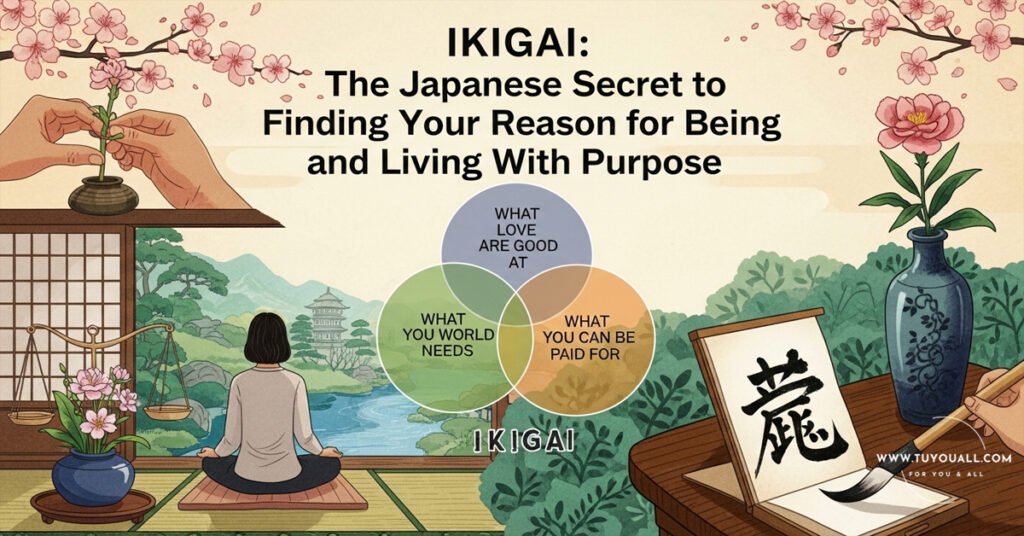
This Japanese philosophy isn’t just about career advice. It’s a holistic approach to life that suggests true fulfillment comes from the intersection of four essential dimensions:
- What you love (your passion)
- What you’re good at (your skills)
- What the world needs (your mission)
- What you can be paid for (your profession)
When all four of these elements overlap in the middle, you’ve found your Ikigai.
As the philosophy suggests, “When we do the right things with the right mindset, we’re able to enter a state of flow.”
The Four Pillars of Ikigai: Your Recipe for a Fulfilling Life
Let’s break down each dimension so you can start identifying where your own Ikigai might be hiding.
What You Love: Following Your Passion
This is the fun part—but also the tricky one. What makes your heart sing? What activities make you lose track of time?
The challenge here is that even dream jobs have boring parts. For Example: You might love being a YouTube content creator. You enjoy writing scripts and editing videos, but you absolutely hate filming. That filming becomes a “bottleneck” that kills your joy.
The key is either finding ways to make the annoying parts bearable (changing your workflow, shifting your mindset) or outsourcing them so you can focus on what you truly love.
If the whole activity makes you miserable with no hope of improvement, listen to your gut. Your intuition knows when something isn’t right for you.
What You’re Good At: Honoring Your Natural Gifts
Everyone has a unique skill set. Some abilities come from practice (nurture), while others are inborn (nature)—like IQ, motor skills, empathy, or physical strength.
Here’s where most people go wrong: They spend their whole lives fixing their weaknesses instead of mastering their strengths.
Think about it. Why spend years becoming mediocre at something you hate when you could become exceptional at something you already enjoy?
The world doesn’t need you to be average at everything. It needs you to be great at something.
What the World Needs: Finding Your Mission
This is the ethical dimension of Ikigai. It’s not enough to do what you love and what you’re good at if it doesn’t help others.
The good news? The world needs all kinds of things. Jobs that seem “low status” are often absolutely essential. Someone picks up the trash. Someone fixes your sink. Someone cleans up the mess.
For Example:
If you find joy in plumbing, you might save a family from a flooded basement. If you’re good at accounting, you might help a small business survive. Every skill has a place in making the world better.
Do some market research. Look at current demands. Ask yourself: “How can my specific skills make the world a better place?”
What You Can Be Paid For: Making It Sustainable
Some people say “money doesn’t matter,” but let’s be real—you can’t pay your rent with passion alone. Money is the energy that fuels your pursuits.
If your reason for being doesn’t generate income, it’s just a hobby. And that’s fine, but it means you’ll still need a day job you might hate, sacrificing most of your time and energy for something that isn’t your life’s mission.
Your Ikigai must include financial viability. Otherwise, you’ll burn out working two lives: one that pays the bills and one that feeds your soul.
Why Most People Feel Stuck (And How Ikigai Fixes It)
Before we talk about the solution, let’s look at the problem. Many adults are stuck in what we might call “Sunday Night Syndrome.”
You know the feeling. The weekend is ending, and anxiety creeps in. You think about that dreadful Monday morning when you have to drag yourself out of bed. You arrive at work already nostalgic for the weekend. You count down to your first break, then the next, then the next, until you can finally go home and repeat the process tomorrow.
This isn’t living—it’s surviving. And it’s terrible for your health.
| Living Without Ikigai | Living With Ikigai |
| Sunday night dread and anxiety | Excitement for Monday morning |
| Counting down hours until breaks | Losing track of time while working |
| Depression and health problems | Energy and vitality |
| Feeling useless and like a failure | Sense of purpose and contribution |
| Work feels like hell | Work feels like “effortless action” |
The change you need is twofold: You must shift your mindset AND your circumstances. You can’t just think positive thoughts about a job you hate forever. Eventually, you need to align your nature with the nature of your environment.
The Dangerous Intersections: When You’re Missing One Piece
Understanding what Ikigai isn’t helps clarify what it is. When you only have two or three of the four elements, you end up in incomplete states that lead to frustration:
Passion (What You Love + What You’re Good At)
You enjoy it and you rock at it, but nobody pays you for it, and the world might not need it. It’s just a hobby. For Example: You might be amazing at playing guitar and love it, but if you can’t make money and nobody wants to hear it, it’s not your Ikigai—it’s just fun.
Mission (What You Love + What the World Needs)
You care deeply about a cause and want to help, but you might not have the skills to do it well, and it definitely doesn’t pay. This leads to burnout and poverty. For Example: Volunteering to build houses when you have no construction skills might be noble, but it’s not sustainable.
Vocation (What the World Needs + What Pays)
Society demands it and you get a paycheck, but you hate it and might not even be good at it. This is the “dead-end job” trap. You do it out of duty, but it drains your soul.
Profession (What You’re Good At + What Pays)
You’re skilled and compensated, but you don’t love it, and it might even harm the world. For Example: Being a brilliant lawyer who defends corrupt corporations. You get paid well, but you feel empty inside.
True Ikigai requires all four. Only when passion, mission, vocation, and profession overlap do you find your reason for being.
Finding Your State of Flow Through Ikigai
When you align all four elements, something magical happens: You enter a state of flow.
This is that feeling when you’re so immersed in an activity that nothing else matters. Time flies. Distractions disappear. You’re working, but it feels effortless.
The ancient Taoists called this Wu-Wei, which translates to “effortless action.” It’s the secret to making your pursuit sustainable over the long term.
For Example:
Imagine a teacher who loves children, is naturally gifted at explaining complex ideas, works in an underserved community that desperately needs good education, and earns enough to live comfortably. When she teaches, she’s not watching the clock. She’s not exhausted at the end of the day. She’s energized. That’s Wu-Wei. That’s flow. That’s Ikigai.
How to Find Your Reason for Being: A Practical Guide
Ready to find your purpose? Here’s how to start your Ikigai journey:
- Make Four Lists: Spend 30 minutes writing down everything that fits into each category (love, skills, world needs, paid work). Don’t censor yourself.
- Look for Overlaps: Circle anything that appears on multiple lists. These are your clues.
- Test Small: Before quitting your job, try your potential Ikigai as a side project. Does it actually pay? Do you still love it when it’s “work”?
- Adjust Your Mindset: Sometimes the change starts with how you see your current situation. Can you shift your perspective to make today better while building toward tomorrow?
- Stay Flexible: Remember, your Ikigai isn’t set in stone. As the world changes, you must adapt and fine-tune your position.
For Example:
Let’s say you love cooking (love), you’re great at organizing events (skill), your town needs a community gathering space (need), and catering pays well (money). Your Ikigai might be starting a community supper club that brings neighbors together while earning you a living. If the world changes (like a pandemic), your Ikigai might shift to virtual cooking classes or meal prep services. The core remains, but the expression adapts.
Frequently Asked Questions About Ikigai
Q.1. Can I have more than one Ikigai?
Yes, absolutely. Your reason for being can evolve throughout different seasons of life. What fulfills you at 25 might differ from what fulfills you at 55. Ikigai is an active entity that changes with time.
Q.2. What if I can’t find anything that pays me for what I love?
Then you haven’t found your Ikigai yet—keep looking. Sometimes you need to get creative about how to monetize your skills. Other times, you need to develop new skills around what you love to make it marketable.
Q.3. Is Ikigai only about work and career?
ot necessarily. While career is a big part of it for most adults, Ikigai can also encompass family, community service, creative pursuits, or any combination that gives your life meaning and sustains you.
Q.4. How long does it take to find my Ikigai?
For some, it’s a lightning bolt of realization. For others, it’s a slow discovery process that takes years. The key is to start exploring rather than staying stuck in misery.
Q.5. Can I have Ikigai if I’m retired or not working?
Yes. As long as you have something that gets you out of bed in the morning—a passion that serves others and gives you purpose—you can experience Ikigai regardless of employment status.
Conclusion: Your Reason for Being Is Waiting
Finding your reason for being isn’t a luxury—it’s essential for a healthy, happy life. The Japanese philosophy of Ikigai offers you a practical framework to stop surviving and start thriving.
Remember these key takeaways:
- You need all four elements: what you love, what you’re good at, what the world needs, and what pays
- Stop fixing your weaknesses and start mastering your strengths
- Your work should serve others, not just yourself
- Money is energy that makes your mission sustainable
- Stay flexible—your Ikigai will evolve as you do
- The goal is effortless action (Wu-Wei) and flow
You don’t have to accept Sunday night dread as your permanent reality. You have control over your circumstances. You can change your mindset, reassess your nature, and find something different to do—something that makes you excited to wake up every single morning.
What’s the one activity that makes you lose track of time? Could that be the beginning of your Ikigai?
Source/Credit:
This blog post is based on insights from the YouTube video about Ikigai and finding one’s reason for being.
The original content has been translated, expanded, and repurposed for educational purposes.