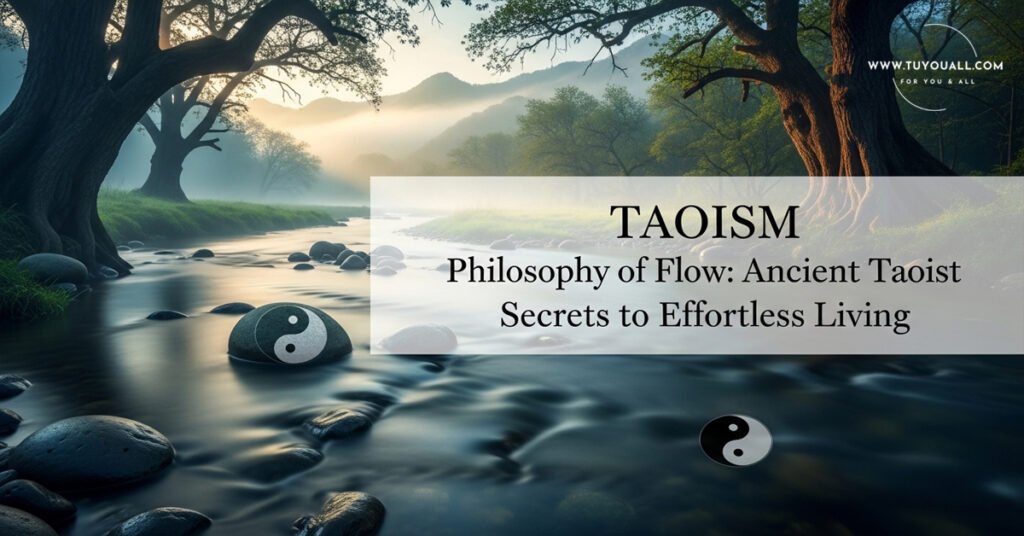
Discover wu wei (TAOISM Philosophy of Flow )—the art of effortless action. Learn how Taoist wisdom from the Tao Te Ching helps you stop struggling and start flowing with life.
Have you ever felt like you’re swimming upstream in life—exhausting yourself with effort but getting nowhere? What if the secret to success isn’t working harder, but learning to work smarter by aligning with the natural rhythm of the universe?
This isn’t some New Age buzzword. It’s a 2,500-year-old philosophy that elite athletes, top performers, and ancient sages have used to achieve extraordinary results with minimal friction. Welcome to wu wei—the Taoist art of “effortless action.”
What Is Wu Wei? Understanding the Paradox of Non-Action
Wu wei (無為) is one of the most misunderstood concepts in Eastern philosophy. Often poorly translated as “non-action” or “doing nothing,” it actually represents something far more powerful: action without forced effort—a state where you move in perfect harmony with the natural flow of things .
Think of it like this: when a professional basketball player enters “the zone,” they don’t try to make shots—they simply flow. Time slows down. Movements become automatic. Decisions happen before conscious thought. As retired NBA legend Bill Russell described it in his biography: “It was almost as if we were playing in slow motion. During those spells I could almost sense how the next play would develop and where the next shot would be taken.”
This is wu wei in action. Not passive laziness, but engaged flow—where you’re fully present, completely absorbed, and moving with rather than against the current of reality.
The Tao: The Unnamable Force Behind Everything
To understand wu wei, we first need to grapple with the Tao (道)—the central concept of Taoism. Here’s where it gets interesting: the Tao cannot be defined.
Lao Tzu, the legendary Chinese philosopher who authored the Tao Te Ching around the 6th century BC, opens his masterpiece with a paradox: “The Tao that can be described is not the eternal Tao. The name that can be spoken is not the eternal Name.”
The Tao is the all-encompassing life force that flows through everything—the underlying pattern of the universe that makes rivers run downstream, seasons change, and flowers bloom without anyone “making” them do so. It’s strikingly similar to the Stoic concept of living in harmony with Nature.
While we can never fully grasp the Tao with our limited human perception, Taoist philosophy teaches us to align ourselves with it. This alignment is where wu wei becomes practical.
The Cook Ting Story: A Masterclass in Effortless Action
One of the most vivid illustrations of wu wei comes from the Zhuangzi—another foundational Taoist text. It tells the story of Cook Ting, a humble butcher who cuts up oxen with such grace that he catches the attention of Lord Wen-hui .
When complimented on his skill, Cook Ting explains his secret:
“What I care about is the Way, which goes beyond skill. When I first began cutting up oxen, all I could see was the ox itself. After three years I no longer saw the whole ox. And now, now I go at it by spirit and don’t look with my eyes. Perception and understanding have come to a stop and spirit moves where it wants. I go along with the natural makeup, strike in the big hollows, guide the knife through the big openings, and following things as they are. So I never touch the smallest ligament or tendon, much less a main joint.” — Cook Ting
Here’s the kicker: while mediocre cooks change their knives every month because they hack, and good cooks change them every year because they cut, Cook Ting used the same knife for nineteen years. By working with the natural structure of the ox rather than forcing his way through, he preserved his energy, his tools, and achieved superior results.
For Example:
Imagine you’re learning to play guitar. At first, you consciously think about every finger placement—this is forced effort. But after years of practice, your fingers find the right chords automatically. You’re no longer “trying” to play; the music flows through you. That’s wu wei.
Why Harder Work Often Leads to Burnout (Not Success)
Modern culture worships the yang qualities of life: speed, productivity, aggression, control, and constant striving. We’re told to “hustle harder,” “sleep when we’re dead,” and force our way to success. Yet anxiety disorders, depression, and burnout are at all-time highs .
Taoism offers a radical alternative. It observes that results do not equal the amount of energy spent. A rose doesn’t “try” to bloom—it simply unfolds when conditions are right. The sun doesn’t struggle to shine—it radiates naturally. Nature is efficient because it doesn’t force .
When we constantly swim against the current of life—trying to control outcomes, micromanage others, or resist what is—we create friction. We burn energy on things we can’t actually control: our digestion, blood flow, other people’s reactions, the future, or even who we fall in love with .
The Taoist insight: Most problems solve themselves if we stop interfering. Many solutions emerge naturally when we create space for them.
Be Like Water: The Softness That Overcomes Hardness
If wu wei had a mascot, it would be water. Lao Tzu repeatedly uses water as the ultimate metaphor for the Taoist way of being:
“The supreme good is like water, which benefits all of creation without trying to compete with it. It gathers in unpopular places. Thus it is like the Tao.” — Lao Tzu
Water embodies everything wu wei represents:
| Quality | How Water Demonstrates It | How to Apply It in Life |
| Softness | Water yields to any obstacle | Be flexible in your approach; don’t rigidly cling to “your way” |
| Humility | Water flows to the lowest places | Don’t always seek the spotlight; serve without ego |
| Persistence | Water erodes rock over time | Small, consistent actions beat sporadic bursts of effort |
| Adaptability | Water takes the shape of its container | Adjust to circumstances rather than demanding they adjust to you |
| Non-contention | Water doesn’t compete; it simply flows | Stop comparing yourself to others; run your own race |
For Example:
Think about the Shawshank Redemption protagonist Andy Dufresne. He didn’t try to overpower the prison system with brute force. Instead, he used small, consistent actions over 19 years—befriending the right people, using his banking skills, sending one letter per week—to achieve what seemed impossible. He was like water: soft, patient, and ultimately unstoppable.
The State of Flow: Where Wu Wei Meets Modern Psychology
Modern psychology has finally caught up with what Lao Tzu knew 2,500 years ago. Psychologist Mihaly Csikszentmihalyi’s concept of “flow state”—that optimal experience where challenge meets skill and time seems to disappear—is essentially wu wei by another name .
When you’re in flow:
- The thinking mind quiets down—no rumination, no anxiety about the future, no regret about the past
- Action becomes spontaneous—you’re not deciding; you’re simply doing
- Time distorts—hours feel like minutes
- The ego disappears—there’s no “you” trying to perform; there’s just the performance itself
This is why Bruce Lee famously advised: “Be water, my friend.” When water enters a cup, it becomes the cup. When it enters a bottle, it becomes the bottle. It adapts without resistance, yet it can penetrate any obstacle over time .
How to Practice Wu Wei in Your Daily Life
Taoist literature doesn’t offer a step-by-step manual, but we can extract practical principles:
1. Cultivate Stillness of Mind
Stillness isn’t just sitting meditation (though that helps). It’s the ability to remain calm and clear while in action. When your mind is turbulent like a stormy sea, you can’t see the bottom. When it’s still like a quiet lake, everything becomes visible .
Practice: Before reacting to a stressful situation, take three conscious breaths. Ask: “Am I responding to reality, or to my thoughts about reality?”
2. Know When to Act and When Not To
Wu wei isn’t about never acting—it’s about timely action. Sometimes the most powerful thing you can do is wait. Other times, you must move decisively. The wisdom lies in knowing the difference .
Practice: When facing a problem, ask: “Am I forcing a solution, or allowing it to emerge? Is this the right time, or am I rushing from anxiety?”
3. Let Go of the Need to Control
We spend enormous energy trying to control things that were never in our control. Taoism suggests a radical trust in the natural unfolding of life—not as passive resignation, but as active cooperation with reality .
Practice: Make a list of what you can actually control (your responses, your effort, your attitude) versus what you can’t (other people, the past, the future). Focus only on the first list.
4. Embrace “Amor Fati”—Love of Fate
The Stoics called it amor fati—loving whatever happens. Taoism teaches the same: stop fighting what is. When you flow with the river instead of against it, you conserve energy and open yourself to possibilities you couldn’t see while struggling .
Practice: When something doesn’t go your way, try saying: “This is the way it is. Now, what can I do with this reality?”
Common Misconceptions About Wu Wei
| Misconception | The Reality |
| Wu wei means doing nothing | It’s about effortless action, not inaction |
| It’s passive and lazy | It requires full engagement and presence |
| You should never plan or strive | It’s about forced striving, not all striving |
| It means accepting injustice | It’s about accepting reality, not resigning to it—you can still act to change things, but from a place of clarity, not anger |
| Only monks can practice it | Athletes, artists, and professionals use it daily |
FAQ: Your Questions About Taoist Flow Answered
Q: Is wu wei the same as “going with the flow” in a passive, lazy way?
A: Absolutely not. As one modern interpreter explains, wu wei is “sailing, not rowing.” When you sail, you’re not passive—you’re actively adjusting sails, reading wind patterns, and steering. But you’re cooperating with nature rather than fighting it . It’s intelligent action, not passive drift.
Q: Can I still have goals if I practice wu wei?
A: Yes—but hold them lightly. The paradox is that when you focus entirely on the present task (the process) rather than obsessing over the outcome (the goal), you often achieve better results. Bill Russell wasn’t thinking about winning the championship in those flow moments; he was fully present to the game itself .
Q: How is wu wei different from mindfulness?
A: They’re closely related. Mindfulness emphasizes present-moment awareness; wu wei adds the dimension of effortless, spontaneous action arising from that awareness. Mindfulness is the stillness; wu wei is the flow that emerges from it .
Q: Can wu wei help with anxiety and stress?
A: Yes. Much anxiety comes from resisting reality—wanting things to be different than they are. Wu wei teaches acceptance of what is, while still allowing for skillful response. It’s the difference between swimming against the current (exhausting) and floating with it (effortless) .
Q: Is Taoism a religion or a philosophy?
A: It can be both. Philosophical Taoism (as described here) is a way of living and seeing the world. Religious Taoism involves rituals, deities, and practices. The Tao Te Ching itself is philosophical, requiring no belief in supernatural elements—just an openness to seeing life differently .
Conclusion: Stop Swimming, Start Flowing
The ancient wisdom of the Tao Te Ching offers a radical invitation: stop exhausting yourself by swimming against the current of life. You don’t need to control the river. You don’t need to understand exactly where it’s going. You simply need to let go, trust the flow, and navigate skillfully from moment to moment.
When you embrace wu wei—whether you’re writing, parenting, working, or relating—you discover that the best results often come with the least friction. The soft overcomes the hard. The slow and steady outlasts the forceful and frantic. The present moment contains everything you need.
The river is already flowing. The question is: are you fighting it, or are you ready to flow with it?
Source & Credit
This blog post is based on insights from a YouTube video exploring Taoist philosophy, the Tao Te Ching, and the concept of wu wei.
The original content has been translated, expanded, and repurposed for educational purposes.