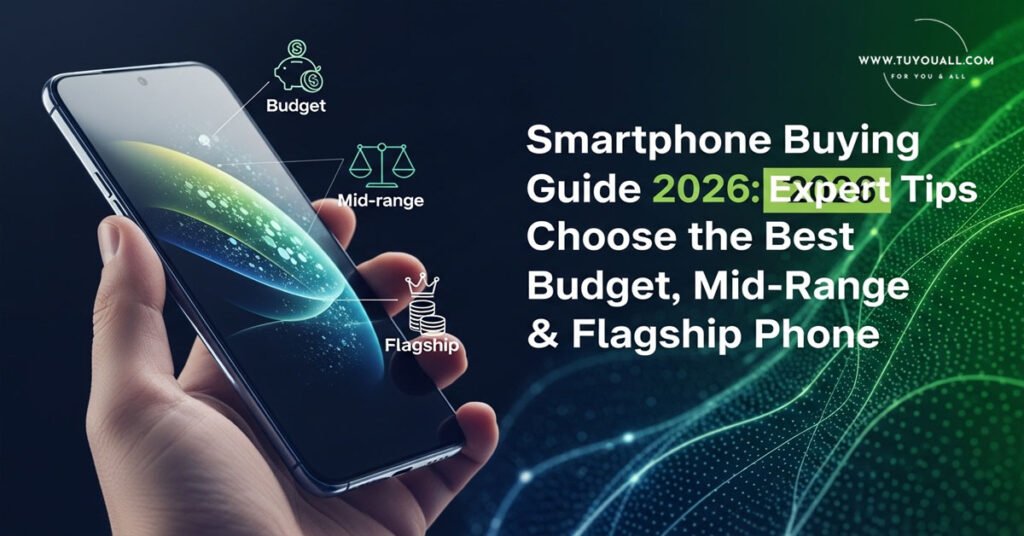
Master smartphone buying in 2026! Learn expert tips to choose budget, mid-range & flagship phones without marketing traps. Display, camera, performance & more.“
Are you tired of walking into a phone shop with a ₹20,000 budget and walking out with a ₹30,000 phone you never planned to buy? Do you feel overwhelmed by marketing jargon like “108MP camera” or “AI-powered everything”?
You’re not alone. In 2026, buying a smartphone has become more confusing—and more expensive—than ever before.
But here’s the good news: after reading this guide, you’ll never need to ask “which phone should I buy?” again. Whether your budget is ₹10,000 or ₹50,000+, you’ll know exactly what to look for and what to avoid.
This comprehensive guide is based on insights from tech expert Manoj Saru, who breaks down complex tech specs into simple, actionable advice that even a complete beginner can follow.
Why 2026 Is a Tricky Year for Smartphone Buyers
Let’s start with some hard truth about the current market.
“Honestly speaking, 2026 is not going to be good for smartphones. Why? Because first of all, smartphone prices are going to increase a lot.” — Manoj Saru
Here’s what happened: The phones that used to cost ₹15,000 (budget category) are now priced as mid-range phones. Mid-range phones have jumped to “premium mid-range” prices, and premium phones now cost what flagships used to cost.
What this means for you: You might need to spend a bit more than you planned, but more importantly, you need to be smarter about where every rupee goes.
The Three Smartphone Categories
Before diving into specs, lock down your category:
| Category | Price Range (2026) | Best For |
| Budget Phones | Under ₹15,000 | Daily tasks, multitasking, YouTube, content consumption |
| Mid-Range Phones | ₹15,000 – ₹35,000 | Balanced performance, camera, battery, and display |
| Flagship Phones | ₹35,000+ | Top-tier display, camera, performance, and premium features |
Pro Tip: Never walk into a store saying “I’m looking for a phone around ₹20,000.” Shopkeepers will push you toward ₹25,000-30,000 models. Decide your absolute maximum budget before you start looking.
Display: The Spec You Stare at All Day
Here’s a fact: you will spend more time looking at your phone’s screen than any other component. Yet most buyers ignore display quality and regret it later—often when their eye doctor prescribes glasses.
“You keep scrolling all day, and then one day the doctor says, ‘Here, wear glasses.'” — Manoj Saru
Display Requirements by Budget (2026 Standards)
| Budget | Minimum Display Specs | Why It Matters |
| Under ₹10,000 | IPS LCD (acceptable) | Basic viewing, limited budget constraints |
| ₹15,000 – ₹25,000 | FHD+ AMOLED + 120Hz | Color accuracy, smooth scrolling, better contrast |
| ₹25,000+ | 1.5K AMOLED + 120Hz minimum | Sharp text, vibrant colors, premium feel |
The Three Non-Negotiable Display Features
- AMOLED or OLED Technology — Avoid IPS LCD displays in 2026 if you’re spending over ₹15,000. AMOLED offers deeper blacks, better colors, and improved power efficiency.
- 120Hz Refresh Rate — Skip 90Hz displays. In 2026, 120Hz is the sweet spot for smooth scrolling and gaming. Below ₹15,000, 90Hz is acceptable, but above that, demand 120Hz.
- TÜV Rheinland Certification — This is the most underestimated feature. Blue light from screens damages your eyes over time, causing headaches and sleep disruption. TÜV certification ensures reduced blue light emission.
For Example: Imagine buying a ₹25,000 phone with a stunning camera but a basic 60Hz IPS display. Three months later, you’re experiencing eye strain during late-night scrolling sessions. That “great deal” suddenly feels like a mistake.
Bottom line: If a phone in 2026 doesn’t meet the display criteria for its price bracket, avoid it. There are better options available.
Camera: Why Megapixels Don’t Tell the Full Story
Walk into any offline mobile shop, and you’ll hear: “Sir, this phone has 108MP camera! 200MP! Best camera in this price!”
Don’t fall for it.
“If you’re buying a camera phone based on megapixels in 2026, you’re making a mistake. The megapixel trap is very common in the offline market.” — Manoj Saru
The Three Real Camera Priorities
Instead of counting megapixels, check for these three components:
| Priority | What It Does | Budget Requirement |
| 1. Sensor Quality | Captures light and detail | Sony sensors are industry-leading |
| 2. OIS (Optical Image Stabilization) | Reduces blur in photos/videos | Must-have for camera-focused buyers |
| 3. Telephoto/Periscope Lens | Optical zoom without quality loss | Premium feature for distant subjects |
Camera Requirements by Budget
| Budget | Must-Have Camera Features |
| ₹15,000 – ₹20,000 | OIS is mandatory |
| ₹20,000 – ₹30,000 | OIS + Sony sensor |
| ₹30,000 – ₹40,000 | OIS + Sony sensor + Telephoto or Periscope lens |
Honest Recommendation: If photography is your priority, keep a minimum budget of ₹25,000 in 2026. Below this, finding a truly capable camera phone is extremely difficult.
For Example: Two phones might both advertise “64MP cameras.” But Phone A uses a high-quality Sony sensor with OIS, while Phone B uses a cheap sensor without stabilization. Phone A will produce significantly better photos in low light and while moving—despite having the same “megapixel count” on paper.
Performance: The Heart of Long-Term Satisfaction
Want your phone to last 3-4 years without lag? The processor is your most critical component.
“If you want your phone to last long, run smoothly, not lag—the processor is the most important part.” — Manoj Saru
The Simple Performance Hack: AnTuTu Scores
Instead of memorizing dozens of processor names (Snapdragon, MediaTek, Exynos, Bionic), use this simple chart:
| Budget | Minimum AnTuTu Score | Storage Type |
| Under ₹15,000 | 400,000 – 500,000 | UFS 2.2 acceptable |
| Under ₹20,000 | 700,000 – 800,000 | UFS 2.2 or better |
| ₹20,000 – ₹30,000 | 1,000,000+ | UFS 3.0 minimum |
| Above ₹30,000 | 1,000,000 – 1,500,000 | UFS 4.0 preferred |
What is AnTuTu? It’s a benchmarking tool that measures overall phone performance. You don’t need to run tests yourself—tech reviewers include these scores in their unboxing and review videos.
The Rule: If a phone’s score falls within the range for its price, it’s value-for-money. If it’s significantly lower, the processor is weak, and the phone won’t age well.
Gaming Phone Requirements (2026)
Planning to game seriously? Here’s the reality check:
- Minimum AnTuTu Score: 1,000,000+
- Minimum Budget: ₹25,000+
- Storage: UFS 3.0 or higher (UFS 4.0 preferred above ₹30,000)
For Example: A ₹22,000 phone with a 650,000 AnTuTu score might handle casual games today, but in 2028, it will struggle with new releases. Spend ₹3,000 more for a phone crossing the 1,000,000 threshold, and you’re future-proofed.
Battery and Charging: Power Through Your Day
Battery specs are straightforward but often overlooked:
- Capacity: Higher mAh = longer battery life
- Optimization: Software optimization matters as much as battery size
- Charging Speed: Faster charging reduces downtime
2026 Battery Standards
| Feature | Recommendation |
| Minimum Capacity | 5,000 mAh (avoid smaller) |
| Ideal Capacity | 6,000 mAh or 7,000 mAh |
| Charging Speed | 65W, 80W, or 90W fast charging |
Pro Tip: A 5,000 mAh battery with poor software optimization performs worse than a well-optimized 4,800 mAh battery. Check reviews for real-world battery tests, not just specifications.
Software Experience: Where Hardware Meets Usability
A phone with powerful hardware but weak software is like a sports car with a bad driver—it won’t deliver the experience you paid for.
Software Checklist for 2026
| Feature | Minimum Requirement (₹20,000+) |
| Clean UI | Minimal bloatware, close-to-stock Android |
| OS Updates | 3 years minimum |
| Security Updates | 4 years minimum |
The Bloatware Reality: Even brands like Nothing Phone have started including pre-installed apps. While perfect “bloatware-free” phones are rare, prioritize brands offering cleaner interfaces.
For Example: Phone A has a slightly weaker processor but offers 4 years of OS updates and a clean interface. Phone B has a faster chip but heavy custom skin and only 2 years of updates. After 18 months, Phone A will likely feel smoother and more secure than Phone B.
Brand Trust and After-Sales Service: The Ignored Essentials
This is where most buyers make costly mistakes—especially with new brands offering “flagship killers” at low prices.
The Three Brand Checks
Before buying any phone, verify:
- Brand Trust — How long has the company been in India? What’s their track record?
- Service Center Network — Are there authorized service centers in your city/region?
- After-Sales Feedback — What do existing customers say about repair quality and speed?
“If your phone develops a problem later, software issues appear, or hardware fails—you’ll keep running around, but your phone won’t get fixed.” — Manoj Saru
For Example: A new brand offers a ₹25,000 phone with flagship specs. Six months later, the charging port fails. You discover the nearest service center is 200 km away, and customer support is unresponsive. Your “great deal” becomes a costly paperweight.
Flagship Phone Requirements (₹35,000+): No Compromises Allowed
Spending ₹35,000 or more? Do not accept compromises. At this price, brands will use heavy marketing to convince you that certain cutbacks are “normal.”
“₹35,000 is not loose change that you’re giving to a brand. If I were in your place, I wouldn’t tolerate compromises.” — Manoj Saru
The Non-Negotiable Flagship Checklist (2026)
| Component | Minimum Requirement |
| Display | 1.5K resolution, AMOLED, 120Hz, HDR support |
| Camera | OIS compulsory, Sony or Samsung flagship sensor, Periscope lens |
| Performance | 2,000,000+ AnTuTu score (v11/v12) |
| Storage | UFS 4.0 |
| Software | 4 years OS updates + 5 years security updates |
The Rule: If a ₹35,000+ phone is missing any of these criteria, walk away. There are competitors who offer the complete package.
Quick Reference: Your 2026 Smartphone Buying Checklist
For Budget Buyers (Under ₹15,000)
✅ IPS display acceptable, AMOLED preferred
✅ 90Hz refresh rate minimum
✅ 4,00,000+ AnTuTu score
✅ 5,000 mAh battery minimum
For Mid-Range Buyers (₹15,000 – ₹35,000)
✅ FHD+ AMOLED + 120Hz display
✅ TÜV Rheinland certification
✅ OIS camera (₹20,000+)
✅ Sony sensor (₹25,000+)
✅ 1,000,000+ AnTuTu score (₹20,000+)
✅ UFS 3.0 storage
✅ 3 years OS updates
For Flagship Buyers (₹35,000+)
✅ 1.5K AMOLED + 120Hz + HDR
✅ OIS + Sony/Samsung flagship sensor + Periscope
✅ 2,000,000+ AnTuTu score
✅ UFS 4.0 storage
✅ 4 years OS + 5 years security updates
✅ Established brand with local service centers
Frequently Asked Questions (FAQ)
Q1: Is a higher megapixel count always better for cameras?
No. A 12MP camera with a quality Sony sensor and OIS will outperform a 108MP camera with a cheap sensor and no stabilization. Focus on sensor quality and stabilization, not megapixel numbers.
Q2: What’s the minimum refresh rate I should accept in 2026?
For phones under ₹15,000, 90Hz is acceptable. Above ₹15,000, demand 120Hz. The smoothness difference in daily scrolling and gaming is significant.
Q3: How important is TÜV Rheinland certification really?
Very important for eye health. It ensures reduced blue light emission, preventing eye strain, headaches, and sleep disruption from prolonged screen time. Don’t skip this, especially if you use your phone for 4+ hours daily.
Q4: Can I get a good gaming phone under ₹20,000 in 2026?
Honestly, no. For a proper gaming experience that will last 2-3 years, you need to spend at least ₹25,000 to get the required AnTuTu score (1,000,000+) and UFS 3.0 storage.
Q5: How do I check a phone’s AnTuTu score before buying?
Tech reviewers and unboxing videos on YouTube always mention AnTuTu scores. Search for “[Phone Model] review AnTuTu” before purchasing. No need to run tests yourself.
Conclusion: Be the Smart Buyer in a Tricky Market
2026’s smartphone market is challenging—prices are up, marketing is aggressive, and specifications can be misleading. But armed with this guide, you’re now equipped to make informed decisions.
Remember the golden rules:
- Set your budget in stone before shopping
- Prioritize display quality and eye protection
- Ignore megapixel marketing; check sensors and OIS instead
- Use AnTuTu scores to judge performance simply
- Verify software support and brand service networks
- Never accept compromises in flagship price ranges
The perfect phone for you exists—you just need to know what to look for.
What’s your current smartphone, and does it meet the 2026 standards for its price bracket? Share your thoughts below, and let’s discuss whether it’s time for an upgrade!
Source & Credit
This blog post is based on insights from Manoj Saru’s YouTube video: “Smartphone Buying Guide 2026 | How to Choose the Perfect Phone.”
The original content has been translated, expanded, and repurposed for educational purposes. All technical recommendations and insights are credited to the original creator’s expertise and research.