This blog post is based on insights from Curiosity Code‘s YouTube video: “7 Unique Brain Exercises to Make Your Brain Healthier, Sharper & More Focused”.
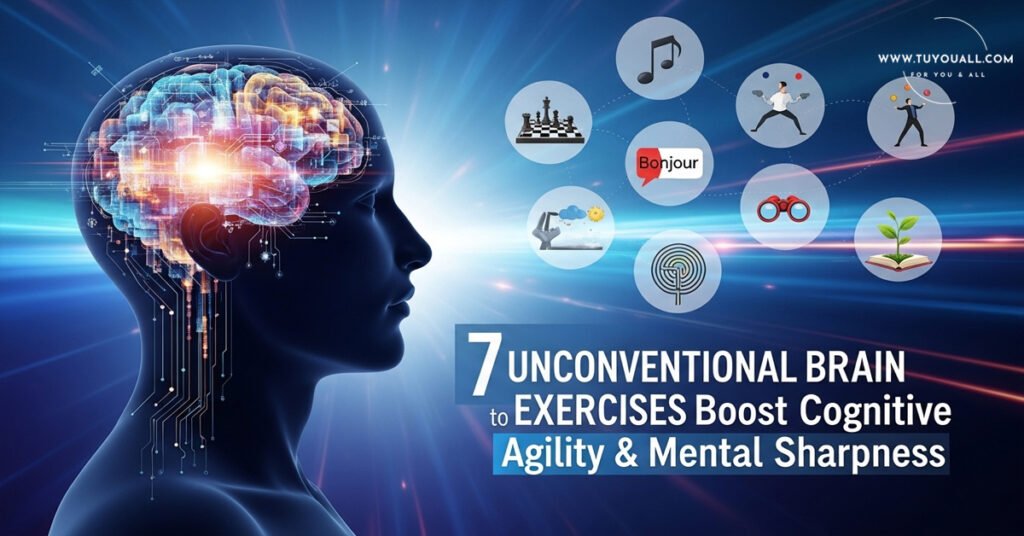
Discover 7 Science-Backed Brain Exercises to enhance neuroplasticity, memory, and focus. From Schulte tables to non-dominant hand training, boost your cognitive agility today!
When was the last time you gave your brain a real workout? Not the usual “take deep breaths and meditate” advice you’ve heard a thousand times, but something that actually challenges your neurons to fire in new patterns?
Most of us assume our minds are sharp enough—until we find ourselves staring at a password screen, unable to recall a PIN we’ve used for years, or walking into a room and forgetting why we’re there. The truth is, cognitive agility isn’t something you’re born with and slowly lose; it’s a muscle that atrophies without proper training.
Forget everything you think you know about brain exercises. The routines you’re about to discover aren’t just effective—they’re genuinely fun, surprisingly challenging, and designed to create lasting neuroplasticity in ways traditional mindfulness simply can’t match.
Why Traditional Brain Training Falls Short
We’ve all been there: downloading a “brain training” app, completing a few basic puzzles, and wondering why we don’t feel any sharper. The problem isn’t you—it’s the approach.
Most conventional advice focuses on passive relaxation rather than active cognitive stretching. While meditation has its place, your brain craves novelty, resistance, and adaptation. Think of it like physical fitness: you won’t build strength by lying still, and you won’t enhance mental sharpness by simply calming your thoughts.
What your brain actually needs are disruptive challenges—tasks that force different regions to communicate, create new neural pathways, and push your processing speed beyond its comfort zone. That’s exactly what these seven brain exercises deliver.
7 Brain Exercises That Actually Work
Ready to test your limits? These interactive challenges target different cognitive functions, from peripheral vision and spatial memory to multitasking and mind-body coordination. Try them in sequence, or pick your favorites for a quick mental boost.
1. The Schulte Table Challenge (Information Processing Speed)
The first exercise looks deceptively simple but will reveal the true speed of your cognitive processing.
How it works: Imagine a 5×5 grid containing numbers 1 through 25 arranged randomly. Your mission? Locate each number in ascending order as quickly as possible—ideally within 30 seconds—while focusing on the center of the grid.
The science: This isn’t just a visual test. The Schulte Table forces your brain to process information peripherally while maintaining central focus, essentially training your attention span and visual scanning speed simultaneously.
For Example:
Picture yourself at a busy intersection. Instead of darting your eyes everywhere, you keep your gaze centered while still registering the cyclist approaching from your left and the pedestrian on your right. That’s peripheral processing in action—and this exercise makes it stronger.
Pro tip: You can find printable Schulte Tables online or download dedicated apps. Aim to complete the sequence in under 30 seconds consistently. As your speed improves, try larger grids (6×6 or 7×7) to keep challenging your neuroplasticity.
2. Color-Word Confusion (The Stroop Effect)
This next challenge exploits a fascinating psychological phenomenon called the Stroop Effect, and it’s guaranteed to trip up even the sharpest minds.
How it works: You’ll see words written in colors that don’t match their meaning—imagine the word “RED” written in blue ink. Your task? Say the color of the ink aloud, not the word itself.
Why it’s brutal: Your brain has been trained since childhood to read words automatically. Deliberately overriding this instinct requires massive executive function resources, engaging your anterior cingulate cortex—the region responsible for cognitive flexibility and conflict resolution.
For Example:
Think about driving through a neighborhood where every stop sign is painted green. Your immediate instinct says “go,” but your conscious mind must override it with “stop.” That’s the mental muscle you’re building here.
This exercise strengthens memory, concentration, and multitasking abilities by forcing parallel processing streams to compete and cooperate.
3. Sensory Deprivation Tasks (Spatial Memory)
Now let’s strip away one of your primary senses and watch your brain compensate in remarkable ways.
How it works: Complete small daily tasks with your eyes completely closed. Try writing your name on paper, drawing basic shapes (circles, triangles, squares), or even typing simple sentences without visual feedback.
The neurological benefit: When you remove visual input, your brain amplifies proprioception—your body’s ability to sense its position in space. This activates dormant neural pathways and enhances spatial memory and recall capabilities.
For Example:
Imagine being able to navigate your own home in complete darkness during a power outage, or reaching for your coffee mug without looking while typing an email. These aren’t party tricks—they’re evidence of a well-developed spatial map in your brain.
Challenge yourself right now: Can you type a short comment or text with your eyes closed? Notice how your fingers automatically search for keyboard landmarks (like the raised bumps on the F and J keys). That’s your sensory adaptation at work.
4. Bilateral Hand Coordination (Mind-Body Connection)
This exercise looks like a simple party trick, but it reveals—and fixes—the disconnect between your brain hemispheres.
How it works: Make a “P” sign with your right hand (thumb up, fingers curled) and an “OK” sign with your left hand (thumb and index finger touching). Now, simultaneously switch them—”P” on the left, “OK” on the right. Try completing five switches in 10 seconds without your hands “mirroring” each other.
The cognitive load: Most people find this maddeningly difficult because it requires independent control of both hemispheres simultaneously. This strengthens the corpus callosum—the bridge between your brain’s left and right sides—and enhances overall mind-body connection.
For Example:
Musicians, surgeons, and elite athletes often display superior bilateral coordination. By training this skill, you’re essentially upgrading the communication bandwidth between your logical and creative brain centers.
5. Non-Dominant Hand Training (Neural Pathway Formation)
Perhaps the most practical exercise on this list, non-dominant hand training seamlessly integrates into your daily routine while delivering massive neuroplasticity benefits.
How it works: Switch your non-dominant hand for routine tasks. Brush your teeth, write notes, eat meals, or operate your phone using your “weak” hand.
Why it works: Your dominant hand has established strong, efficient neural pathways through decades of repetition. Forcing your non-dominant hand to perform these tasks creates entirely new motor maps in your brain, forging fresh neural connections and strengthening cognitive reserve.
For Example:
Notice how initially awkward it feels to brush your teeth with your left hand (if you’re right-handed). That awkwardness is your brain literally building new circuitry. Within weeks, you’ll notice improved dexterity—and studies suggest this cross-training can even enhance creativity and problem-solving.
Quick challenge: Try liking this article with your non-dominant hand right now. Feel that slight hesitation? That’s your brain working overtime to reroute motor commands.
6. Strategic Brain Games (Decision Making)
Not all games are created equal. While mindless scrolling through addictive apps like Candy Crush offers little cognitive benefit, strategic games can significantly improve decision-making and working memory.
The winners:
- Sudoku: Enhances logical reasoning and pattern recognition
- Chess: Develops strategic planning and foresight
- Riddles: Boosts lateral thinking and creative problem-solving
- Word scrambles: Strengthens verbal fluency and memory retrieval
For Example:
A chess player doesn’t just see the current board—they hold multiple future scenarios in their mind simultaneously, evaluating consequences three moves ahead. This mental time-travel strengthens the prefrontal cortex, your brain’s CEO.
Platforms like Lumosity offer science-backed brain training games designed by neuroscientists, but even traditional puzzles work wonders when practiced consistently.
7. Digital Detox Memory Work (Mental Self-Reliance)
Our final exercise might be the hardest for modern brains: intentional technological limitation.
The problem: Smartphones and digital assistants have outsourced our memory functions. We no longer memorize phone numbers, calculate tips mentally, or remember appointments without calendar notifications. This cognitive offloading creates a dependency that weakens natural memory retention.
The solution: Reclaim your mental self-reliance through deliberate analog practice:
- Calculate tips and splits without your phone’s calculator
- Memorize important phone numbers and addresses
- Navigate using mental maps instead of GPS for familiar routes
- Keep shopping lists in your head rather than on your phone
For Example:
Instead of immediately creating a digital note, challenge yourself to remember your grocery list for three items. Walk through your house mentally, placing each item in a specific room (toilet paper in the bathroom, milk in the kitchen). This “memory palace” technique has been used since ancient times and keeps your hippocampus thriving.
This isn’t about rejecting technology entirely—it’s about making your memory the first tool you reach for, rather than the backup plan.
How These Exercises Rewire Your Brain
When you consistently practice these brain exercises, something remarkable happens at the neurological level. Your brain doesn’t just get “better” at the specific tasks—you’re literally increasing neuroplasticity, the brain’s ability to reorganize itself by forming new neural connections throughout life.
Research in cognitive science shows that novel, challenging activities increase brain-derived neurotrophic factor (BDNF), a protein that supports the survival of existing neurons and encourages the growth of new ones. This means these exercises don’t just maintain your current mental sharpness—they can actually build cognitive reserve that protects against future decline.
The combination of sensory deprivation (blindfolded tasks), bilateral coordination, and non-dominant hand training creates a perfect storm for neural pathway formation. Meanwhile, the Schulte Table and color-word challenges enhance processing speed and executive function.
Creating Your Personal Brain Training Routine
You don’t need to spend hours daily to see results. Here’s a simple weekly structure:
| Day | Exercise Focus | Time Required |
| Monday | Schulte Table + Color-Word | 10 minutes |
| Tuesday | Non-dominant hand tasks | Throughout day |
| Wednesday | Blindfolded spatial work | 15 minutes |
| Thursday | Strategic games (chess/Sudoku) | 20 minutes |
| Friday | Hand coordination drills | 5 minutes |
| Weekend | Digital detox memory challenges | Ongoing |
Consistency beats intensity. Five minutes of focused brain training daily yields better results than an hour once a week.
Frequently Asked Questions
Q: How quickly will I notice improvements in my cognitive agility?
Most people report enhanced focus and mental clarity within 2-3 weeks of consistent practice. However, structural changes in neuroplasticity typically require 6-8 weeks of regular training.
Q: Can these brain exercises help prevent age-related cognitive decline?
Yes. Studies consistently show that novel, challenging mental workouts increase cognitive reserve—the brain’s resilience against damage and decline. While no exercise can guarantee prevention, regular brain training significantly reduces risk factors.
Q: Is it safe to perform sensory deprivation exercises if I have balance issues?
Always prioritize safety. If you have mobility or balance concerns, perform blindfolded tasks while seated or in a secure environment. The cognitive benefits come from removing visual input, not from standing challenges.
Q: Which exercise provides the fastest results for improving memory?
The non-dominant hand training and digital detox memory work tend to show the quickest improvements in memory retention because they directly challenge your brain’s default patterns and force hippocampal engagement.
Q: Can children benefit from these same brain exercises?
Absolutely. These activities are excellent for developing brains and can enhance academic performance, coordination, and problem-solving skills in children and adolescents.
Conclusion: Your Brain Deserves Better Than Boredom
You’ve now discovered seven brain exercises that go far beyond the generic advice cluttering the internet. From the visual challenge of Schulte Tables to the awkward brilliance of non-dominant hand training, each activity serves a specific purpose in sharpening your cognitive agility and building lasting neuroplasticity.
The key takeaway? Your brain craves novelty. It thrives on resistance, adapts to challenge, and rewards consistent effort with enhanced mental sharpness that permeates every aspect of your life—from work performance to creative pursuits.
You don’t need expensive equipment, hours of free time, or special apps. You just need the willingness to feel slightly uncomfortable for a few minutes each day while your brain builds new neural pathways.
So here’s your challenge: Which exercise will you try first? Will you attempt the color-word confusion test at your next family dinner, or start brushing your teeth with your non-dominant hand tomorrow morning? The path to a sharper, more resilient mind starts with a single, slightly awkward step.
Source & Credit
This blog post is based on insights from Curiosity Code‘s YouTube video: “7 Unique Brain Exercises to Make Your Brain Healthier, Sharper & More Focused”.
The original content has been translated, expanded, and repurposed for educational purposes.
“Forget the usual advice like breathing exercises or meditation—these exercises are fun, engaging, and something you’ll actually enjoy doing in your free time.”