This blog post is based on insights from Dr. Ahmed Ergen’s YouTube video: “12 Signs Of Poor Diabetes Control Or Insulin Resistance On Your Skin.” Dr. Ergen is a board-certified endocrinologist and certified diabetes educator.
Have you ever looked in the mirror and noticed a weird patch, bump, or dark spot that wasn’t there last month? You might dismiss it as “just getting older” or “dry weather,” but what if your skin is actually sounding an alarm about your blood sugar?
Here’s the thing most people don’t realize: your skin is often the first organ to cry for help when diabetes or insulin resistance creeps in. In fact, many people notice these changes months—or even years—before a doctor officially diagnoses them. Think of your skin as a giant display screen for what’s happening inside your body, especially when glucose levels start climbing.
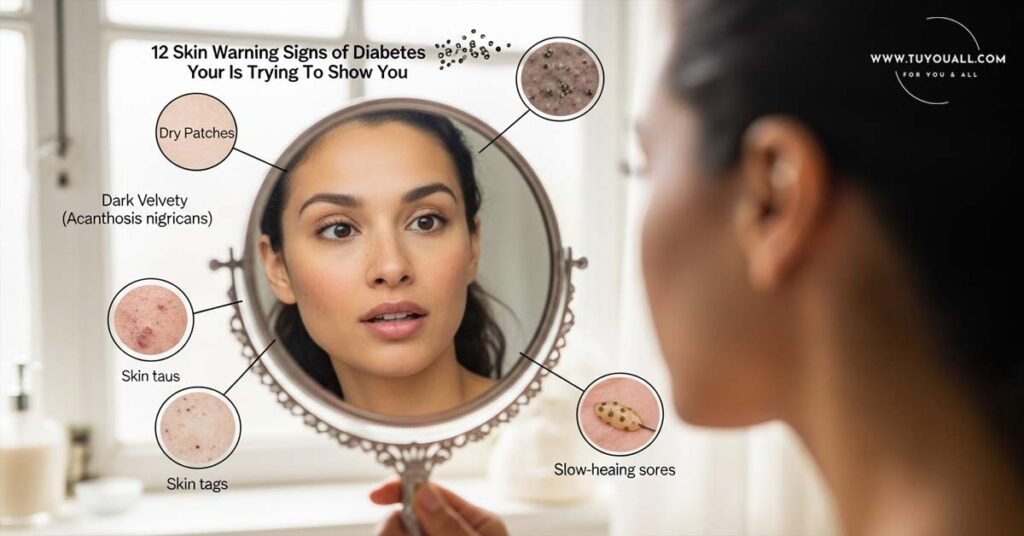
Today, we’re walking through 12 specific clues your skin might be giving you right now. These range from harmless-looking dark patches to painless blisters that could signal serious trouble ahead. As Dr. Ahmed Ergen, a board-certified endocrinologist and diabetes educator known as “SugarMD,” reminds us, “they may not even know that they have diabetes before they see these signs on their skin.”
Let’s decode what your body is trying to tell you.
The Dark and Velvety Warnings
The “Dirty Neck” That Won’t Wash Away (Acanthosis Nigricans)
Imagine scrubbing the back of your neck in the shower, but no matter how hard you rub, it stays dark and feels strangely soft—like velvet. This isn’t dirt, and it’s not about hygiene.
Acanthosis nigricans shows up as brown or black velvety patches, typically in skin folds like the back of your neck, armpits, or groin. For example, a teenager might develop a dark ring around their neck that looks like a tight collar stain, or an adult might notice their underarms looking perpetually shadowed no matter what deodorant they use.
Dr. Ergen points out this is “very common with pre-diabetes as well.” These patches are often the first indicator of insulin resistance, appearing when your body has too much insulin circulating. The good news? These often fade when you manage your blood sugar.
Skin Tags: Harmless Bumbs That Whisper “Check Your Blood Sugar”
Many people have one or two skin tags—those tiny, soft growths that hang off a little stalk, often on eyelids, neck, armpits, or groin. But if you’re suddenly developing clusters of them, listen up.
According to Dr. Ergen, “having a lot of them could actually indicate that you have way too much insulin in your blood or that you may actually have type 2 diabetes already.” For example, if you look down and realize you have five or six new tags on your neck within a few months, it’s worth getting your fasting glucose checked.
Patches, Spots, and Mysterious Bumps
Shiny Spots on Your Shins (Diabetic Dermopathy)
Take a look at your shins. Do you see light brown, scaly spots or faint lines that look like small dents in the skin? These “shin spots” are so common in diabetes that doctors call them diabetic dermopathy (also known as diabetic shin spots).
For example:
Someone might mistake these for aging spots or old scars, especially since they usually don’t hurt or itch at all. Dr. Ergen notes that while these spots “normally vanish within 18 to 24 months” in people without diabetes, they “can last sometimes permanently if you do not control your diabetes.” They signal that your blood sugar has been elevated long enough to damage small blood vessels.
The Yellow-Red Lumps That Mean Business (Eruptive Xanthomatosis)
Picture this: You wake up to find small, reddish-yellow bumps on your buttocks, thighs, or the back of your knees. They look like angry pimples at first, but they turn yellowish quickly and feel tender or itchy. This is eruptive xanthomatosis, and it’s essentially fat deposits popping up on your skin when your diabetes is poorly controlled.
The silver lining? Dr. Ergen explains that “when your diabetes is well controlled, these bumps typically disappear super quickly.” Think of them as temporary speed bumps that vanish once you get your glucose back on track.
Scaly Yellow Spots Around Your Eyes (Xanthelasma)
Look closely at your eyelids, especially near the nose. Do you see soft, yellow, scaly patches? These are called xanthelasma, and they pop up when your body fat cells are too high in your blood.
For example:
You might notice a small yellowish “stain” on your upper eyelid that foundation won’t quite cover. As Dr. Ergen warns, these indicate “your diabetes is poorly managed” and signal that your cholesterol or triglycerides might need attention too.
When Your Skin Turns Tough and Waxy
The Waxy, Tight Fingers (Digital Sclerosis)
Run your fingers over the back of your hands. Does the skin feel tight, thick, and waxy—almost like candle wax? Are your fingers getting stiff and harder to straighten? This condition, called digital sclerosis, happens when sugar molecules get deposited in your skin’s collagen, making it hard and inflexible.
For example:
You might struggle to make a tight fist, or you might feel like there are “pebbles” in your fingertips when you press on them. Dr. Ergen notes that this can expand from your hands up to your forearms, shoulders, and even your face in severe cases.
The texture is distinctive:
Wherever it appears, it often has the “texture of an orange peel.” If you notice this, don’t just moisturize—inform your diabetes doctor immediately. Dr. Ergen suggests that alpha-lipoic acid and benfotiamine supplements may help, and physical therapy can preserve your ability to move your joints.
The Dangerous Spots: Blisters, Infections, and Open Sores
Painless Blisters That Look Like Burns (Bullosis Diabeticorum)
This one sounds strange but it’s real: some people with diabetes develop large, fluid-filled blisters that look like second-degree burns—except they don’t hurt at all. These diabetic bullae typically appear on the backs of hands, feet, legs, or forearms.
For example:
You might wake up with a half-dollar-sized blister on your forearm and have no idea how it got there. These aren’t from burns or injuries; they’re from diabetes affecting your skin structure. Do not pop these. Dr. Ergen emphasizes that you should “report [them] to your doctor because you will want to take precautions to avoid the infection.”
Hot, Swollen, and Angry Skin (Infections)
If you’re getting frequent yeast infections, or your skin seems to catch infections at the drop of a hat, diabetes might be weakening your skin’s defenses. Diabetic skin infections often show up as:
- Hot, swollen, painful areas
- Itchy rashes with tiny blisters
- Dry, scaly patches
- Discharge that looks like pus or cottage cheese
For example:
An athlete’s foot that won’t quit, or a hangnail that turns into a red, throbbing mess. These infections love warm, moist areas like between your toes, around your nails, or on your scalp.
Dr. Ergen warns that “treating skin infections timely is very important otherwise it may progress.” In diabetes, a simple infection can spiral into something that requires stronger antibiotics or longer treatment than it would for someone without blood sugar issues.
The Wounds That Won’t Quit (Open Sores and Ulcers)
Perhaps the most serious skin sign is a sore or wound that just won’t heal—or starts as a tiny cut and becomes a deep ulcer. This happens when high blood sugar damages your nerves (so you don’t feel the injury) and your circulation (so healing supplies can’t reach the wound).
For example:
You might notice your sock has a blood spot, only to discover a dime-sized crater on your foot you never felt forming. Dr. Ergen is adamant about daily foot checks: “Don’t really expect your doctor or nurse to check your feet like every three to six months because if you have a lesion, it may get worse within a few days… do your own investigation it is I’m telling you 100 times more effective.”
If you spot open sores, especially on your feet, seek medical attention immediately. Untreated lesions can lead to severe infections and, in worst cases, amputation.
The Reddish-Brown Patches on Your Legs (Necrobiosis Lipoidica)
These start as small, raised bumps that look like pimples, then evolve into shiny, reddish-brown or yellow patches that can spread on your legs. The skin around them often develops a gleaming porcelain-like finish, and you might see tiny blood vessels underneath.
For example:
You might notice a quarter-sized reddish patch on your shin that looks waxy and thin. While not always harmful, these patches can crack open easily and ulcerate. If you see these and haven’t been tested for diabetes, Dr. Ergen’s advice is simple: “Take action now… you need to either get tested or control your diabetes better.”
Ring-Shaped Bumps (Granuloma Annulare)
These appear as raised red or skin-colored bumps that often form rings or contiguous patterns, commonly on the backs of hands, feet, or elbows. While many people with this condition don’t have diabetes, studies show the incidence jumps from 1% in the general population to 3% in people with diabetes.
For example:
You might notice a ring of small bumps on the back of your hand that looks almost like a bracelet made of skin. If these come and go frequently, Dr. Ergen suggests you “should be evaluated for diabetes.”
That Maddening Itch (Dry, Itchy Skin)
Sometimes it’s not a specific spot, but just skin that feels tight, flaky, and constantly itchy all over. While dry skin happens to everyone, in diabetes it can be relentless—caused by high blood sugar pulling moisture from your tissues, poor circulation, or brewing infections.
Your At-a-Glance Skin Sign Checklist
| Skin Sign | What to Look For | Common Locations | Urgency Level |
| Acanthosis Nigricans | Dark, velvety patches | Neck, armpits, groin | Schedule glucose test |
| Skin Tags | Multiple soft, hanging growths | Eyelids, neck, armpits, groin | Get A1C checked |
| Diabetic Dermopathy | Light brown spots, slight dents | Shins (front of lower legs) | Monitor, improve control |
| Xanthelasma | Yellow, scaly patches | Around eyes (eyelids) | Check cholesterol + glucose |
| Digital Sclerosis | Waxy, tight, thick skin | Fingers, toes, forearms | See doctor + physical therapy |
| Diabetic Bullae | Large, painless blisters | Hands, feet, forearms | Urgent – infection risk |
| Necrobiosis Lipoidica | Shiny reddish-brown patches | Legs (shins) | See dermatologist |
| Eruptive Xanthomas | Yellow-red, itchy lumps | Buttocks, thighs, elbows | Urgent – indicates very high sugar |
How to Care for Your Skin at Home
While persistent issues require a doctor, Dr. Ergen shared some practical tips for managing minor skin problems safely:
For Blisters:
- Do not pop them. The skin roof protects against infection.
- Gently wash with warm water and mild soap.
- Apply antibacterial ointment without breaking the blister.
- Cover with gauze and secure with hypoallergenic or paper tape—don’t wrap too tight.
- Change the bandage at least once daily.
- If it’s on your foot, switch shoes until healed.
For Small Cuts and Rashes:
- Wash gently with warm water and mild soap.
- Skip the alcohol—it hurts more than helps and can damage tissue.
- Apply antibiotic ointment.
- Cover with gauze or cotton bandage, securing with paper tape.
- Change daily and watch for signs of infection (increasing heat, spreading redness, or pus).
Frequently Asked Questions
Q: Can these skin signs appear even if my blood tests are normal?
Yes. Dr. Ergen notes that many people “may not even know that they have diabetes before they see these signs on your skin.” Skin changes can be the earliest warning, sometimes appearing during pre-diabetes or insulin resistance before glucose levels reach diagnostic thresholds.
Q: Are these skin conditions reversible if I control my diabetes?
Many are. Conditions like eruptive xanthomatosis can disappear “super quickly” once blood sugar is controlled. Others, like diabetic dermopathy, may fade over 18–24 months with good management, though some can become permanent if diabetes remains uncontrolled.
Q: If I see one of these signs, should I go to a dermatologist or an endocrinologist?
Start with your primary care doctor or endocrinologist, especially if you suspect diabetes. However, if you already have diagnosed diabetes and develop persistent skin changes, both specialists working together provides the best care. “It is important to see your diabetes doctor and dermatologist occasionally if you’re seeing any of the following signs,” advises Dr. Ergen.
Q: Can children or teenagers get these skin signs too?
Absolutely. Acanthosis nigricans in particular is increasingly common in children with insulin resistance, often showing up as a “dirty neck” that parents can’t scrub clean. This can be an early warning of type 2 diabetes risk in youth.
Q: How often should I check my skin if I have diabetes?
Daily. Dr. Ergen emphasizes this strongly for foot care: “Do your own investigation—I’m telling you, 100 times more effective” than waiting for quarterly doctor visits. Set a specific time each day, perhaps after your shower, to scan your skin for new spots, cuts, or color changes.
Listen to Your Skin Before It’s Too Late
Your skin isn’t just a wrapper—it’s a sophisticated alarm system. When diabetes or insulin resistance begins brewing internally, your skin often waves the first red flag. From velvety dark patches to waxy fingers and mysterious blisters, these 12 signs give you a head start on protecting your health.
The key takeaway? Don’t ignore persistent skin changes, even if they don’t hurt. Getting your blood sugar checked at the first sign could prevent years of complications. For example, that “dirty neck” you keep scrubbing might be the clue that saves you from nerve damage down the road.
Which of these signs have you noticed on your own skin—or on someone you care about?
Credit Section:
This blog post is based on insights from Dr. Ahmed Ergen’s YouTube video: “12 Signs Of Poor Diabetes Control Or Insulin Resistance On Your Skin.” Dr. Ergen is a board-certified endocrinologist and certified diabetes educator.
This content is for educational purposes only and does not constitute medical advice. Always consult with your healthcare provider for personal medical concerns.